Space Academy (no, the other one)by Dwayne A. Day
|
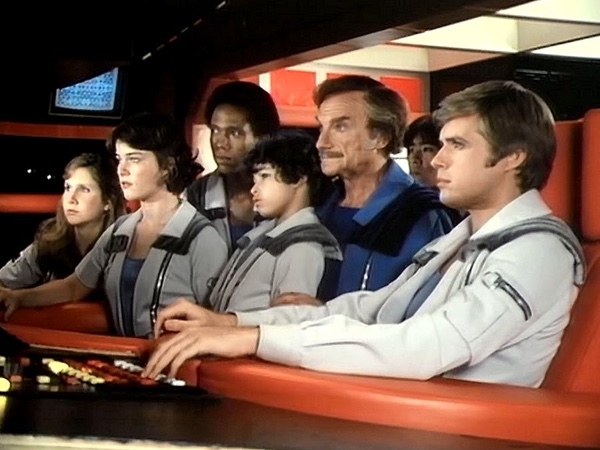
| Unlike Star Trek, Space Academy may not have been trying to push a social agenda, but simply by showing a diverse set of space explorers, it was telling kids that this was the way it should be. |
The show was set aboard a space station carved into an asteroid that was established in the “Star Year” 3732. It followed the exploits of the cadets of “Blue Team” enrolled in the Space Academy, who were all in their late teens and 20s (with one exception). The program starred veteran actor Jonathan Harris, best known as Dr. Zachary Smith of Lost in Space, as Commander Gampu, who claimed to be 300 years old. Co-starring were brother and sister Chris and Laura (played by Ric Carrott and Pamelyn Wanda Ferdin) who shared a telekinetic bond, Adrian (played by Maggie Cooper), Tee Gar (Brian Tochi), and Paul (Ty Henderson). They were joined by the orphaned boy Loki (Eric Greene), and of course a cute robot named Peepo, because after Star Wars, every sci-fi story needed a robot for comic relief.
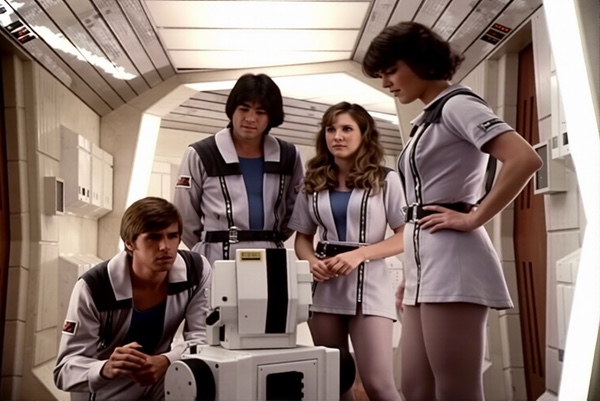 The cadets had a robot, because after Star Wars, almost every science fiction show needed a robot. (credit: Filmation Studios) |
Other than Jonathan Harris, who had an extensive theater and television background, Pamelyn Ferdin had appeared in many television shows by that time and was probably the most recognizable actor for the young audience. She and Brian Tochi had both appeared in the 1968 Star Trek episode “And the Children Shall Lead,” inarguably the worst episode of the original series.
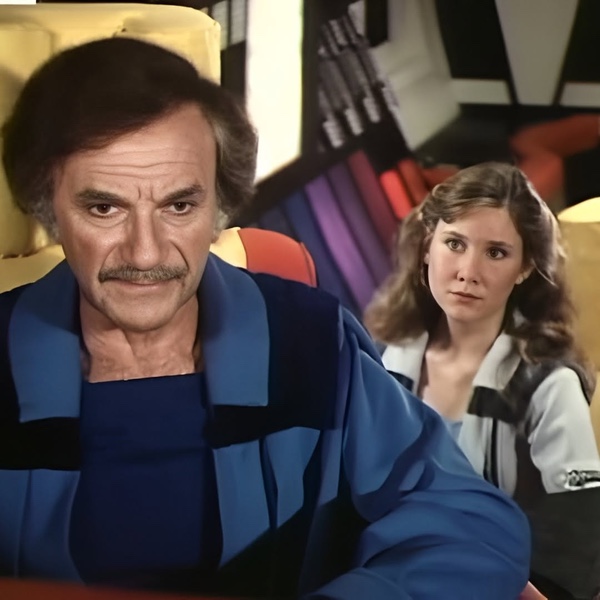 Actors Jonathan Harris and Pamelyn Ferdin were the most recognizable performers on the show. Harris had starred in Lost in Space in the 1960s, and Ferdin had appeared in many television shows by the time she was 18 and appeared in Space Academy. (credit: Filmation Studios) |
The cast was obviously inspired by Star Trek, showcasing two women, a black man, and an Asian man exploring space at a time when there were no black, Asian, or female astronauts in the United States. In fact, women had only been admitted to American military service academies in summer 1976, and every day they faced males in their classes telling them that women did not belong there. That attitude, that astronauting was a man’s job and women couldn’t or shouldn’t be in space, continued among some in the NASA astronaut corps when it was opened up in 1978, as astronaut Mike Mullane admitted in his 2006 memoir.
It is common to note that Star Trek inspired many people to go into scientific, technical, and even medical careers, but it also clearly had an effect on inspiring girls and minorities into careers they had never considered open to them. Unlike Star Trek, Space Academy may not have been trying to push a social agenda, but simply by showing a diverse set of space explorers, it was telling kids that this was the way it should be, while enabling girls and people of different races to see somebody like themselves exploring space. The old saying that you can’t be what you cannot see was inherent in the show’s premise, and so easily forgotten today.
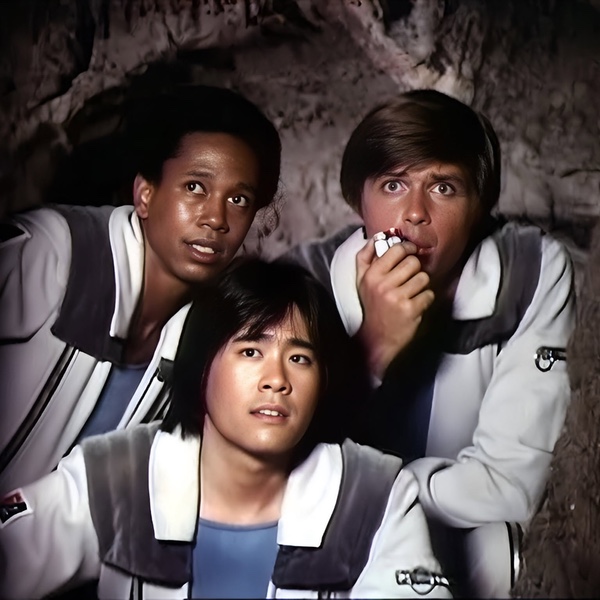 At the time that Space Academy aired, there were no female, black, or Asian astronauts. For young girls and minorities, seeing people like them exploring space in the future was undoubtedly inspiring. (credit: Filmation Studios) |
Saturday morning ambition
Space Academy’s stories were not particularly good, but it had ambition that far outshot its budget and its format. Television networks faced pressure from activist groups starting in the late 1960s and adopted broadcast standards that children’s television could not feature violence, unless it was animated and absurd (i.e. a coyote getting squashed by an anvil), and limiting the time devoted to commercials. These standards defined the kind of science fiction drama the show could feature. The young protagonists could only be put in danger in certain ways—like falling into the gravity well of a black hole—but they could not shoot their way out of a problem, because nobody had guns.
Children’s television in the seventies was generally required to have some educational value, usually in the form of a moral lesson delivered at the end of an episode, often via heavy-handed dialogue. Space Academy was no exception, and the cadets learned a new life lesson every week. By the early 1980s, the educational component of children’s television was mostly abandoned as broadcast TV was largely deregulated, leading to a slew of cartoons intended to sell toys, interspersed by commercials selling breakfast cereal, and more toys. The primary children’s lesson of the ‘80s became consume.
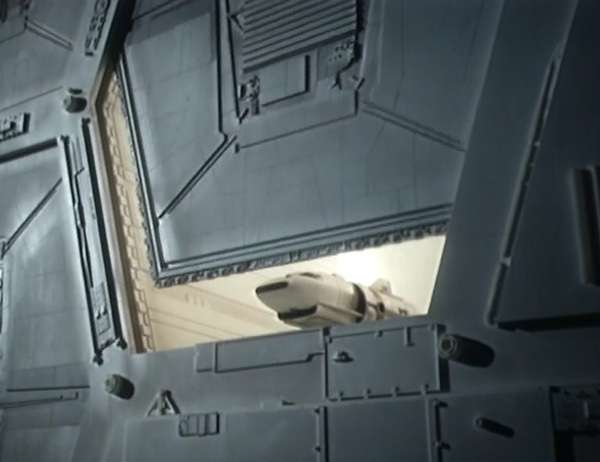
There was no way that a Saturday-morning kids’ television show could afford great sets or special effects, but Space Academy still looked remarkably good for the time, with decent production values and set design that in some ways rivaled Space 1999, made a couple of years earlier for much more money. Filmation’s founder, Lou Scheimer, remarked in a DVD commentary that one of the reasons the models were so good was that he managed to hire some of the modelmakers who had worked on Star Wars and were then between jobs. They didn’t have a lot of time or money, but they were some of the best model-builders in the world, sort of like finding Michelangelo down on his luck and hiring him to paint your house one weekend. The primary models consisted of the large asteroid with the academy habitats, a spaceship hangar, and the Seeker, which was the equivalent of a Star Trek shuttlecraft that carried the cadets to other planets, and danger. Like all television science fiction of the era, special effects shots were endlessly reused.
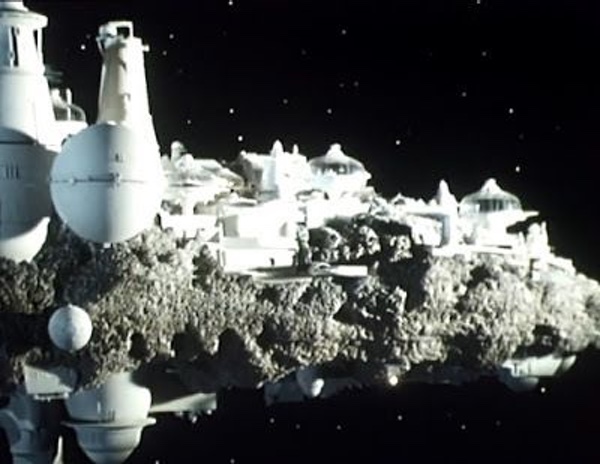 Space Academy was set on an asteroid in deep space. Some of the model-builders for the show had worked on Star Wars and were among the best in the business. The show's producer managed to hire them while they were between jobs. (credit: Filmation Studios) |
The sets were inspired by Space: 1999, which of course was inspired by 2001: A Space Odyssey, with gleaming white walls and a lack of clutter. The kids belonged to Blue Team, but there were also Red and Gold Teams, mimicking the same colors used on Star Trek. Space Academy relied upon a familiar science fiction visual language that predated Star Wars. From that point onward, most movie and television science fiction would depict a much grittier and dirtier vision of the future.
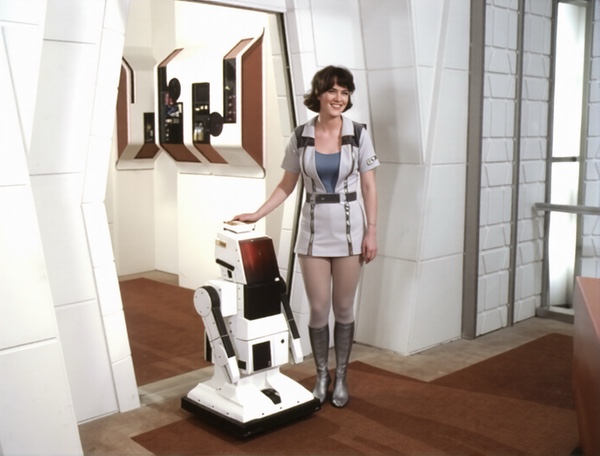 The sets for the show were inspired by 2001: A Space Odyssey, and Space: 1999. This was a common visual language for science fiction that was about to be replaced with the much grittier look of Star Wars and, later, Alien and Blade Runner. (credit: Filmation Studios) |
It was commonly thought among network executives at the time that kid audiences quickly aged-out of serialized shows and would not stick with them for multiple seasons, although they would watch reruns. Filmation’s business model was largely built on this assumption, and they rarely produced a show beyond a single season (the company was founded in 1962 and closed in 1989). Thus, Filmation’s first live-action show in 1976, Ark II—which one writer referred to as “sort of Damnation Alley for kids”—was replaced by Space Academy in 1977, which was replaced by Jason of Star Command in 1978.
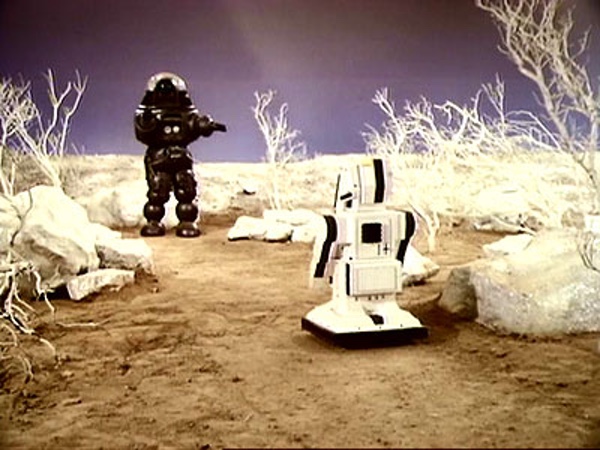 The per-episode budget for Space Academy was the highest for a Saturday-morning show at the time, but not enough to avoid sets that looked like soundstages. (credit: Filmation Studios) |
Creator Lou Scheimer was disappointed that Space Academy did not continue past 15 episodes. Space Academy borrowed props and sets from its predecessor. Most notably, the big truck used to rove the post-apocalyptic wasteland in Ark II had its wheels removed and was used as the front end of the Seeker spaceship seen in Space Academy, and the Seeker model was designed to resemble that full-size prop. Jason of Star Command was set on another part of the same asteroid as the academy, and used many of the same sets as well as the big asteroid model. The limited budgets really showed when the cadets went to alien planets that looked like soundstages. There was no way to avoid it.
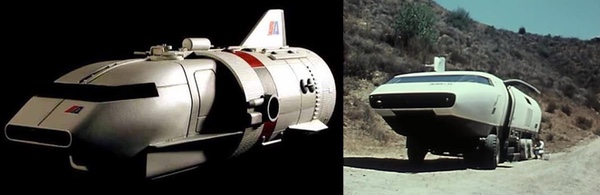  The cadets traveled in a spacecraft named the Seeker. The model was based on the real-world futuristic truck left from a previous Filmation show. The truck, with its wheels removed, was used on-set for exterior shots involving the actors. (credit: Filmation Studios) The cadets traveled in a spacecraft named the Seeker. The model was based on the real-world futuristic truck left from a previous Filmation show. The truck, with its wheels removed, was used on-set for exterior shots involving the actors. (credit: Filmation Studios) |
Respecting the young audience
Scheimer had planned to bring Jonathan Harris back for Jason, but claimed that a misunderstanding resulted in Harris being offended and not accepting the offer. Harris never phoned in his performance on Space Academy, and although Saturday morning television was probably the lowest point of his career, he took the job seriously. His young castmates recalled that he was always working hard at his lines and set an example for them. They recalled him fondly as a great inspiration. Years later, Harris never dismissed the show and referred to the young cast and crew he worked with admiringly.
| But the basic premise of young people learning how to explore space will likely be repeated again in some other form, hopefully with a bigger budget, and a better robot. |
Space Academy’s stories were never terribly sophisticated, and consisted of a mix of science fiction themes and kids-in-peril drama often initiated by Loki or Peepo. There were phantom planets, distress signals, and ancient aliens, and although it was not high-brow, it largely succeeded at telling stories showing the young cadets growing into themselves. The 15 half-hour episodes ran until December 1977, and were repeated off-and on until September 1979.
In some ways, Space Academy was a spiritual successor to Robert Heinlein’s “juvenile” novels like Space Cadet, as well as to Star Trek. Using a science fiction setting, the show taught lessons of responsibility, acceptance of diverse alien races, and the limits of power. There have been other movies and shows in school settings that followed much later that had similar overall goals, like the Harry Potter books and movies (and now television show) and the recent Starfleet Academy. The best ones can also appeal to older audiences.
A common problem for children’s entertainment is tone: how can adults who barely remember what it was like being a kid write for a younger audience without talking down to them, or simply pandering? The “How do you do, fellow kids?” meme captures this dilemma well. Space Academy treated its young audience with respect. The character of Loki was clearly intended to appeal to the young end of the audience, and Peepo was included because Star Wars made comical robots almost a necessity for science fiction shows. Adult writers often assumed that young kids wanted stories where they could see somebody of their own age in an exciting drama. But kids tend to be aspirational—they want to be older, they look up to older siblings and their friends. There were probably far more kids who watched the show and wanted to be Laura, Adrian, Tee Gar, or Paul (Chris was a bit of drip) than Loki. Finding that tone and balance is never easy, and Space Academy mostly succeeded. Unfortunately, it was gone after 15 episodes, and today is mostly forgotten. But the basic premise of young people learning how to explore space will likely be repeated again in some other form, hopefully with a bigger budget, and a better robot.
Note: we are now moderating comments. There will be a delay in posting comments and no guarantee that all submitted comments will be posted.