Mission Impossible: How Star Trek used the aerospace community to try and win an Emmyby Glen E. Swanson
|
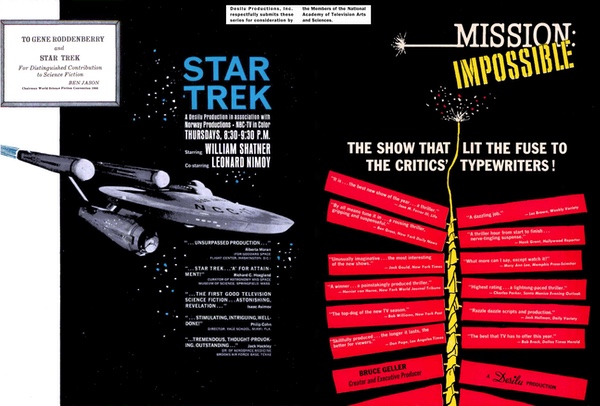
| Both ads featured quotes from individuals in science fiction, the military, NASA, private schools and public museums. |
Before winning an Emmy, shows must first submit their entries for consideration for nomination by the Academy of Television Arts & Sciences, the governing body that oversees the awards. As a result, prior to being nominated, studios would promote their Emmy submissions. During the time when Star Trek was produced, the primary method to do that was through placing ads in various trade publications in the hopes that this would help get their shows noticed. In anticipation of the 1967 Emmy Awards, Desilu Productions, the studio that created Star Trek, began placing ads that spring in Variety, the leading trade publication that covered the film and television industry.
About a week after NBC formally announced it had renewed Star Trek for a second season, Desilu issued a full-page ad in the March 14, 1967 issue of Daily Variety as a way to not only congratulate the show for being picked up again, but also with an eye toward helping promote the series for Emmy consideration.[1] A little over a month later and just a few short weeks before the Emmy nominations were formally announced, Desilu ran the ad again but this time it appeared next to a full-page ad for Mission: Impossible, a popular television show that the studio also produced during the same time as Star Trek but which aired on CBS. Together, these two ads made an eye-catching spread that included the notification: “Desilu Productions, Inc. respectfully submits these series for consideration by the Members of the National Academy of Television Arts and Sciences.”[2] Two ads for two different shows that aired on two competing networks but both having one goal: to win an Emmy.
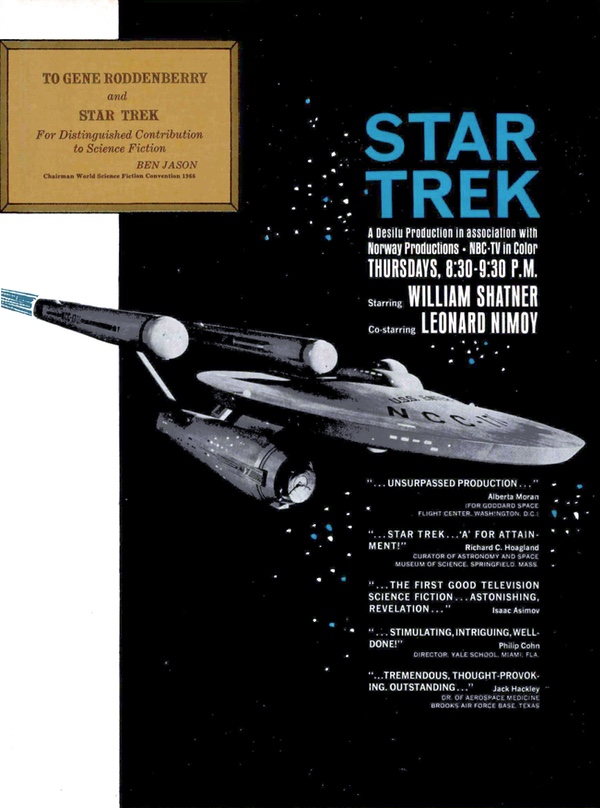 The portion of the Variety ad for Star Trek. (credit: Daily Variety) |
Relative unknowns
Both ads featured quotes from individuals in science fiction, the military, NASA, private schools and public museums. All of these, except perhaps one, were relative unknowns.
Desilu’s ad for Mission: Impossible was printed in three colors with one being an eye-catching red used for the strips of firecrackers or dynamite in keeping with the show’s highly explosive introductory theme. Nearby is a lit fuse that, when combined with the explosives, conveyed a sense of suspense and action. Written into each of the pyrotechnic pieces are reviews of the show by professional critics. The ad for Star Trek was not as colorful, but it did feature the starship Enterprise warping out of the page against a backdrop of stars. Two very different ads yet both designed to promote action-packed shows.
Some argue that the Star Trek ad contained material solicited or contrived by Roddenberry who was well known to stretch the truth. In studying the Star Trek ad, it is worth examining the individuals quoted to better understand why they were chosen for inclusion.
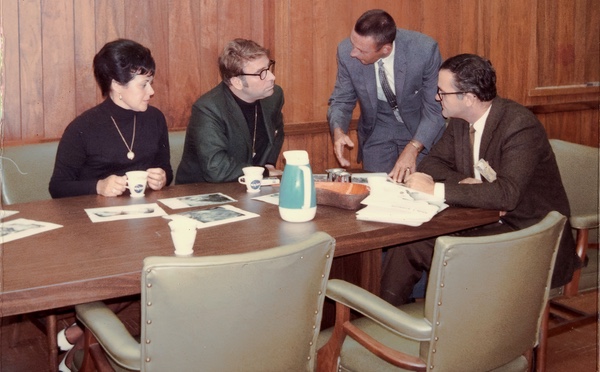 Alberta Moran is shown along with Gene Roddenberry as they are being briefed at Vandenberg Air Force Base prior to viewing the launch of the ESSA-7 meteorological satellite on August 16, 1968 (credit: Alberta Moran and NASA) |
“… UNSURPASSED PRODUCTION …” Alberta Moran (FOR GODDARD SPACE FLIGHT CENTER, WASHINGTON, D.C.)
The first person examined is someone who worked for NASA. This was not an accident, as Roddenberry courted the nation’s space agency from Star Trek’s inception and had a very good working relationship with them through all three seasons of the show. Star Trek made extensive use of still imagery from NASA as well as footage of the Saturn V. There was even a direct mention of the Apollo program in the episode “Return to Tomorrow,” where Kirk gives a memorable speech about risk that includes the line, “do you wish that the first Apollo mission hadn't reached the Moon, or that we hadn't gone on to Mars and then to the nearest star?”
In 1966, Alberta Moran was the assistant to John F. Clark, director of NASA’s Goddard Space Flight Center. She was also one of the founders of the National Space Club, an organization formed by industry and government representatives along with education institutions and the press to promote leadership in the burgeoning new field of astronautics. She along with her two teenage daughters were also fans of Star Trek.
Every year the National Space Club sponsored the Goddard Memorial Dinner. Held in Washington, the dinner is named after American space pioneer Robert H. Goddard and recognizes persons and institutions that have made outstanding contributions to space science and technology during the previous year. Moran chaired the special events committee that was responsible for assembling the invitation list for the Goddard Dinner.
At the urgings of her two daughters, Moran got in touch with Roddenberry and was able to get Mr. Spock, as played by Leonard Nimoy, to come to the Goddard Dinner. At the black-tie affair held on March 15, 1967, Nimoy shared the head table with top space people from NASA and its contractors, including astronaut John Glenn, the first American to orbit the Earth. Also seated at the dais was NASA Administrator James Webb, Robert Goddard’s widow, and Vice President Hubert Humphrey.
Moran became very good friends with Roddenberry and remained in touch with him on a regular basis. Her oldest daughter was the same age as one of Roddenberry’s daughters, so they shared something in common besides an interest in Star Trek. Moran was very well respected at NASA and among the aerospace community. Because of the show’s close connections to NASA and because Roddenberry personally knew Moran these were most likely among the factors as to why her endorsement was chosen to be listed first in the ad.
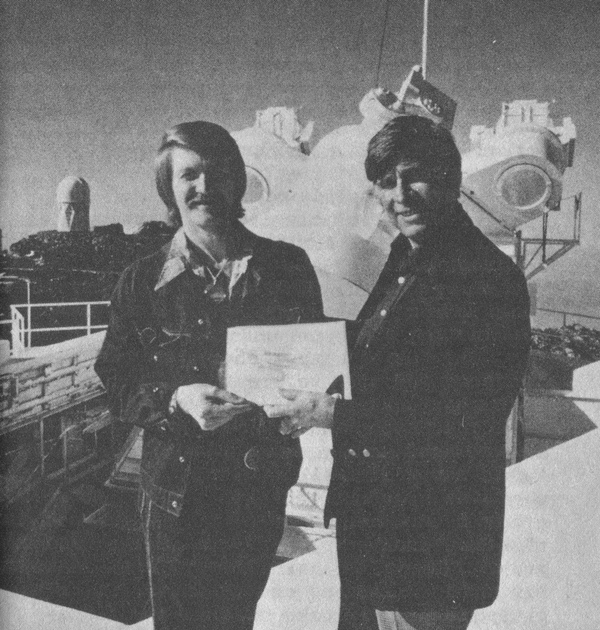 Richard Hoagland (left) with Gen Roddneberry at Kitt Peak National Observatory. Here Gene is shown giving Hoagland a Flight Deck Certificate. (credit: Letters to Star Trek by Susan Sackett, Ballantine Books 1977) |
“… STAR TREK… ‘A’ FOR ATTAINMENT!” Richard C. Hoagland CURATOR OF ASTRONOMY AND SPACE MUSEUM SCIENCE, SPRINGFIELD, MASS.
Hoagland was a Curator of Astronomy and Space Sciences at the Springfield Massachusetts Science Museum from 1964 to 1967 and Assistant Director at the Gengras Science Center in West Hartford, Connecticut from 1967 to 1968.[3]
His interest in space began with his time as a planetarium lecturer. In 1965 he produced a program called “Mars: Infinity to 1965” that coincided with the Mariner 3 and 4 missions to Mars.[4]
G. Harry Stine, one of the founding figures of model rocketry as well as a science and technology writer and (under the name Lee Correy) an author of science fiction, knew Hoagland. Both he and Hoagland were active in early Star Trek fandom and participated in a letter writing campaign that helped secure a third season of the show.
Years later in 1976, Hoagland initiated a letter-writing campaign that was then picked up by John and Bjo Trimble that encouraged President Ford to change the name of the first Space Shuttle from Constitution to Enterprise.
As someone who was well connected to the early Star Trek community and as a curator of astronomy and space at an east-coast museum of science, it made sense for Roddenberry to choose Hoagland as one whose comments and professional background were worth including. By using Hoagland’s affiliation, Roddenberry felt that he was furthering his cause to include “scientific accuracy” in Star Trek, a selling point that he often employed to help distinguished his series from other television shows at the time.
“… THE FIRST GOOD TELEVISION SCIENCE FICTION… ASTONISHING, REVELATION…” Isaac Asimov
Of all the individuals listed in the ad, Isaac Asimov was the closest to a celebrity and therefore most likely the only one that the public may have recognized.
In addition to being a prolific author, Asimov was one of the first authorities within the science fiction community to write about Star Trek. Asimov wrote in the November 26, 1966 issue of TV Guide that he observed an astronomical error after watching Star Trek’s second pilot. Though minor compared to those mistakes that Asimov found in a competing network’s television show Lost in Space, Roddenberry still saw it fitting to write Asimov a letter that took the famous writer to task. This started an exchange of correspondence that eventually changed Asimov’s mind about Star Trek and to become more of a fan than a critic.
| In addition to being a prolific author, Asimov was one of the first authorities within the science fiction community to write about Star Trek. |
Asimov’s support for the show was revealed in a subsequent Star Trek article that Asimov published in the April 29, 1967, issue of TV Guide. The article contains language that most likely was exchanged in earlier letters between Roddenberry and Asimov, language that could have been co-opted for use in the spring Variety ad. In particular, Asimov mentioned in the April 29 article (author emphasis in bold), “A revolution of incalculable importance may be sweeping America, thanks to television. And thanks particularly to Star Trek, which, in its noble and successful effort to present good science fiction to the American public, has also presented everyone with an astonishing revelation.”[5] This language is not out of character for Asimov and he would have denied what was quoted by him in the Variety ad if they were not his genuine thoughts about the show.
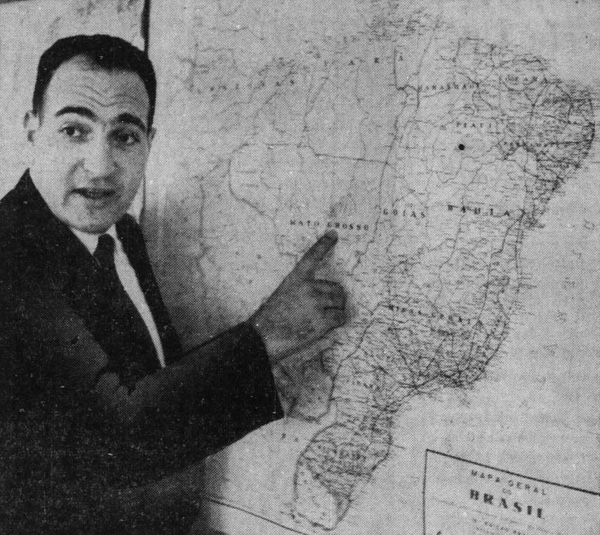 Phil Cohn (credit: Miami News, January 29, 1961) |
“… STIMULATING, INTRIGUING, WELL DONE!” Philip Cohn DIRECTOR, YALE SCHOOL. MIAMI, FL
Of the six endorsements given in the Variety ad, this one is the most unusual.
Philip L. Cohn was born in the Bronx and after a stint in the Merchant Marines, he moved to Florida where he and his father opened a real estate company. After doing well selling property in Miami, they both began selling land in Brazil.[6]
In addition to selling real estate, Philip Cohn created several schools in the Miami area.[7] Called “tutorial schools,” these schools catered to students that ran into trouble at more conventional private or public schools. One of Cohn’s schools was called Yale.
“My purpose is to get these kids through high school,” said Cohn in an interview about his schools and their programs for troubled youth. “If it means them looking out the window, smoking a cigarette or listening to music here at school, that’s OK.”[8]
Because of the special nature of his students, Cohn may have encouraged his teachers to have their students watch Star Trek so that they could incorporate the series into the classroom. Such innovation might have helped teachers get through to students that faced many personal problems. “I think kids are getting the message that you can die if you stick a needle in your arm,” Cohn said of his students at Yale. Star Trek may have helped them cope.
Even though Cohn may have written to Roddenberry telling him how much he liked the show and how he used the series to reach through to the kids at his school, Roddenberry may have also simply thought that readers might see Yale and associate the name with the more prestigious university and not some obscure private school for troubled youth.
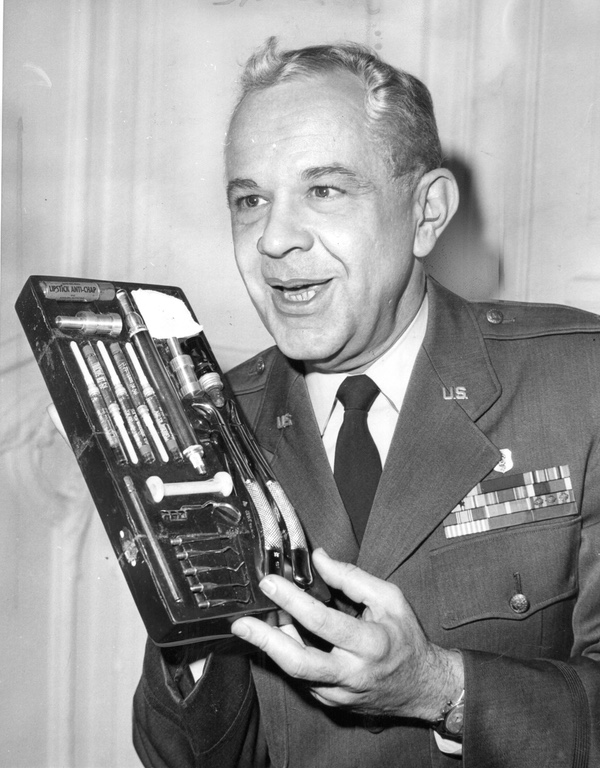 USAF Lieutenant Colonel Jack L. Hartley, displaying his 1-pound, 4-ounce, dental repair kit that he developed to prevent astronaut toothaches. Photo was taken on March 2, 1966 and courtesy of the author. |
“… TREMENDOUS, THOUGHT-PROVOKING. OUTSTANDING…” Jack Hackley, DR. OF AEROSPACE MEDICINE BROOKS AIR FORCE BASE, TEXAS
Even though Jack Hartley’s last name is spelled “Hackley” in the ad, there is no doubt that the Variety ad is talking about the same person.
Dr. Jack L. Hartley was a Lt. Colonel in the United States Air Force and an aerospace dental scientist that worked at Brooks Air Force Base in Texas. He wrote a book on dental standards for the selection and examination of space crewman and was also a Star Trek fan. He saw the very first episode of the show when it aired on September 8, 1966, and was so impressed that he sent the following telegram to Roddenberry the very next day: “TREMENDOUS THOUGHT PROVOKING EXCELLENT CAST AND SCENERY SUSPENSEFUL OUTSTANDINL PLEASE ACCEPT CONGRATULATIONS AND PLEA TO CONTINUE.”[9]
While serving at Brooks, Hartley studied the problem of what to do if an astronaut got a toothache while in space. As a result, he developed the science of astrostomatology and created a portable dental kit for the Aerospace Medical Division of the Air Force Systems Command. Called the “buddy-care” kit, it weighed just a few pounds and contained instruments specifically designed for use by astronauts in space.
In an interview with Hartley’s oldest daughter Patricia, she said that her father had many exchanges with Roddenberry. “He collaborated a fair amount with Roddenberry. He [Roddenberry] was really very good about trying to get things right, in spite of the fact that he had a very limited budget.”[10]
Of the items quoted in the Variety ad, this is the only one with documented proof that the words cited by the individual are genuine because of the telegram that was originally sent. Roddenberry welcomed the affiliation with the Air Force as the Pentagon approved of Star Trek as the show proved popular among those serving in the military.
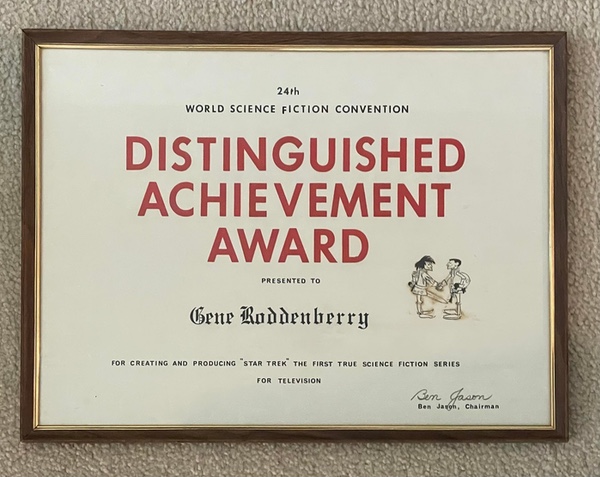 The Distinguished Contribution to Science Fiction award presented to Gene Roddenberry on September 4, 1966 the day after showing the first two Star Trek pilots to attendees of Tricon, the 24th Annual World Science Fiction Convention held in Cleveland. (credit: Dave Arland) |
The plaque
There is one last item to examine in the Variety ad. In the upper left corner, there appears to be a replica of an award plaque that says:
and
STAR TREK
FOR DISTINGUISHED CONTRIBUTION
TO SCIENCE FICTION
The award is then shown signed by BEN JASON Chairman World Science Fiction Convention 1966.
The World Science Fiction Convention, or Worldcon, and the Hugo Awards associated with it, are held every year and are principally focused on books and magazines and other publications in science fiction.[11]
| When Star Trek first began, many fans found science fiction and fandom through the new television series. As a result, some hardcore SF fans resented the new series because people came to fandom through something other than traditional literature. |
The 24th annual World Science Fiction Convention was held during Labor Day weekend in Cleveland in 1966. Benedict Paul Jablonski, also known as Ben Jason, was an American science fiction fan who co-designed the Hugo Award. He was also chairman of TriCon, the name given to the 1966 World Science Fiction Convention because the bidders that won the host city for that year came from science fiction groups in Detroit, Cincinnati, and Cleveland. They successfully pooled their efforts together to secure the bid for Cleveland.
When Star Trek first began, many fans found science fiction and fandom through the new television series. As a result, some hardcore SF fans resented the new series because people came to fandom through something other than traditional literature. Some went so far as to suggest that Star Trek wasn’t true science fiction and, therefore, not worthy of any kind of programming at a convention.
Ben Jason wrote Roddenberry in March of that year inviting him to come to Tricon and to bring with him the two Star Trek pilots to show and talk about the show. Fortunately, the Star Trek sound stages were closed for nine days due to the Labor Day break. The cast went on tour to promote the series’ upcoming premiere and Roddenberry accepted Jason’s invitation to come to Cleveland.[12]
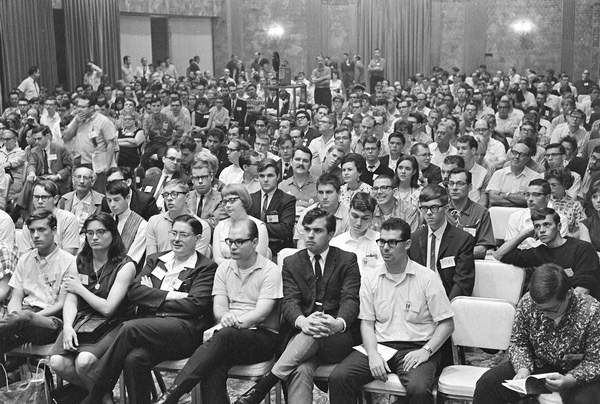 The first two Star Trek pilots being shown to the attendees of the 24th Annual World Science Fiction Convention held in Cleveland on September 3, 1966. Photo courtesy the Jay Kay Klein Collection, Special Collections & University Archives at the University of California, Riverside. |
During TriCon, Roddenberry screened the first two Star Trek pilots five days prior to the series’ network television premiere. On September 3, 1966, over 1,000 attending convention members saw the second pilot “Where No Man Has Gone Before”[13] followed by a showing of “The Cage,” which was only screened in black an white because a 16mm color internegative was not made.[14] Among the audience members present was Isaac Asimov who, according to fandom, was told to “stop talking” by Roddenberry while the films were showing. David Alexander, in his authorized biography of Roddenberry, said of the incident, “The fellow quieted down and Gene’s seat companion quietly whispered in his [Roddenberry’s] ear that he’d just chewed out Isaac Asimov.”[15]
The over 1,000 convention attendees were stunned at what they saw. Indeed, the response was so overwhelming that Roddenberry sent a telegram that very evening to Samuel A. Peebles, the man who wrote the screenplay for the show’s second pilot, the one that eventually convinced NBC to air the show. Gene also sent a telegram to Herb Solow, the Executive in Charge of Production during the show’s first two seasons. Both telegrams included the following message: "Star Trek HIT OF CONVENTION, VOTED BEST EVER. RECEIVED STANDING OVATION."[16]
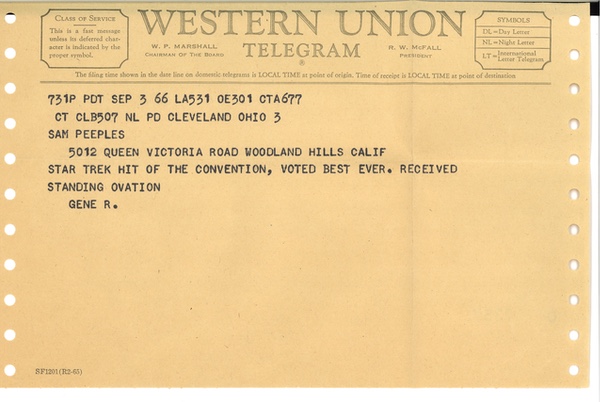 The first showing of Star Trek to a large public audience occurred at Tricon. Here the two pilots were shown to all 850 attending members on Saturday, September 3, 1966. Roddenberry sent this telegram to Sam Peebles, the writer of “Where No Man Has Gone Before” that evening. Photo courtesy of the Samuel A. Peeples papers at the University of Wyoming’s American Heritage Center. |
Rod Serling’s television series The Twilight Zone won Hugo Awards for Best Dramatic Presentation in 1960, 1961, and 1962. The show helped break down some of the attitudes toward science fiction on television. No winners were chosen in 1963 or 1964. Stanley Kubrick’s Dr. Strangelove or: How I learned to Stop Worrying and Love the Bomb won in 1965. By the time 1967 rolled around and nominations were being accepted for the category of Best Dramatic Presentation for 1966, NBC had already aired 16 Star Trek episodes and Roddenberry was eager to have his new show considered for nomination. Some members of the Hugo Awards committee thought he was a little too eager.
According to the Hugo award rules of that time, for a television series to be considered for a Hugo, only individual episodes could be nominated, not the entire show. Each episode would have to be treated like a separate standalone feature film.[17] Roddenberry didn’t like that rule and he made his objections known.
On November 4, 1966, Roddenberry wrote to Andrew Porter, the secretary of the 25th Annual World Science Fiction Convention (NyCon 3) that was to be held in New York City over Labor Day weekend 1967. In this letter, he argued that it was a mistake to judge an entire series by one single episode. Not satisfied with Porter’s response, Roddenberry wrote another letter on November 17. This time he sent it to NyCon 3’s co-chair Ted White. In this round, Roddenberry argued that it was unfair to judge a television episode less than an hour long against a big-screen theatrical film. He reasoned that theatrical films had far greater budgets and a lot more time in which to film them. They were also designed for a paying audienc-, not a channel surfing television viewer who sat at home watching something for free. Rebuffed by his second attempt, Roddenberry wrote still a third time on November 24.
White finally responded on May 5, 1967, three days after it was announced that Star Trek was nominated for an Emmy. White’s response was not what Roddenberry wanted to hear.
“I’m sure it must be disappointing to you,” wrote White “to find that you are in competition with Fantastic Voyage and Fahrenheit 451 for the Hugo Award this year, but, unfortunately, the Hugo Awards are not geared for your exclusive set of interests, nor will they be…. ”[18]
Each year’s Hugo Awards are based upon judging from what was shown the year prior. Star Trek had four episodes nominated for the 1967 award: “The Naked Time,” “The Corbomite Maneuver” and the “Menagerie” (Parts 1 and 2). This by itself was impressive because no episodes of any other television show from that year that competed in the same category, such as Voyage to the Bottom of the Sea, Lost in Space, or Time Tunnel were nominated.
| It turns out that Roddenberry’s Hugo Award was not the first honor given to Star Trek by the World Science Fiction Convention. |
In a letter to Asimov dated June 19, 1967, Roddenberry explained that he would not attend NyCon3 out of fear of “humiliation.”[19] Over that summer, Roddenberry must have reconsidered because he did go, as photographs show both he and his wife Eileen mingling with attendees at the convention. Perhaps still fearing “humiliation,” Roddenberry was not present when they announced that “The Menagerie” had won the Hugo for Best Dramatic Presentation of 1966.
Since Star Trek’s first Hugo was awarded in September 1967 some three months after the Emmy Awards, mention of the award could not have been included in the Variety ad. What then was the nature of the award shown in the ad? Where did that come from and why was it included?
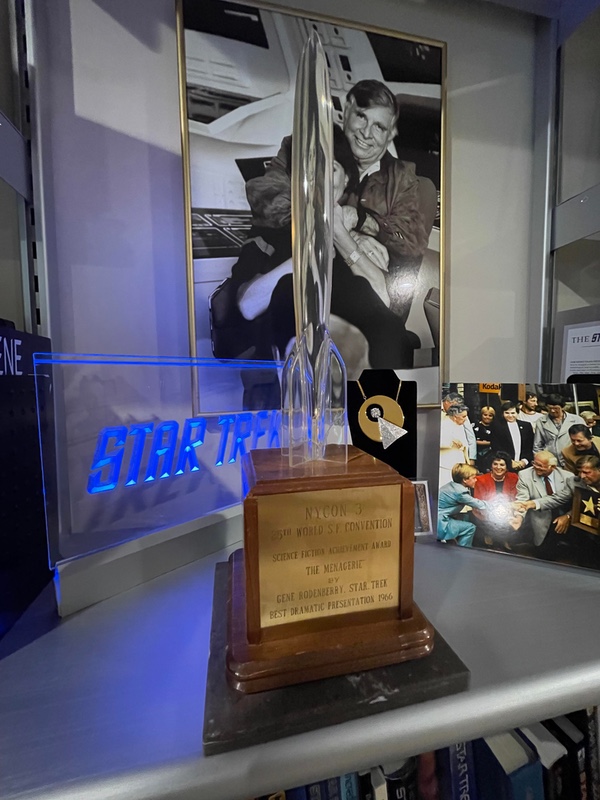 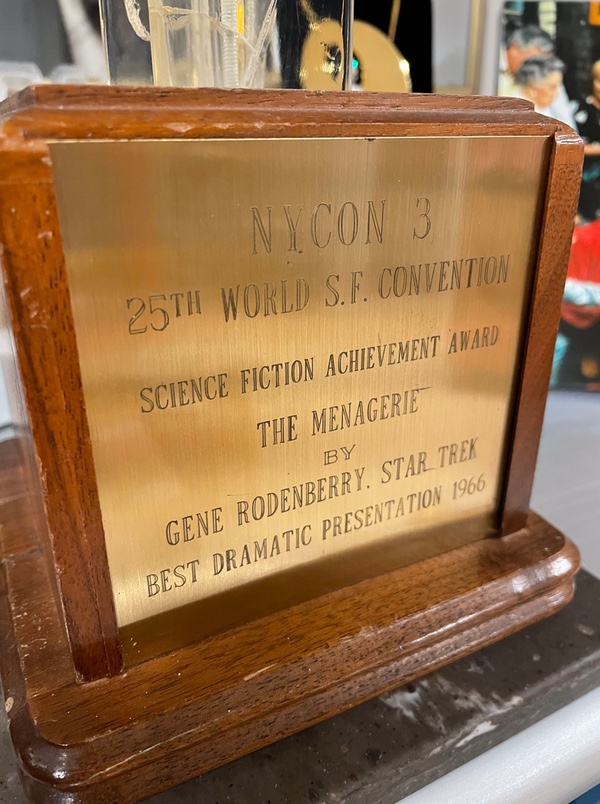 Photos of Gene Roddenberry’s first Hugo Award. Note that they spelled “Roddenberry” wrong on the plaque. (credit: Dave Arland) |
Other awards
It turns out that Roddenberry’s Hugo Award was not the first honor given to Star Trek by the World Science Fiction Convention. After the showing at TriCon of the first two Star Trek pilots, convention delegates decided on the spot to award Roddenberry an award for “the best television series of the coming season.” This was “a first of its kind” reported the national news.[20]
Star Trek collector David Arland owns Roddenberry’s 1966 Hugo Award. He also has the award given to Star Trek at Tricon. When viewed up close, the award appears to be a hastily assembled affair, made with rub-on letters and placed in an inexpensive metal picture frame. It does not look like the award shown in the Variety ad nor does it state “the best television series of the coming season” as reported by the news media.
The September 14, 1966, issue of Variety mentions that Fantastic Voyage was screened at TriCon and that afterwards it was given “A Distinguished Achievement Award” presumably identical to the one given to Roddenberry after showing the two Star Trek pilots.
As part of the five-day TriCon festivities, on Sunday September 4, Worldcon held its annual Hugo awards banquet. During that time, photos show Roddenberry coming up to the stage and given what appears to be a wooden plaque by convention chairman Ben Jason.[21] Unfortunately, no photos show what was printed on the plaque. The monthly fanzine “Yandro,” published by Robert & Juanita Coulson in Hartford City, Illinois, reported on TriCon in their October 1967 issue. They wrote, “A couple of plaques were given to Star Trek and Fantastic Voyage for being nice and giving the con preview performance.”[22] It is assumed that the plaque mentioned in “Yandro” is the same plaque shown in the Variety ad. Though the small replica plaque that appears in the Variety Emmy ad is different both in layout and wording. Roddenberry may have taken liberties in reproducing the original contents to better suit his needs for publicity. In any event, at least one special award was given to Roddenberry at Tricon prior to the show’s first Hugo.
And the winner is…
On May 1, 1967, the Emmy nominations were formally announced, and CBS took the lead with 72 nominations, followed by 53 for NBC and 41 for ABC. Star Trek had five nominations: Outstanding Dramatic Series (Producer Award) for Gene Coon, Outstanding Performance by an Actor in a Supporting Role in Drama for Leonard Nimoy, Individual Achievements in Art Direction and Allied Crafts (Mechanical Special Effects) for Jim Rugg, Individual Achievements in Cinematography (Photographic Special Effects) for Howard Anderson, and Individual Achievements in Film and Sound Edition (Sound Editor) for Douglas H. Grindstaff.[23] All total, Desilu received 14 Emmy nominations.
Nimoy was home with his wife when he received notice from the National Academy of Television Arts & Science that he had been nominated. Marc Cushman writes in These Are The Voyages, his three-volume history of Star Trek that, “He was so surprised and overcome by the news that he joined his wife in doing a very un-Spock-like thing – he cried.”[24] In an interview in 2002 conducted by the Archive of American Television, Nimoy recalled, “I thought, ‘Who. Wow. What a thrill.’ Particularly because nominations were done by your fellow actors, and I thought ‘They’re getting it, they can see what I’m doing.’ It just really moved me deeply.”[25]
The biggest surprise was the fact that Star Trek had been nominated for the coveted Emmy for Outstanding Dramatic Series. This was an achievement in itself, as no science fiction show had ever been nominated before in this category. When the announcement came, Gene L. Coon’s name was attached to the Outstanding Drama nomination. Back then, only the producer of record was credited in the nomination. As the show’s Executive Producer, Roddenberry would have had to watch Coon mount the dais alone if Star Trek had won.
It is not certain if Coon did this on his own or was prompted by Roddenberry, but on May 2, the day after the Emmy nominations were formally announced, Coon sent a letter to the Television Academy encouraging them to add Roddenberry’s name next to his. “It would be grossly unfair to an important talent in our industry,” wrote Coon, “if by chance Star Trek wins the Emmy, if I were to walk up and accept an Emmy which at the very least belongs to both of us, not myself alone.”[26] The Academy reissued the nomination to include both their names.
On Sunday, May 4, 1967, CBS won big by taking away 17 Emmy Awards followed by ABC with 12 and NBC with 10. The ABC television special “Brigadoon,” walked away with five Emmys. Desilu did manage to secure three Emmy Awards for Mission: Impossible: one for Barbara Bain as Best Actress in a Dramatic Series, one for Bruce Geller for Best Dramatic Writing, and one again for Geller, the show’s creator, along with Joseph Gantman its executive producer for Outstanding Dramatic Series. Even the head of Desilu, Lucille Ball, herself took home an Emmy for Outstanding Continued Performance by an Actress in a Leading Role in a Comedy Series. Star Trek failed to win in any of its nominated categories.[27]
| For Roddenberry, the snubbing by the National Academy of Television Arts & Science of his original Star Trek television series was especially painful because a win would have represented acknowledgement by the television industry as a whole for his pioneering new series. |
While Mission: Impossible and Star Trek were both produced under Desilu Studios, there was friction between the two. In a 1996 interview Star Trek associate producer Edward K. Milkis recalled, “Mission Impossible was relegated a bigger budget than Star Trek, even though our show was the more difficult one to produce in our minds. The deal Desilu made with CBS was better than the deal they were able to make with NBC.”[28]
First airing the same year as Star Trek, Mission: Impossible picked up eight Emmy Awards out of a total of 23 nominations during the course of its seven-year season run. By comparison, Star Trek earned a total of 13 Emmy nominations during the original series three season run; eight in technical degrees, three for Nimoy as best supporting actor, and outstanding drama for the first two years of the series. Star Trek failed to win in any of its nominated categories.
Star Trek may have lost an Emmy, but it did win a Hugo as the Worldcon committee gave the two-part episode “The Menagerie” the coveted award for Best Dramatic Presentation for 1966.[29] Even though Roddenberry won a Hugo it seems that no one bothered to notify the winner. It was through a conversation with Isaac Asimov almost a month after it was awarded that Roddenberry learned that he had won. Photos show that it was presented to him during the October 1967 filming of the Star Trek episode “The Gamesters of Triskelion.” During a break in filming, actress Angelique Pettyjohn, who played the character Shana in the episode, posed next to Roddenberry as the award was finally presented.
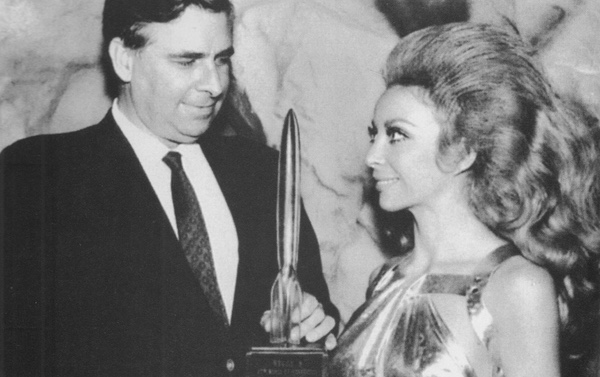 Roddenberry shown posing with actress Angelique Pettyjohn and the Hugo he received in 1967 for “The Menagerie,” the two-part episode of Star Trek that aired during the show’s first season which was made from the show’s first pilot. Pettyjohn played Shana in the Star Trek episode “The Gamesters of Triskelion,” which was being filmed when the award arrives. Photo courtesy of The March of Dimes. |
In addition to the 1967 Hugo, Star Trek would go on over the next three years to win other awards. Before its three-season run had ended in June of 1969, Star Trek won a Golden Reel Award by the Motion Picture Sound Editors for the Best Sound Edited Television Series of 1967. In 1968 it won Photoplay magazine’s Gold Medal Award for Most Popular Television Show. It also garnered a Writers Guild of America Award in 1968 for the episode “The City on the Edge of Forever,” as well as a second Hugo in 1968 for the same episode.
Recognition is important among one’s peers. For Roddenberry, the snubbing by the National Academy of Television Arts & Science of his original Star Trek television series was especially painful because a win would have represented acknowledgement by the television industry as a whole for his pioneering new series.
Over the years since the original series first aired, the Star Trek franchise went on to win other awards, including 19 Emmys awarded to the popular spinoff television series Star Trek: The Next Generation. In 1988 it won a George Foster Peabody Award for the STTNG episode “The Big Goodbye.” Still later, Star Trek would win its first and so far, only Academy Award when it won in the category of Best Makeup and Hair for the J.J. Abrams Star Trek 2009.
The Variety ad that was used to help nominate Star Trek for an Emmy was just one example of how Roddenberry made use of the recognition given the show by the aerospace industry. Another example was, as mentioned previously, Nimoy’s appearance at the Goddard Memorial Dinner. NBC executives thought enough about that event that they included prominent mention of it in a sales brochure that their marketing team assembled to promote the second season of the show to their affiliates. The slick six-page printed color fold-out that they produced showed numerous clips from the series along with text that included the following: “This unique NBC-TV adventure series was accorded another unusual distinction when Leonard Nimoy was invited by the National Space Club to represent Star Trek as the guest of honor on a recent extensive tour of the Goddard Space Flight Center in Washington, DC. The tour was followed by a dinner for 1,500 club members, at which Vice President Humphrey was the principal speaker.” These are just a few examples of how Roddenberry sought to connect real-world space to his new television series. Fortunately for him, that was not too difficult to do during the 1960s.
By the end of WWII, 60% to 70% of America’s aerospace industry was based in Southern California.[30] When Roddenberry began developing Star Trek, 15 of the 25 largest aerospace companies were in the greater Los Angeles area.[31] The good climate and open land that helped draw aviation to the region also lured the motion picture and television industry. A producer could literally walk across the street from his studio to consult with experts in the field. Roddenberry also had the advantage of being a pilot, which gave him clout when dealing with experts in the field. One of the endearing traits of the series that helped distinguish it from anything else then on the air was its regular infusion of science and technology into each episode. Star Trek treated its subject seriously and that gained the respect from NASA, the military and the aerospace industry.
In looking at the names quoted in the ad, one might wonder why Roddenberry chose relative unknown individuals like these to help promote his show, especially for Emmy consideration. There may have been a couple of reasons for this. One is that the show had only been on the air for less than one season, and it takes time to generate viewership. In addition, Star Trek was like no other television show before it. It took the genre of science fiction seriously and that was new to television audiences. The relative obscurity of those named in the ad and their unique affiliations may have been used by Roddenberry and network executives because they thought it might actually help rather than hinder the show’s chances toward winning. By showing the nominating committee a sampling of diverse viewer comments from individuals that perhaps normally don’t watch that much television, they could argue that these individuals were nevertheless drawn to Star Trek to the point where they took the time to write the studio.
After Tricon, a fan by the name of Mike Deckinger wrote the following letter to the studio on December 7, 1966, expressing his thoughts about the new series:
I have been a science fiction reader for twelve years, and I am a confirmed follower of your program Star Trek. As one who has seen all the juvenile, mediocre hack-work that has been called science fiction on television I feel that only Star Trek presently offers stories that are adult, intelligent and are not directed at a dismally low I.Q. level. I feel that this in itself is remarkable, since there are so few television shows, of any nature, that seem designed for an adult, aware audience.
I was present at the World Science Fiction Convention in Cleveland, Ohio, over the Labor Day Weekend when Mr. Roddenberry previewed two Star Trek episodes to the over 1,000 attendees, and was given a standing ovation by the viewers. I feel that by obtaining stories from known science fiction writers, who have already proven their talents, by employing a cast that is likeable and believable, and by combining these and other diverse elements into the production of a science fiction program that is mature, interesting, and frequently memorable, Mr. Roddenberry is doing a service to both viewers and non-viewers alike. I trust that everything will be done to retain this valuable and engrossing series.[32]
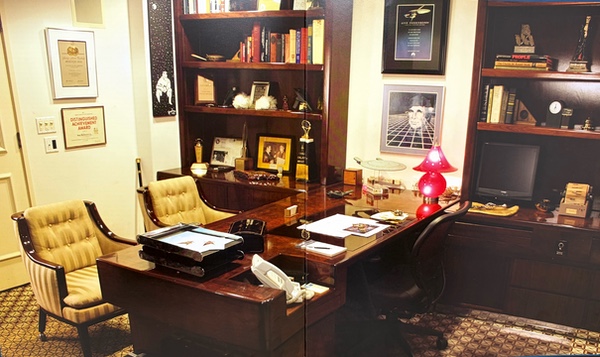 Roddenberry’s office at his Bel Aire home. You can see the Distinguished Contribution to Science Fiction Award that was given to him on September 4, 1966. Photo courtesy Julien’s Auctions |
Gene Roddenberry died October 24, 1991. His wife Majel Barrett passed away on December 18, 2008. On June 27, 2010, Julien’s held an auction that included the contents of the Roddenberry’s Bel Air home. Furniture, paintings, and sculptures were listed from the estate along with expensive dinnerware and even a baby Steinway grand piano.
They also had up for sale the contents of Gene’s home office where the auction catalog showed many of Roddenberry’s awards just as he displayed them there before he died. The auction catalog photos show his 1967 Hugo next to books along with his 1963 Golden Reel Award for best sound for The Lieutenant. Hanging on the wall directly opposite Gene’s desk is the Distinguished Achievement Award that was given to him at Tricon days before NBC first began airing the series on television in 1966. That hastily made award looks out of place among all the others but there it is, hung on a wall directly opposite Gene’s desk, perhaps intentionally placed there so that he could easily see it and be reminded of the show’s beginnings.
Endnotes
- Daily Variety, Vol. 135 No. 7, March 14, 1967, p. 13.
- Daily Variety, Vol. 135 No. 31, April 17, 1967, pp. 28-29.
- Richard C. Hoagland on Facebook.
- Richard Sanderson, “Springfield’s Link to the Red Planet,” Springfield Journal, Vol. 26 No. 3.
- Isaac Asimov, “Mr. Spock is Dreamy!” TV Guide, April 29, 1967.
- Agnes Ash, “He’ll Sell You A ‘Home’… Where Headhunters Roam ‘Neath Sky in ‘Rustic’ Brazil,” The Miami News, January 29, 1961, p. 14.
- “Adelphi School Guides Young Students with Many Special Course,” The Miami Herald, July 10, 1965, p. 10.
- Heath Meriwether and Steve Sink, “Private School Drug Use Scope Uncertain,” The Miami Herald, April 16, 1972, p. 72.
- Western Union Telegraph dated September 9, 1966 from Jack Hartley to Gene Roddenberry. UCLA Library Special Collections, Gene Roddenberry Collection, Correspondence/General Files, Correspondence, Miscellaneous, Box 27, Folder 17.
- Author interview with Patricia Hartley November 8, 2020.
- Andrew Porter is an American editor, founder and publisher of the Science Fiction Chronicle and active in science fiction fandom for many years. Porter attended NyCon 3, the 25th annual World Science Fiction Convention in1967. In an interview he told me that back then, it was a common fallacy that there is such a thing as a World Science Fiction Society. “There was an attempt to form one, but it devolved into lawsuits involving in the early 1950s,” he said. “At the business meeting of the 1958 WorldCon, in California, the chair of the convention, famously said something along the lines of, ‘This is the business meeting of the Worldcon, and NOT of the World SF Society.’”
- March 8, 1966 letter by Ben Jason, the Tricon Chairman, where he indicated to Gene Roddenberry that they would like to have him bring the two Star Trek pilots to Tricon and give a talk on them. Letter courtesy of the Roddenberry Archive. Stephen Whitfield in his book The Making of Star Trek (Ballentine Books, 1968), states that Gene showed “Where No Man Has Gone Before” to the crowd at Tricon.
- Memo from Gene Roddenberry to Bill Heath dated August 16, 1966, UCLA Library Special Collections, Gene Roddenberry Collection, Correspondence/General Files, Box 27, Folder 23.
- Memo to Gene Roddenberry from Cliff Palmeter dated August 26, 1966, UCLA Library Special Collections, Gene Roddenberry Collection, Correspondence/General Files, Box 27, Folder 23.
- David Alexander, Star Trek Creator, the Authorized Biography of Gene Roddenberry, (A ROC Book, Penguin Books, New York, 1994), p. 266.
- A copy of the Peebles telegram dated September 3, 1966, is housed in the Samuel A. Peebles collection at the American Heritage Center Archives at the University of Wyoming. A copy of the Solow telegram is quoted in Stephen Whitfield’s The Making of Star Trek (Ballantine Books, 1968).
- The WSFC Constitution did not exist prior to 1963. Before that, they had individual Business Meetings that produced resolutions to govern the body in addition to committees which periodically would ignore the rules if it seemed appropriate. As a result, fans were sometimes happy about decisions made and sometimes not. In 1963 a committee had been formed by the 1962 Chicon III Business Meeting to more closely look at the rules for the Hugo. They reported back their findings in 1963 during Discon I. This resulted in the first Constitution which incorporated all the resolutions and other new decisions. One of those new decisions was to formalize the Hugo rules. The 1963 Constitution said that in the category of Best Dramatic Presentation for a television series, only the individual episodes were eligible not the series. As a result, starting with the 1964 Hugos, only episodes or whole movies could be nominated. The Best Dramatic Presentation (BDP) category did not get split into BDP Long Form and Short Form until later. As a result, movies competed with individual episodes which is what Roddenberry did not like. In 1967, four episodes of Star Trek were nominated for a Hugo as were two films. The episodes were “The Naked Time,” “The Corbomite Maneuver,” and “The Menagerie Parts 1 and 2.” The two films nominated were Fantastic Voyage and Fahrenheit 451. Star Trek’s “The Menagerie” won for Best Dramatic Presentation in 1966. The author wishes to thank Robert Sawyer, Andrew Porter and Ben Yalow for their assistance in helping to clarify this history of the Hugo Awards.
- Marc Cushman, These Are The Voyages TOS Season Two, (Jacobs/Brown Press, Los Angels, California, 2014), p. 315.
- Letter from Gene Roddenberry to Isaac Asimov dated June 19, 1967 is referenced in Joel Engel’s book Gene Roddenberry The Myth and the Man Behind Star Trek (Hyperion, New York City, New York 1994), p. 119. The same letter is also referenced by Marc Cushman in These Are The Voyages TOS Season Two (Jacobs/Brown Press, San Diego, California, 2014), p. 316.
- “’Star Trek’ Gets Honor As Science-Fiction Show,” Fremont Tribune (Fremont, Nebraska), September 29, 1967, p. 17.
- Benedict Paul Jablonski (March 18, 1917 – May 15, 2003), is also known as Ben Jason, was an American science fiction fan and booster who co-designed the Hugo Award. The award was based upon a rocket-shaped hood ornament from an Oldsmobile 88. He was also chairman of the 1966 World Science Fiction Convention located in his hometown of Cleveland, Ohio.
- Yandro 162, edited by Robert & Juanita Coulson, Vol 14 No. 9, p. 6.
- “CBS Wins Emmy Nominee Race,” Daily Variety, Vol. 135 No. 42, May 2, 1967, p. 1, 9-19.
- Marc Cushman, These Are The Voyages TOS Season One, (Jacobs/Brown Press, Los Angels, California, 2013), p. 610.
- Leonard Nimoy interview by Karen Herman, Archive of American Television, November 2, 2002.
- Letter from Coon to the Academy of Television Arts & Science dated May 2, 1967. UCLA Library Special Collections, Gene Roddenberry Collection, Correspondence/General Files, Emmy Awards, Box 27, Folder 24.
- “CBS Wins Emmy Race with 17,” Daily Variety, Vol. 135 No. 65, June 5, 1967, p. 1. 14-15.
- Sue Uram, “Post-Production Guru,” Cinefantastique, July 1996, Vol. 27 No. 11/12, pp. 88-89.
- In a September 7, 2026, interview with Andrew Porter, he told me that “Back then, there was no Hugo Award committee. Just the current year's committee, which counted the votes. The whole separate Worldcon Hugo committee thing came later.”
- Robert W. Kamm, “Greetings from the NASA Western Operations Office,” Proceedings of the Science Education in the Space Age Conference,” (NASA, November 1964), 3-4.
- Dwayne A. Day, “Blue Skies on the West Coast: A History of the Aerospace Industry in Southern California,” Space Review, August 20, 2007.
- December 7, 1966 letter from Mike Deckinger to Desilu Studios courtesy of the Roddenberry Archive.
Note: we are now moderating comments. There will be a delay in posting comments and no guarantee that all submitted comments will be posted.