The 1962 Iowa Summer Studyby Danny Robb
|
| Science’s place in NASA, and in the Apollo program, was being actively negotiated. But the agency’s relationship to the outside scientific community was uncertain, shifting, and often tense. |
In one of their invitation letters, study organizer Lloyd Berkner defined the stakes. “A number of the key people in NASA will devote themselves full time to the summer study,” he wrote, “and it is clear that the outcome of the summer’s deliberations will have a far reaching influence. If we as individual scientists do not provide a major input this summer, we may miss the boat…”[1]
An earlier draft of that letter had ended with the question: “WHERE WERE YOU WHEN THE DECISIONS WERE MADE IN THE SUMMER OF 1962?”[2]
Berkner was chair of the Space Science Board (SSB), a committee of the National Academy of Sciences (NAS). NASA administrator James E. Webb had directly requested that Berkner and the SSB organize the study with NASA funding. The two-month long event would conclude with a direct report to Webb himself.
The Iowa Summer Study, as it came to be known, convened at a critical moment. A year earlier, President John F. Kennedy had established the goal of landing a man on the Moon. Then, in November 1961, an “Office of Space Sciences” appeared on NASA’s organizational chart, with mathematician Homer Newell at the head. Science’s place in NASA, and in the Apollo program, was being actively negotiated. But the agency’s relationship to the outside scientific community was uncertain, shifting, and often tense.[4]
The SSB had been created in 1958, the same year as NASA, specifically to advise government agencies. Berkner approached this role with a gusto that was not always well-received.[5] Early NASA officials often saw outside scientists as presumptuous regarding their potential influence. For their part, some of the scientists on the SSB had played leading roles in the rocket programs that preceded the creation of NASA, and knew that science was one of the only practical uses for rockets beyond weaponry.[6] It may have been from this position that some desired, or presumed to already possess, significant input on the space program as a whole.
And while Webb and Newell were in the process of developing in-house scientific talent, they both knew that NASA would need a good working relationship with the broader scientific community. By the end of 1961, Newell noticed that many scientists in the academic community increasingly felt like outsiders, unable to influence the direction of instruments they would be expected to use.[7] Meanwhile, NASA’s launch capabilities were expanding, and the Moon was now looming on the horizon.
Webb himself was highly sympathetic to the scientists and the SSB. He was a good friend of Berkner and had even participated in a NAS summer study on transportation.[8] Summer studies like these were an established practice by this point, used by both the Department of Defense and the NAS to bring experts together on specific problems or questions.[9] But the scope, purpose, and timing of the Iowa Summer Study made it somewhat unique.
To Newell, Iowa was in part an opportunity to heal an essential relationship before it worsened. To Berkner, it was a chance to preserve and deepen the influence of the SSB during NASA’s formative years. To Webb, it was a way to gather information on the best way to achieve his president's goals in space. And for the scientists, it was an opportunity to learn more about NASA, and perhaps influence the trajectory of the nation’s space program just as it got off the ground.
The summer of ’62
James Van Allen was a natural fit to chair the study. He was a key member of the early rocket groups, and his experiments flew on the first US satellite, Explorer 1. He was also a member of the SSB. And so his home institution, the State University of Iowa, was chosen as the venue, and preparations began early in 1962.
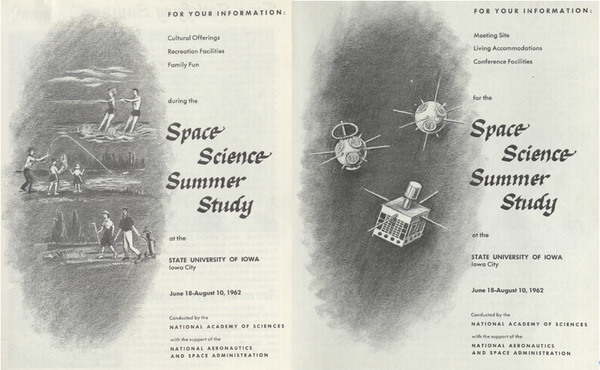
On the planning team’s priority list, the evaluation of NASA’s existing scientific program was item number one. But they also intended to consider “long-range scientific goals in space science” more broadly.[10] SSB planners sent multiple invitations to a long list of scientists. A brochure sold the amenities of the university and the surrounding area, hoping to get busy scientists to commit to a two-month program.
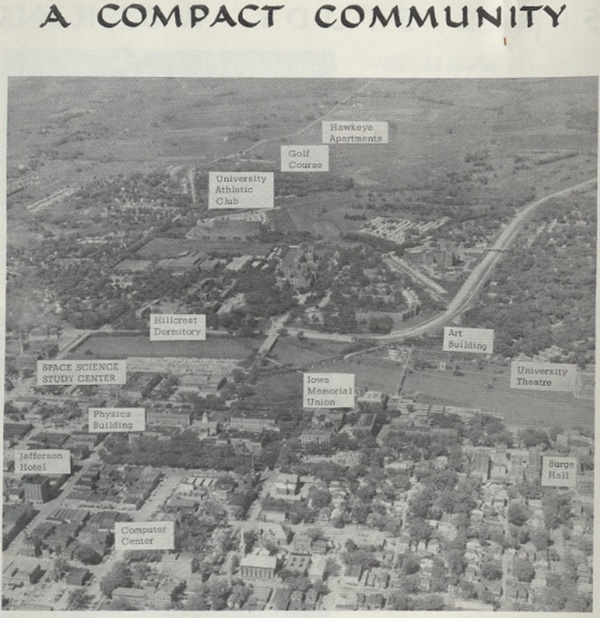 An aerial map of the State University of Iowa Campus and surrounding amenities.[11] |
There was major competition for their attention: for example, the Navy was conducting their own space-related study and astronomer Gerard Kuiper was moving his growing Lunar and Planetary Lab into new facilities.[12] Despite the challenges, they ended up with a solid list of full-time participants, and the roster expanded further because part-time participation was quite feasible. The study was broken up into working groups, and participants could show up when the relevant working group was meeting.
| The active and extensive involvement of NASA officials in these sessions reinforced the notion that this study might seriously influence their planning. |
Eighteen working groups covered almost every aspect of space science imaginable, including astronomy, solar system atmospheres, particles and fields, and meteorological rockets and satellites. Some working groups covered topics beyond basic scientific research, considering NASA’s relationship with universities, international cooperation, and the social and economic implications of the space program. Working groups met promptly at 9 am and continued until the end of the work day, with a break for lunch. NASA officials often kicked off the working group sessions with explanations of existing NASA programs, and direct guidance on the sort of advice they sought.
The active and extensive involvement of NASA officials in these sessions reinforced the notion that this study might seriously influence their planning. In public statements near the end of the study, Webb reiterated this idea. “We are financing this study to bring the best brains in our universities and industries together here, to say what’s wise for the United States to do,” he said in a press conference in Iowa, “and we expect to follow their advice wherever we can.” When asked what made this study different from similar ones in previous years, Webb replied that it was the timing: “You don’t any longer have to argue the United States ought to have a [space] program,” he said, “now you’ve got to address yourself specifically what should the program be, in detail.”[13]
After Webb received briefings in August, participants compiled their work into a massive formal report titled A Review of Space Research, containing a panoramic view of scientific disciplines in the middle of 1962.[14] James Van Allen, in an August address, likened the report to “an anthology of detective stories--very good ones!” But, he pointed out, these stories remained largely incomplete.[15] The question remained how much impact these stories would actually have on NASA, and Apollo was one of the biggest tests.
The future of Apollo
The working groups most relevant to Apollo were the Working Group on Lunar and Planetary Research and the Working Group on Man as a Scientist in Space Exploration. Many NASA officials attended their sessions, including Charles Sonett from NASA’s Ames Research Center and Joseph Shea from the Office of Manned Space Flight (OMSF). Sonett asked Lunar and Planetary participants to focus on specific recommendations and gave direct feedback on proposals for pre-Apollo lunar sample return and budgetary issues.[16] Shea had also made an earlier request for proposals of experiments to be run by the Apollo crew.[17]
The Subgroup on Scientific Undertakings for Man in Space (chaired by Gerard Kuiper and geologist Eugene Shoemaker, with Carl Sagan as secretary) took up broader questions of science in Apollo and beyond. A variety of NASA and DoD officials contributed, including Sonett and Verne Fryklund Jr., acting director of the Office of Space Sciences. In this group, Sonett distributed a draft report that his internal NASA committee on Apollo science had put together.[18]
This document would become known as the Sonett Report, and it had been specifically requested by the OMSF earlier in the year.[19] Sonett’s committee, which included Shoemaker, had met during the Iowa Summer Study to produce this draft. The Iowa working group then made recommendations that influenced the final report.
In 1963, Fryklund sent a memo to director Robert Gilruth at the Manned Spacecraft Center (MSC), who also present in Iowa, with guidelines on the scientific objectives for the Apollo program. In it, he outlined the Sonett report and the incorporation of the Iowa Summer Study recommendations.[20] In the end this meant prioritizing generalized observation, sample collection, and deployment of monitoring equipment like seismometers.
| Shoemaker’s memory of Iowa was not a pleasant one, because he got the sense that this advice was already falling on deaf ears. |
These recommendations seem to have influenced Apollo scientific planning in a fairly general sense. Apollo scientific planners Noel Hinners and Donald Beattie, neither of whom actually attended, both saw the discussions in Iowa as foundational for their work.[21] But while these early reports may have broadly influenced mission architecture, many of their specific recommendations would not make it to actual Apollo missions.[22] And one of their strongest recommendations would end up being firmly denied.
The SSB had sent out a questionnaire earlier in the year, which W.W. Kellogg summarized in Review.[23] “Should a scientist (at least one) be a member of the first Apollo crew?” one question read. Kellogg’s summary of the responses included what may be the only exclamation point in the entire document: “Emphatically, ‘Yes!’”[24]
This was also the conclusion of both the Iowa working groups and the Sonett Report. But Shoemaker’s memory of Iowa was not a pleasant one, because he got the sense that this advice was already falling on deaf ears. In a 1988 interview, historian Ron Doel asked Shoemaker about Iowa.
“It was perfectly plain that [the MSC representatives] didn’t want scientists sticking their damn noses in any way into the whole venture,” Shoemaker recalled. “They regarded us as a huge nuisance. It was offensive.”[25] In the end, a scientist would not fly on an Apollo mission until Apollo 17.
But tensions surrounding Apollo went even deeper. Some in the scientific community had already been vocal about their opposition to the Apollo program altogether. In Iowa, this conflict became more direct as NASA officials and scientists were thrown into the same rooms. Iowa Journalism professor William Porter was tasked with making observations, and in a reflection written near the end of the Study, mentions what he called “steamy sessions” that addressed the question of overall national goals.[26]
The summary in Review characterized these discussions as revealing “considerable confusion about the Apollo mission and its proper justifications.”[27] This impression likely came both from those opposed to Apollo, and those who saw Apollo as a primarily scientific mission. NASA officials emphasized to the scientists that Apollo was primarily an engineering effort, and that science (while important) was firmly secondary.
Some scientists, for their part, “sensed what they felt was a confusion between public relations and science,” Porter wrote.[28] Some scientists in Iowa expressed fear that a veneer of science was being used to legitimize the Apollo program, a scenario made worse by their perception that Apollo was drawing funds away from productive scientific projects.[29]
These concerns made it all the way to the Oval Office a few months later, when JFK asked Webb about the possibility of doing exactly that to expedite a lunar landing. Webb made a vigorous defense of science, with arguments echoing those presented to him in Iowa.
Webb told the President that “if I go out and say that [Apollo] is the number-one priority and that everything else must give way to it, I’m going to lose an important element of support for your program and for your administration…particularly the brainy people in the industry and in the universities who are looking at a solid base.”[30] In the end, they did not move forward with concepts of a “crash” program.[31]
Webb was trying to both support his president’s goals and maintain a solid relationship with the scientific community—a delicate balancing act. Early in 1963, he used direct quotes from Review to justify Apollo in scientific terms during a speech in Chicago.[32] Regardless of his intentions, this may have been exactly the sort of legitimization tactic that some who contributed to the report had feared.
Both Berkner and Newell also tried to smooth things over with scientists in Iowa and beyond. They emphasized that Apollo was happening regardless, so the scientists should get on board. Many accepted this to varying degrees, but tensions around Apollo would never fully disappear.
Impact and continuing studies
In his final address, Berkner highlighted several topics where he felt the Study had made significant contributions. In addition to lunar science and Apollo, Berkner pointed to discussions concerning the search for extraterrestrial life, investigation of the origins of life, and the sterilization of spacecraft.[33]
| The overall impression from both the report and observers was that in spite of any disagreements, the scientists in Iowa generally endorsed NASA’s existing programs. |
Another topic that emerged was the potential of large space telescopes. Astronomer Leo Goldberg was chair of the astronomy working group. In 1978, Goldberg told Spencer Weart that it was the SSB that connected him directly to NASA. “The big thing I remember about Iowa,” he said, “is that we learned for the first time that it was going to be possible to rendezvous and dock in space. And right away we all began to think: gee, this is how you build a big telescope in space, or a big laboratory.”[34] This was exactly the sort of thing many organizers hoped would come out of these meetings.
The overall impression from both the report and observers was that in spite of any disagreements, the scientists in Iowa generally endorsed NASA’s existing programs, recognized that NASA had hired some competent people, and provided a set of detailed and actionable recommendations at a crucial juncture in the organization’s history.[35]
Throughout, Porter reflected, most scientists had taken their task very seriously. They had strayed, sometimes, beyond their purview, often to the annoyance of the administrators. But Porter had the impression that the scientists were very aware of how limited their influence might ultimately be and persisted regardless.
Porter speculated about why the scientists would have approached the proceedings in this way: “…many individual scientists feel responsibile(sic), in a curious kind of way, for NASA; they feel that the society at large may hold them responsible as a group for the operations of science in space, as they feel that the society at large holds science responsible for the atomic bomb and the things that followed it.”[36]
The relationship between the SSB and NASA deepened in the years following Iowa. The SSB appeared by name on NASA organizational charts starting in August 1962, with a dotted line connecting it directly to the Administrator. The NAS would remain on these organizational charts until 1977.[37]
Van Allen would refer to A Review of Space Research as “a classical document and became the prototype for subsequent studies by the SSB.”[38] The next study after Iowa took place at Woods Hole, Massachusetts, in 1965. There, scientists continued some conversations left off in Iowa, including discussions of the “Large Orbital Telescope.” Goldberg was present once again, and remembered the hopeful atmosphere of the Woods Hole meeting. “At the time, the future just seemed unlimited,” he said.[39]
NASA historian Joseph Alexander explains that after Iowa, “summer studies remained a staple of the SSB’s activities through the 1970s.”[40] The 1980s saw summer studies that rivaled the Iowa study in scale, he writes, before their frequency eventually declined under budgetary pressure.
Endnotes
- Lloyd Berkner, letter to Abelson, March 2, 1962, Box 284, James A. Van Allen Papers (RG99.0142), Special Collections & Archives, University of Iowa Libraries.
- RC Peavey, telegram to J A Van Allen, March 1, 1962, Box 284, James A. Van Allen Papers (RG99.0142), Special Collections & Archives, University of Iowa Libraries.
- Space Science Summer Study brochure, Box 285, James A. Van Allen Papers (RG99.0142), Special Collections & Archives, University of Iowa Libraries.
- See Homer Newell, Beyond the Atmosphere: Early Years of Space Science (NASA, 1980)
- Newell, p 212
- The Rocket Panel went by many names over the years, and had overlapping membership with various scientific advisory groups. This embryonic program also included the IGY committee. See Newell’s account of the Rocket Panel and IGY program in Beyond, pp 25-58. See also Joseph K. Alexander, Science Advice to NASA: Conflict, Consensus, Partnership, Leadership (NASA, 2017) pp 5-11.
- Newell, pp 206-207
- Oral history transcript, James E. Webb, interview 1, April 29, 1969, by T.H. Baker, LBJ Presidential Library, pp 3-5
- For example, the USAF and the Navy had been using summer studies in the early 1950s. See Dwayne Day, Lighting Rod: A History of the Air Force Chief Scientist’s Office (USAF, 2000), p 39
- “Suggested Topics for Consideration,” January 31, 1962, Box 284, James A. Van Allen Papers (RG99.0142), Special Collections & Archives, University of Iowa Libraries.
- Space Science Summer Study brochure, Box 285, James A. Van Allen Papers (RG99.0142), Special Collections & Archives, University of Iowa Libraries.
- Kuiper to Berkner; Peavey to Kellogg, Box 284, James A. Van Allen Papers (RG99.0142), Special Collections & Archives, University of Iowa Libraries.
- “Space Science Press Conference,” 1962-08-23, University of Maryland, American Archive of Public Broadcasting (GBH and the Library of Congress), Boston, MA and Washington, DC, accessed April 28, 2026.
- A Review of Space Research, National Academy of Sciences--National Research Council, (Washington, D.C.: The National Academies Press, 1962)
- James A. Van Allen, “Resume of Summer Study Program”, August 8, 1962, p 3, Box 287, 1962 James A. Van Allen Papers (RG99.0142), Special Collections & Archives, University of Iowa Libraries.
- “Minutes of the Lunar and Planetary Research Working Group”, Jun 25, (p 1), June 29, (p 4-5), Box 289, James A. Van Allen Papers (RG99.0142), Special Collections & Archives, University of Iowa Libraries.
- Ibid, July 2, p. 2
- “Minutes of Meeting of Working Group on Man as a Scientist in Space Exploration,” Box 288, James A. Van Allen Papers (RG99.0142), Special Collections & Archives, University of Iowa Libraries.
- “Report of the Ad Hoc Working Group on Apollo Experiments and Training on the Scientific Aspects of the Apollo Program,” December 15, 1963.
- Fryklund to Gilruth, “Scientific Guidelines for the Apollo Project,” October 8, 1963, in Exploring the Unknown, Volume VII (NASA), 2008), SP-2008-4407, p 617
- Donald Beattie, Taking Science to the Moon: Lunar Experiments and the Apollo Program, (Johns Hopkins University Press, 2001), p xiv; Hinners to Wright, August 18, 2010, (p 11-12),
- See David Portree, “Apollo Science and Sites: The Sonett Report (1963)”.
- Some of the most extensive responses came from Carl Sagan, Thomas Gold, and Harold Urey; Kellogg to Nelson, “Review of Answers to Space Science Board Questions on “Scientific Program for the Apollo Mission”, July 23, 1962, Box 288, James A. Van Allen Papers (RG99.0142), Special Collections & Archives, University of Iowa Libraries.
- Review, Chapter 11, pp 17-19
- Eugene Shoemaker, interview by Ron Doel, session IV, September 8, 1988, transcript, Niels Bohr Library and Archives, American Institute of Physics, pp 6-7; It’s somewhat unclear if Shoemaker is remembering the Iowa Summer Study specifically, or the Sonett group meetings that had convened in Iowa earlier that year. He may be conflating them, and exaggerating their attitudes, but NASA officials certainly tried to temper the expectations of scientists in the study meetings, and comments in the working group meeting minutes could be fairly interpreted as saying that scientists would likely NOT be included on early Apollo missions.
- William Porter, “The Context of the Space Science Summer Study”, p 3, Box 287, James A. Van Allen Papers (RG99.0142), Special Collections & Archives, University of Iowa Libraries.
- Review, Chapter 1, pp 21-22
- Ibid, p 3,
- Newell, 208
- “Transcript of Presidential Meeting in the Cabinet Room of the White House,” November 21, 1962, Prepared by Dwayne Day from John F. Kennedy Library Presdient’s Office files, NASA, p 15-18
- For additional context and analysis, see Dwayne Day.
- James Webb, “Keynote Address--National Goals in the Space Age,” in Proceedings of the Conference on Space-Age Planning (NASA, 1963), p. 5-7; Webb acknowledged some of the scientific dissent and the recommendation for a scientist on the first Apollo crews, but largely emphasized scientific opportunities created by Apollo.
- Lloyd Berkner, “Closing Remarks,” August 9, 1962, Box 287, James A. Van Allen Papers (RG99.0142), Special Collections & Archives, University of Iowa Libraries.
- Goldberg to Weart, transcript, May 17, 1982 Niels Bohr Library and Archives, American Institute of Physics, p 81
- See Review, Porter, and Newell
- Porter, p 2
- See NASA Headquarters Organizational Charts.
- see: https://articles.adsabs.harvard.edu//full/1990AREPS..18....1V/0000019.000.html
- Goldberg, p 84
- Alexander, 25
Note: we are now moderating comments. There will be a delay in posting comments and no guarantee that all submitted comments will be posted.