The road to the asteroid belt runs through the Moonby Chad McElroy and Jacob Smagula
|
| Living on the Moon is more a game of logistics and operational sustainment rather than a contest for who has the biggest habitat or newest scientific equipment. |
After years of preparation, NASA’s Artemis program successfully sent humans around the Moon in April for the first time in more than 50 years, testing equipment and procedures for America’s next leap: A return to the lunar surface no earlier than 2028, now assigned to Artemis 4 following recent restructuring of the program’s mission sequence.
While the plan of flybys, orbital rendezvous, and elaborate lunar landings looks remarkably similar to the Apollo program of the 1960s, NASA has added a critical new element to this campaign: A base on the Moon’s south pole that aims to establish an “enduring human presence on the Moon, unlock new scientific discoveries, and prepare for future exploration of Mars.” This time, humans will seek to live on the Moon permanently, conducting science experiments, supporting eventual tourism, and, inevitably, exploiting an abundant supply of lunar resources.
By funding pathfinding missions, communications demos, and other preparations, NASA has signaled that this push will outlast the geopolitical contest that first brought it to fruition. Similarly, China marches towards a realization of that same ambition following a decade-long campaign of uncrewed lunar landings and sample return missions. With some predicting that Beijing might do so before the United States, China, alongside Russia and other international partners, is poised to compete to become the first nation-state to establish a permanent lunar presence.
While the Apollo missions asked whether humans could reach the Moon, Artemis asks whether they could stay: living on the Moon is more a game of logistics and operational sustainment rather than a contest for who has the biggest habitat or newest scientific equipment. Any lunar settlement requires water, food, waste removal, power, radiation shielding, a way to radiate excess heat, and reliable communications. The side with the best infrastructure will survive the longest.
Initial bases will certainly be constructed from materials sent directly from Earth, yet should a future Moon base need to operate without waiting for infrequent, expensive resource deliveries from Earth, settlers will need to look to the immediate lunar environment to become even partially self-sufficient.
| Lunar development can succeed on its own even if asteroid mining never materializes, but asteroid mining cannot succeed without a lunar industrial economy. |
Luckily, three of the most important elements—power, water, and shielding—can be crafted from resources found on the Moon. Water is trapped within lunar craters permanently shaded from the sun, giving astronauts and scientists a new source of both a commodity and a critical ingredient of rocket fuel. At the same time, the lunar soil itself stands to be one of the Moon’s greatest resources. Companies like Blue Origin are already developing systems designed to turn lunar regolith into solar cells, metals, oxygen, and other useful products. That same lunar soil can be used to cover habitats, providing shielding from both radiation and micrometeorite impacts. NASA, CNSA, and other organizations operating on the Moon will increasingly need industry to provide lunar surveyors, drills, excavators, smelters, robots, factories, and all sorts of machines that coincidentally operate in a very similar environment to that of future low-gravity, high-radiation, and long-distance asteroid mining operations.
The need for permanence changes what will be demanded of those machines. Equipment that keeps a crew alive must run continuously, get maintained, get repaired, and improve, which means the technology will be refined and utilized in the face of real operational pressure, not flown once and archived. Some of these tools and techniques from lunar settlement will naturally carry over into the emerging asteroid mining industry. The Moon is an unusually valuable training ground for proving the viability of asteroid mining: it will allow companies to safely practice many of the same techniques necessary for asteroid mining close to home.
This is not to say the Moon and an asteroid are the same operating environments. The Moon is only a few days away and is easily accessible roughly once a month, enabling a relatively simple iterative development cycle when compared to the idiosyncratic launch windows of near Earth asteroids. Additionally, an asteroid’s microgravity, irregular shape, uncertain geology, and rotational dynamics create challenges that lunar mining equipment cannot simply solve by being transported elsewhere. The value of lunar development, though, is that it will force companies to develop the underlying industrial capabilities that asteroid mining will require.
This would not be the first time the private sector, having mastered one capability under government contract, gained the adjacent skillset needed to unlock another: the companies that delivered cargo to the International Space Station went on to carry crews and launch national security payloads, including the development of the largest satellite constellation in human history. On top of the broad similarity between lunar and asteroid mining, lunar ISRU operations will allow companies new and old alike to forge new relationships with NASA and other US government partners. Should a company that becomes deeply experienced in lunar mining pivot to asteroid mining, it will enter that market positioned with a substantial operational and technological head start.
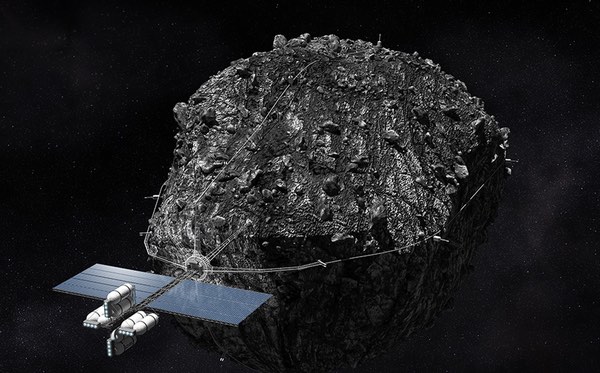
Lunar development can succeed on its own even if asteroid mining never materializes, but asteroid mining cannot succeed without a lunar industrial economy, or something built at equal expense to replace it. More than a decade ago, companies like Planetary Resources and Deep Space Industries raised capital to leapfrog straight to the near Earth asteroids; both folded before reaching one. A new generation of startups, led by companies like AstroForge, is now betting it can succeed where they failed. A successful lunar economy dramatically lowers the technological and operational barriers to asteroid mining that may also create the infrastructure and markets that make asteroid resources valuable in the first place.
If Artemis is successful in producing a permanent lunar industrial apparatus, those who dream of asteroid mining will inherit its foundation without having to ask investors to foot the entire bill of decades of development with an uncertain outcome. If Artemis becomes flags and footprints with better cameras, asteroid mining remains science fiction.
The Moon is not a detour on the way to the asteroids. It is the road.
Note: we are now moderating comments. There will be a delay in posting comments and no guarantee that all submitted comments will be posted.