Voyager 6 seeks the Creatorby Dwayne A. Day
|
| Roddenberry asked if the Star Trek production could borrow JPL’s Voyager mockup for the production. Casani and others at JPL sent Roddenberry diagrams of Voyager instead. |
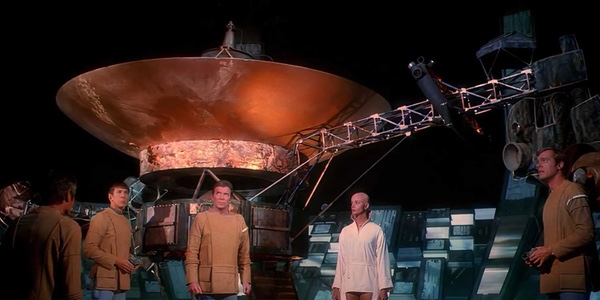
Of course, this is fictional, and a bit whimsical. The 1979 movie Star Trek: The Motion Picture featured a giant alien spacecraft named “Vejur” heading toward Earth. When the crew of the newly refurbished starship Enterprise encountered Vejur, they learned that at its heart was an Earth-built spacecraft named Voyager 6, whose basic programming was “learn all that is learnable, return that information to its creator.” Voyager 6 looked almost exactly like the Voyager 1 and 2 spacecraft that had been launched in late summer 1977. Both had flown past Jupiter in mid-1979 and were very much in the zeitgeist at the time, making Voyager 6 recognizable to many in the audience when the movie premiered only a few months later in December.
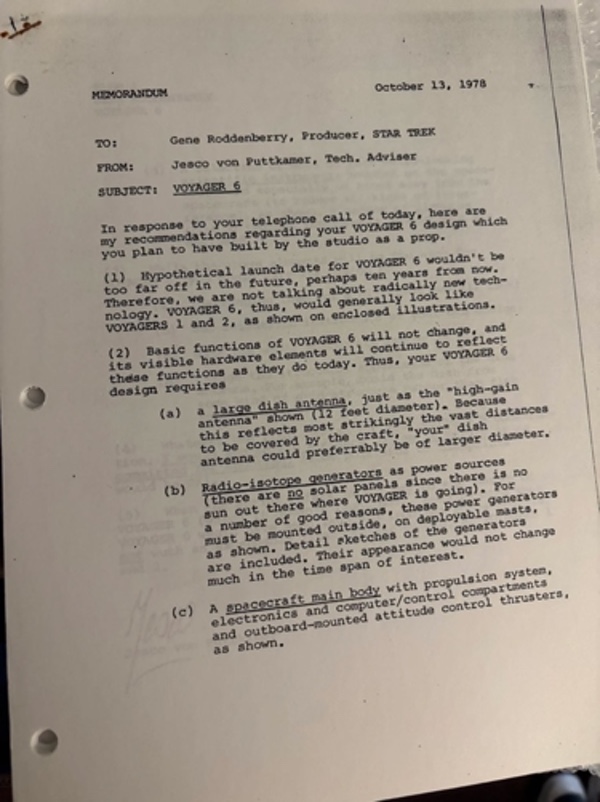 Jesco von Puttkamer wrote this memo to Gene Roddenberry in October 1978 describing the Voyager 6 spacecraft that was planned for the movie, advising that it should be similar to the existing Voyager 1 and 2 spacecraft. Although he suggested that Voyager 6’s main dish antenna might be a bit larger than that on the existing Voyager spacecraft because it was planned to travel farther out in the solar system, the actual prop was slightly smaller than the actual Voyager spacecraft. (credit: @trapperseanmd.bsky.social) |
Voyager’s trip
On October 13, 1978, Jesco von Puttkamer wrote a letter to Gene Roddenberry, the executive producer of the original Star Trek television series in the 1960s and the producer of Star Trek: The Motion Picture. Von Puttkamer was a NASA official and was eventually listed as “Special Science Advisor” in the film’s credits. He was responding to a telephone call earlier in the day where Roddenberry had asked him about the Voyager 6 spacecraft in the script. The studio was going to build the prop for the movie and von Puttkamer was providing scientific and technical advice.
Von Puttkamer suggested that Voyager 6 could be launched “perhaps ten years from now.” Because of that, it would not be “radically new technology,” he added. “Voyager 6, thus, would generally look like Voyagers 1 and 2, as shown on enclosed illustrations.”
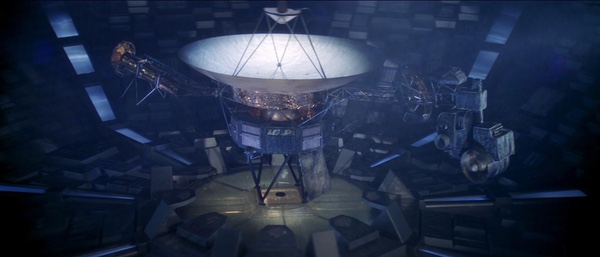 The Voyager prop built for the production was only three-quarters scale compared to the actual spacecraft. Notably, the instrument boom was less detailed. (credit: Paramount) |
Because it was an outer planets mission based upon the Voyager 1 and 2 missions, von Puttkamer explained that the basic functions of Voyager 6 would not change and therefore its visible hardware elements would continue to reflect the functions of the first Voyagers. The Voyager 6 design required a large dish antenna, perhaps slightly larger than Voyagers 1 and 2, radioisotope generators (no solar panels), and a spacecraft main body with a propulsion system, electronics and computer/control compartments and attitude-control thrusters.
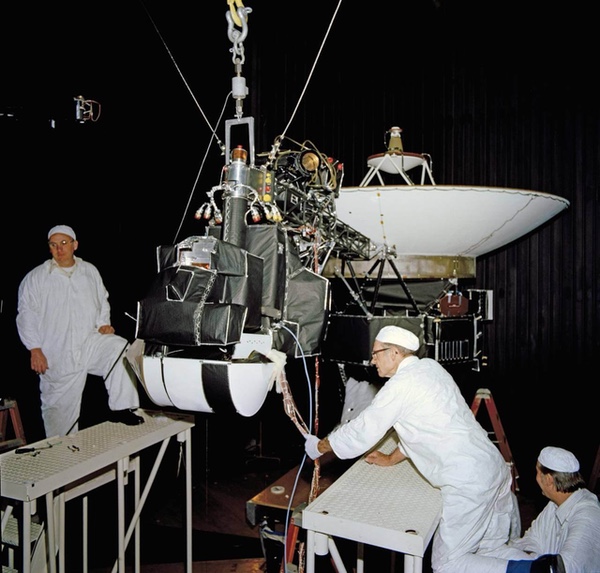 One of the Voyager spacecraft during construction. Here the instrument boom is being attached to the spacecraft main body. (credit: NASA/JPL) |
Two weeks later, on October 28, Roddenberry wrote John Casani, the Outer Planets Program Manager at the Jet Propulsion Laboratory, as a follow-up to a phone call the two men had held. The memo is included in Susan Sackett and Gene Roddenberry’s 1980 book The Making of Star Trek: The Motion Picture (pages 156–157). Roddenberry asked if the Star Trek production could borrow JPL’s Voyager mockup for the production. He wrote that they would need it for five days in November—two for transport and set-up, two or three for shooting, and a day to return it. “Of course, we would supply you with the necessary insurance papers, and would, of course, return it in exactly the same condition in which you gave it to us.” He included the reassurance that “As always, Star Trek will maintain a respectful and supportive attitude toward NASA and the space program.” But the arrangements could not be finalized due to concern that the production could not guarantee that the mockup would not be damaged. Casani and others at JPL sent Roddenberry diagrams of Voyager instead.
| Apparently, members of the movie production team visited nearby JPL to look at the full-size Voyager 2 mockup that JPL used as a backdrop in the press room during the Voyager planetary flybys. They almost certainly photographed the mockup. |
For the production crew, this must have been welcome information because they could use existing diagrams and photographs of the Voyager spacecraft and not have to design anything new or exotic. The Voyager 6 reveal was planned for the film’s finale. The spacecraft would sit in the center of a giant bowl-shaped set using up most of a soundstage. Getting the rest of the set, which represented the inside of the V’Ger spacecraft, to look futuristic and not fake or cheap, was a monumental task. Lighting it was even harder. There were lights underneath the floor and inside of large spires that rose up around the sides; they pulsed with energy and also had to reflect V’Ger’s increasingly-annoyed mood as the machine equivalent of a petulant child threw a fit over not getting what it wanted—its creator. Matching the exterior lighting with the practical lighting inside the set was also challenging. Copying Voyager made one small part of their job easier.
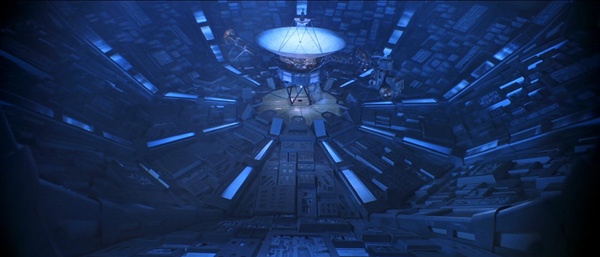 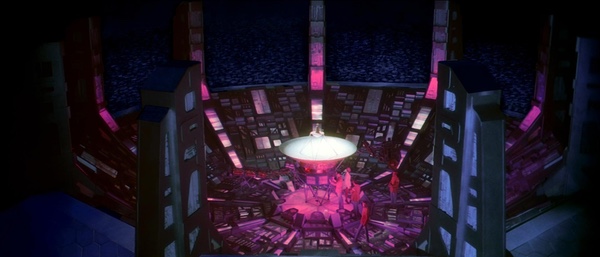 The Voyager prop built for the production was the least of the crew's worries. The large bowl-shaped set had to be constructed to look good on screen and had practical lighting built into the set. Getting the overhead lighting to match with the practical lighting was difficult. The prop was easy. (credit: Paramount) |
The Star Trek production crew already had their hands full with an incredibly complex design and special effects agenda, the most special effects shots of any movie up to that time. They also were working on a film that had to be delivered to theaters in 14 months, even if it was unfinished. Paramount had signed contracts with studios to deliver Star Trek on time, and missing that deadline would result in a class-action lawsuit that could bankrupt the entire studio.
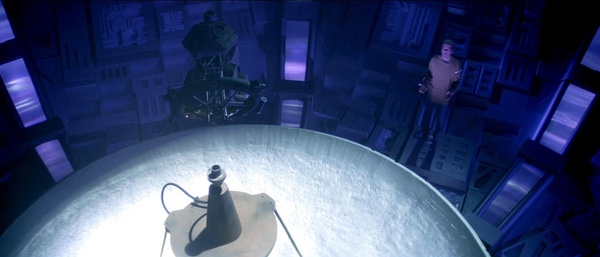 James T. Kirk addresses a giant computer in Star Trek: The Motion Picture. As usual, the computer destroys itself. (credit: Paramount) |
Glory to NASA for sending its Son
According to Preston Neal Jones’ book Return to Tomorrow: The Filming of Star Trek: The Motion Picture, the first draft script for the movie referred to “Voyager 18,” which was changed in one of the many later drafts. A Vejur probe named Tasha (later renamed Ilia) explained that “Voyager 18 was launched in 1996 to send signals back from beyond the solar system, but after it passed Jupiter it stopped transmitting, ‘and all theoreticians agreed it disappeared into a black hole.’” Other inscriptions on the Voyager spacecraft Tasha calls “the Holy Writings. The Creator’s Message… Glory to NASA for sending its Son, and its Message.”
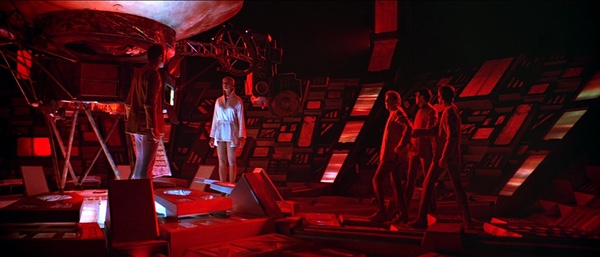 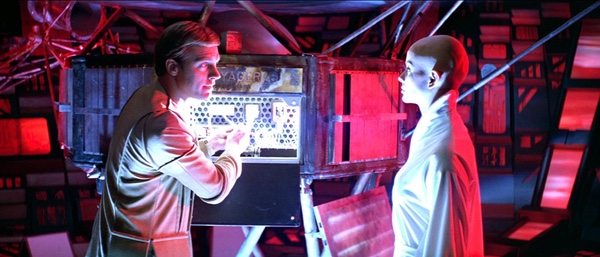 As Vejur gets more demanding, the lights pulsed faster and turned red, indicating that Vejur may have had emotions it was unaware of. (credit: Paramount) |
Another character named Xon—a Vulcan who was taking the place of Spock because Leonard Nimoy did not want to return to Star Trek—explained that a planet populated by living machines was a decaying civilization until the NASA spacecraft arrived: “The Holy One—Voyager 18. Crippled, barely operative, by the standards of the living machines [it] was extremely primitive. It carried within it a regenerative spark. It revitalized the entire race. And 300 years later, having now attained star travel capability, they set out to reach the distant planet from which had come their Savior.” (Page 37)
James T. Kirk addresses a giant computer in Star Trek: The Motion Picture. As usual, the computer destroys itself. (credit: Paramount) |
Apparently, members of the movie production team visited nearby JPL to look at the full-size Voyager 2 mockup that JPL used as a backdrop in the press room during the Voyager planetary flybys. They almost certainly photographed the mockup. Susan Sackett and Roddenberry state in The Making of Star Trek: The Motion Picture that the Voyager 6 prop was built at three-quarters the size of the actual Voyager spacecraft. It appeared in the final act of the film, as the big reveal when the Ilia probe—a sophisticated copy of a former crewmember on the USS Enterprise—leads Captain Kirk, Mister Spock, Dr. McCoy, and Commander Decker to “Vejur.” When she points at the spacecraft, Kirk and the audience get a big surprise, discovering that at the heart of the giant robotic alien spaceship is an ancient spacecraft from Earth, part of its name “Voyager” obscured by scorch marks from its space journey.
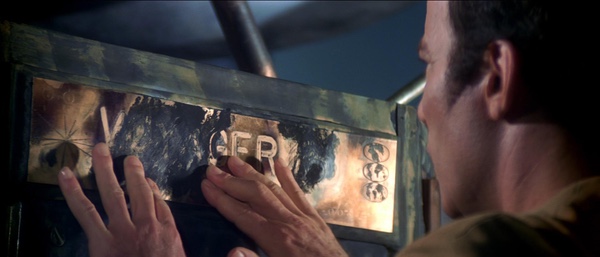 The name of Voyager 6 has been obscured by weathering during its long space journey and only the letters V G E R are visible. The giant spacecraft does not need a name for itself, or a name pronounced in English, until it encounters humans for the first time. (credit: Paramount) |
Some Trek fans wondered how Vejur—V’Ger—could be so super intelligent and so powerful and yet not know that the spacecraft was named “Voyager 6” instead of “V’Ger.” Didn’t the alien machines that found the spacecraft know the space dirt that covered part of the name on the dedication plaque on Voyager 6’s side was not normal? Daren Dochterman, a production illustrator who has worked on many science fiction shows over the years, including productions of Star Trek TV shows such as Voyager and Picard, and was the visual effects supervisor for the Star Trek: The Motion Picture Director’s Edition, had a plausible explanation during an episode of the “Inglorious Treksperts” podcast. Dochterman suggested that Vejur never needed a name for itself until that moment. It certainly never had to speak English, or any words at all, until it created the Ilia probe it placed aboard the Enterprise and the probe had to communicate with the primitive carbon-based units infesting the Enterprise. At that point it merged the visible letters on the spacecraft—V GER—with what it had learned about spoken English and pronounced its name as “Vejur.”
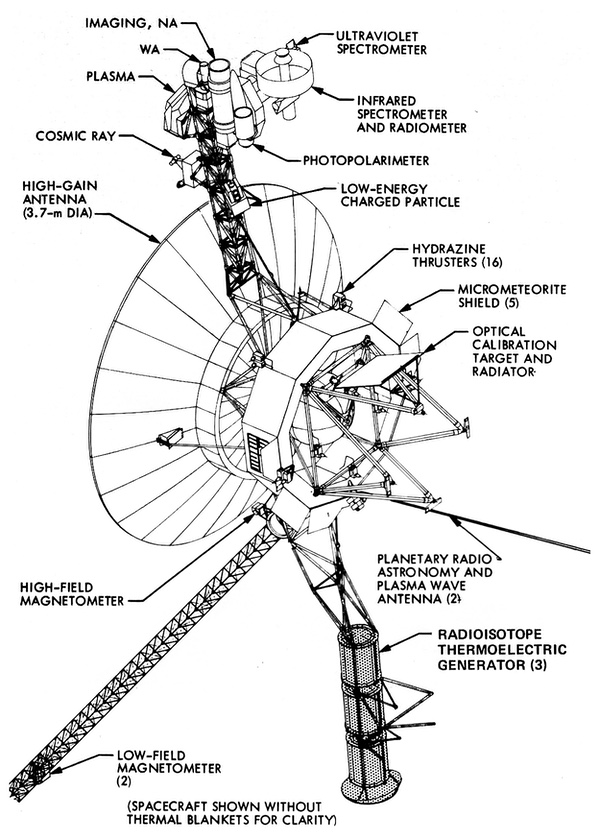 Gene Roddenberry asked JPL to loan the production the full-scale Voyager mock-up. JPL sent the production a bunch of diagrams of Voyager instead. (credit: NASA/JPL) |
From Germany to NASA to Hollywood
The film’s special science advisor, Jesco von Puttkamer, was born in Germany in 1933, and after emigrating to the United States in 1962 he eventually became an aerospace engineer and then a senior NASA manager. He became a US citizen in 1967. He had started writing science fiction in the 1950s in Germany, and continued later in life, although his fiction was primarily short stories.
| Despite a lengthy resume, it has never been exactly clear what von Puttkamer, who died in 2012, did at NASA, because he seemed to move around a lot. |
For the creators of the original Star Trek series, believability, although not necessarily scientific accuracy, was important from the beginning. Roddenberry wanted a show that depicted a spaceship and technology several hundred years in the future. Von Puttkamer had met Roddenberry in 1975 when Fred Durant introduced them at a science fiction convention. He became science advisor on Star Trek: The Motion Picture to help with the believability of the movie. In this role he explained the scientific principles behind certain phenomena—such as the wormhole that swallows the Enterprise early in the film—to special effects experts so they could be more accurate in displaying them in the movie. Von Puttkamer wrote a memo to Roddenberry concerning the wormhole that was later published in Starlog magazine. A month before he wrote Roddenberry about Voyager 6, von Puttkamer informed him that a fictitious story had appeared in the news claiming that NASA had loaned Star Trek electronic equipment, prompting an angry letter to NASA from a senator demanding the truth.
Despite a lengthy resume, it has never been exactly clear what von Puttkamer, who died in 2012, did at NASA, because he seemed to move around a lot. He was sort of a science communicator who talked about NASA to the public, apparently banking off his striking good looks, his German accent, and his connection to Wernher von Braun, although he never worked with von Braun in Germany or during the Army days.
From its beginning in 1964, the creators of Star Trek sought to base the show on real science and engineering, loosely extrapolated hundreds of years into the future. Voyager 6 was just one of the many times that the franchise crossed paths with NASA. It would not be the last.
Note: we are now moderating comments. There will be a delay in posting comments and no guarantee that all submitted comments will be posted.