A crater of our own making: what the SpaceX lunar impact reveals about the future of Moon governanceby Rachita Agrawal
|
| The legal regime governing the Moon was designed for exploration. The future Moon will require a regime for management. |
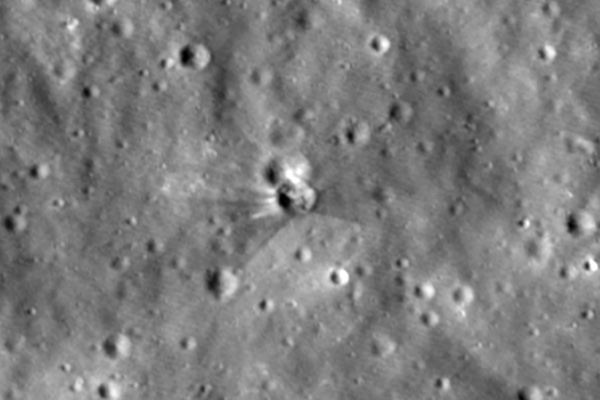
The immediate reaction is understandably scientific: What does the crater tell us about the Moon? But there is a more uncomfortable legal question: What does the crater tell us about humanity’s emerging authority to alter a celestial body that international law declares to be the province of all humankind?
The impact was not a deliberate act of lunar modification. Nor does it, by itself, establish a straightforward case of international liability. Yet that is precisely why it matters. The event exposes a regulatory problem that will become increasingly difficult as lunar activity moves from isolated missions toward sustained commercial and governmental operations.
The legal regime governing the Moon was designed for exploration. The future Moon will require a regime for management.
From exploration to alteration
The 1967 Outer Space Treaty remains the foundation of international space law. Article I provides that the exploration and use of the Moon and other celestial bodies shall be carried out for the benefit and in the interests of all countries. Article II prohibits national appropriation. Article VI makes states internationally responsible for national space activities, including activities conducted by non-governmental entities, and requires authorization and continuing supervision of such private activities.
Article IX is particularly significant. States must conduct lunar activities with “due regard” to the corresponding interests of other states and must pursue exploration so as to avoid harmful contamination of the Moon and other celestial bodies. It also provides for international consultation where an activity could cause potentially harmful interference with another state’s peaceful exploration and use of outer space.
At first glance, these provisions appear broad enough to address the SpaceX impact. But they leave a fundamental question unanswered: When does physical alteration of the lunar surface become a legally relevant harm?
A crater created by a discarded rocket stage may seem insignificant against a Moon covered by billions of years of natural impacts. Yet the legal significance of the event cannot be measured solely by its physical size.
The problem is cumulative. Hundreds of missions could produce hundreds of impacts, as well as discarded components, excavation sites, and construction zones. Lunar activity could eventually create an artificial landscape layered over the natural one.
The law has not yet developed a clear concept of the Moon as an environment requiring cumulative protection.
The limits of liability
The Convention on International Liability for Damage Caused by Space Objects establishes a framework for state responsibility when space objects cause damage. The Outer Space Treaty similarly provides that a launching State is internationally liable for damage caused by its space object or component parts, including on the Moon.
But the concept of “damage” presents a difficulty. The conventional liability framework is fundamentally remedial: an identifiable space object causes identifiable damage, and an affected state may seek compensation. That model works relatively well when the victim is a person, spacecraft or other property. It is less clear, though, when the “victim” is the lunar environment itself.
| The Moon could develop something resembling an environmental externality problem. A mission may be economically rational for the operator while imposing costs on future users. |
Who has suffered legally cognizable damage when an abandoned rocket creates a crater on an otherwise uninhabited part of the Moon? Can a state claim compensation merely because a lunar geological feature has been altered? What if no state-owned spacecraft, installation, or personnel is affected? More importantly, who represents the collective interest of humanity in the integrity of the lunar environment?
The Outer Space Treaty’s language of the Moon as the province of all mankind suggests a collective interest. But the treaty does not establish a dedicated institution capable of acting as the legal guardian of that interest.
This creates a paradox. The Moon cannot be nationally appropriated, but individual states remain responsible for activities conducted by their governmental and private actors. A state therefore exercises regulatory authority over its operators while the physical environment being altered is legally characterized as belonging to no state. That gap will become increasingly consequential.
The lunar surface is becoming infrastructure
The significance of the crater is not to argue or establish that it is the largest or most destructive human intervention on the Moon. It is that it demonstrates how lunar surface alteration can occur even without an actor intending to alter the Moon.
The next generation of lunar exploration will involve repeated landings, commercial missions, resource extraction, scientific experiments and permanent infrastructure. NASA’s Artemis program and other national and commercial lunar programs will increase the number of objects moving between Earth and the lunar surface.
The Moon could therefore develop something resembling an environmental externality problem. A mission may be economically rational for the operator while imposing costs on future users: dust contamination, altered terrain, debris, loss of scientific information, interference with landing zones, or damage to sites of exceptional historical or scientific importance.
The existing principle of “due regard” is valuable, but broad principles alone may not be enough. The international community needs to begin distinguishing between ordinary operational impacts and unacceptable cumulative alteration.
From “space debris” to “lunar debris”
Space debris governance has largely focused on Earth orbit. The growing lunar economy requires the concept to expand. A discarded upper stage that eventually strikes the Moon is no longer merely orbital debris. It becomes lunar debris.
This distinction matters because lunar debris can become permanent. On Earth, environmental systems, weather, and human cleanup can gradually alter or remove waste. The Moon has no comparable natural processes. An artificial object placed on its surface may remain for extraordinarily long periods.
| International space law should develop a dedicated framework for lunar environmental and surface protection with practical implemented mechanisms. |
The legal framework should therefore require operators planning lunar missions to undertake a lunar end-of-mission assessment: Where will the spacecraft, upper stage, lander, or other component ultimately go? Could its trajectory create an avoidable impact? Could it interfere with future missions or scientifically significant locations?
Such requirements need not prohibit lunar exploration. They would simply translate the principle of responsible activity into operational standards.
Protecting the Moon before it becomes crowded
The most important lesson from the Falcon 9 upper stage impact is that conversation cannot alone fight the practical reality and address the gray areas in the current space law regime.
International space law should develop a dedicated framework for lunar environmental and surface protection with practical implemented mechanisms. Such a framework could establish internationally recognized categories of protected lunar areas, impact-risk assessments for lunar missions, notification requirements for planned or unplanned impacts, standards for disposal of lunar-bound hardware, and mechanisms for sharing information about surface alteration. The objective should instead be to ensure that modification is deliberate, proportionate, transparent and internationally accountable.
Article IX of the Outer Space Treaty already provides the legal foundation for such an approach through its requirements of due regard, avoidance of harmful contamination, and international consultation. The next step is to give those principles operational content.
A new lunar social contract
The crater created last month will eventually become another feature on the lunar map. Future missions may land nearby. Scientists may study the exposed material. In the vastness of the lunar landscape, the physical scar may appear insignificant. Legally, however, it should be treated as a warning.
Humanity has entered an era in which the Moon is being visited, landed upon, mapped, used, and increasingly commercialized. The central question is consequently changing from whether humans may explore the Moon to how humans may collectively govern the consequences of exploration.
The SpaceX impact illustrates the inadequacy of waiting for a dramatic catastrophe before developing rules. By the time a lunar base is damaged, a scientifically significant site is contaminated, or an accumulation of debris obstructs a valuable landing region, regulation will be reacting to a problem rather than preventing one.
The Moon does not need to be treated as a museum, nor should every crater created by human activity become an international legal dispute. But the absence of national sovereignty over the Moon cannot mean the absence of responsibility for what happens to it.
The future of lunar governance will depend on whether international space law can move from regulating objects on the Moon to regulating humanity’s cumulative footprint upon the Moon.
Note: we are now moderating comments. There will be a delay in posting comments and no guarantee that all submitted comments will be posted.