To E-3 or not to E-3: the liminal Samos E-3 programby Dwayne A. Day
|
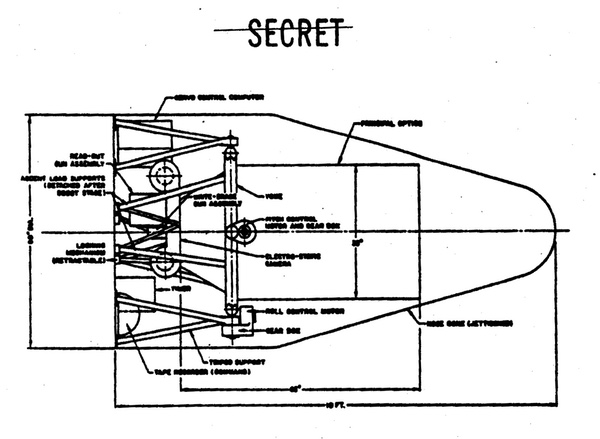 A September 1959 Lockheed illustration of the Samos E-3 satellite. The primary optics, which would have gathered the light to focus inside the camera, are omitted. Unfortunately, the source documents are blurry and not high quality, making some of the labels difficult to read. The Samos E-3 was canceled by December 1959. (credit: NRO) |
From October 1960 to November 1962, the Air Force launched nearly a dozen Samos satellites with designations E-1, E-2, E-5, and E-6. But no Samos E-3 or E-4 satellites were ever launched, making them the most enigmatic spacecraft in the Samos program. The E-4 was a mapping camera that was built but never flown, whereas the E-3 only existed for the second half of 1959, never even getting off the drawing board. The Samos E-3 emerged because the limitations of film readout were becoming apparent by summer 1959, but some in the Pentagon did not want to abandon a requirement to return imagery to the ground soon after the photographs were taken, even if very few photographs were actually taken. The Samos E-3 was the ultimate liminal system, caught between two worlds: the readout technology that was fading due to its limitations and the film-return technology that would dominate US satellite reconnaissance for the next two decades.
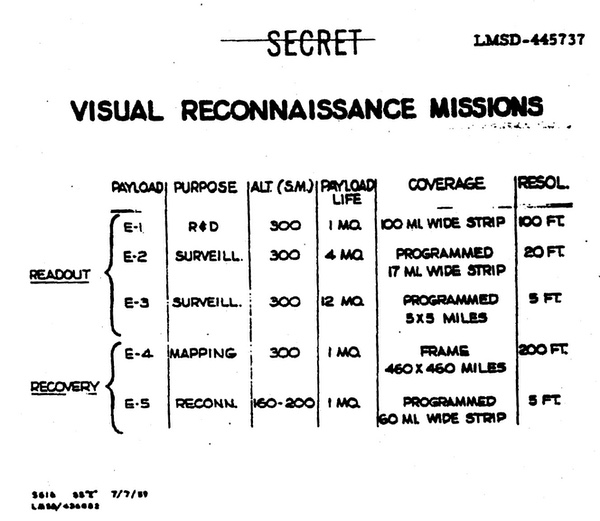 The Samos program consisted of visual reconnaissance satellites with an "E" designation and signals intelligence satellites with an "F" designation. The E-4 and E-5 were never built or flown. In addition to the satellites listed here, the Samos E-6 was also built and flown, but was unsuccessful. (credit: NRO) |
The Samos E series
Samos was initially the overall name for a series of subsystems including the satellite, propulsion system, and payloads that were given letter designations A through G: A for airframe, B for propulsion, C for auxiliary power, D for guidance and control, and G for infrared (missile warning). Most of these designations were quickly abandoned or forgotten by those working on the program except for Samos E, which designated photographic reconnaissance satellites, and Samos F, which designated signals intelligence collection satellites. Both the E and F subsystems soon produced multiple variants.
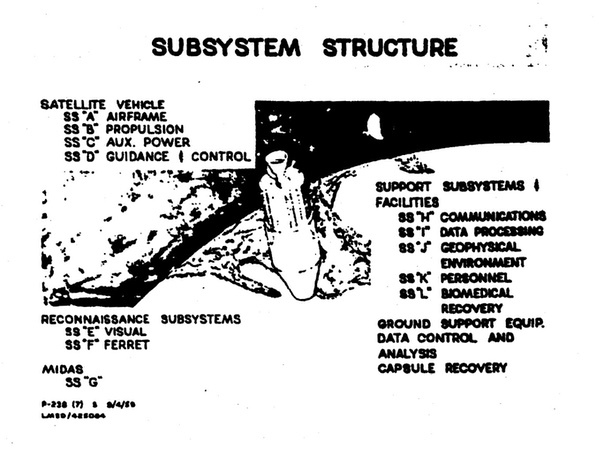 The Samos program had major subsystems designated A-G (later adding subsystem H). In practice, most of these designations were ignored other than Samos E and Samos F. (credit: NRO) |
In early 1958, a project was spun-off from the Samos E-series. It was a small recoverable satellite that would return its film to the ground. It was given the codename CORONA, and the camera system was designed and built by Itek and managed by the CIA, with the Air Force responsible for launch and tracking and spacecraft operations and recovery. CORONA was covert, meaning that its existence was classified, unknown even to most of the Air Force and contractor personnel working on Samos.
Samos E-1 and E-2 were “film-relay” satellites that recorded images on film, developed the film inside the satellite, and scanned that film for relay to Earth via radio transmission. The Samos E-1 was primarily a proof-of-concept system, with the Samos E-2 being the operational system. Up until late 1959, the Air Force expected that eventually multiple Samos E-2 satellites would fly and become the primary Air Force reconnaissance satellite.
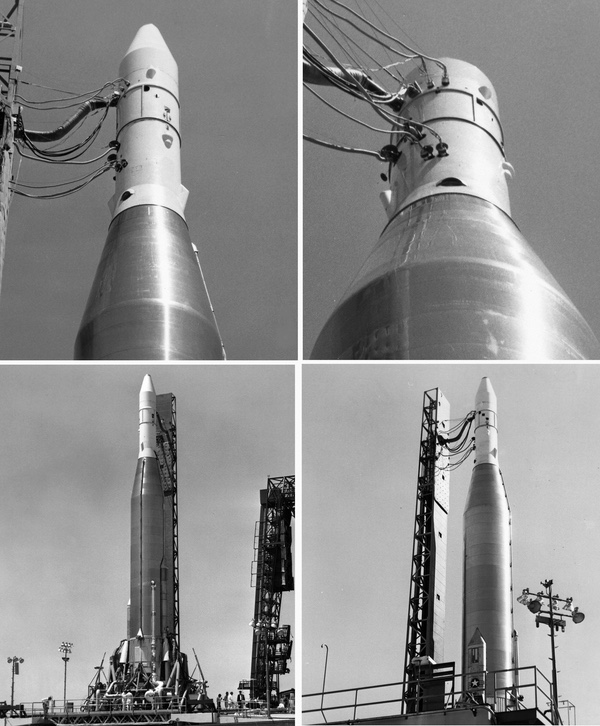 The Samos E-1 satellite. Film-readout technology had existed in some form for many years. Samos was applying it to a satellite. But it had substantial limitations, leading to a search for better technologies. (credit: Peter Hunter Collection) |
By 1959, due to the limitations of the E-2’s film-readout technology, the Air Force began considering Samos film-return systems as well, soon leading to the E-4 and E-5 systems in the first half of 1959, and later the E-6 system. Samos E-5 was a high-resolution “film-return” system that took photographs on film and then returned both the film and the camera to Earth inside a large reentry vehicle. “High resolution” meant the ability to spot images on the ground five feet (1.5 meters) large.
The Samos E-6, which did not start until 1960, was a broader area reconnaissance satellite. Its photos covered more territory than the E-5, were taken by two cameras operating in stereo mode, and were also recorded on film, but the E-6’s ground resolution was not as good as the E-5. The Samos E-6 film, but not the camera, would be returned to Earth inside a reentry vehicle smaller and pointier than the E-5. The E-4 was a mapping system that would use the same large reentry vehicle as the E-5. Although E-4 mapping cameras were apparently produced, the program was canceled at least in part due to bureaucratic in-fighting, with the US Army insisting that it, and not the Air Force, was responsible for mapping the Earth.
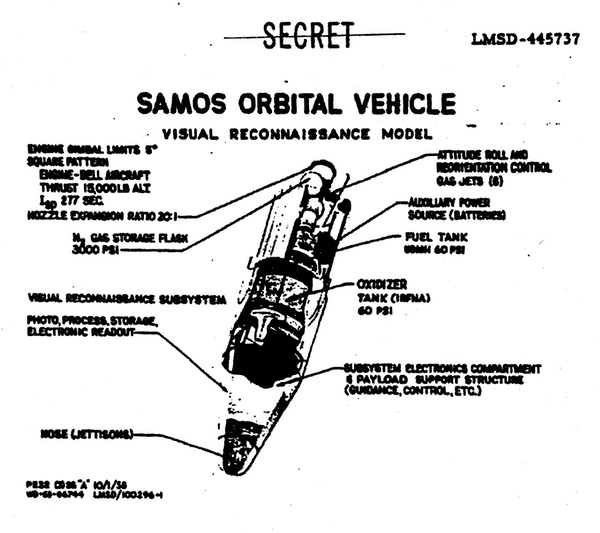 This 1959 illustration shows the overall layout of the Samos vehicles. The payloads were different for each of the E-series. (credit: NRO) |
The Samos E-3 system
Lockheed, which was building the Agena spacecraft that supported all the Samos payloads, proposed the Samos E-3 on July 29, 1959, according to an official history of early satellite programs. The history indicates that Lockheed may have assumed that the Advanced Research Projects Agency (ARPA) then running the overall program was more interested in readout satellites like the E-1 and E-2 than in film-return satellites. Lockheed therefore proposed the E-3 as the next step in technology that could return images to Earth relatively quickly, with the goal of achieving five-foot resolution.
| One of the limitations of the Samos E-2 was that the film supply was finite: once it was used up, the satellite could no longer operate. In contrast, the Samos E-3’s electrostatic storage tape could be reused. |
Lockheed asserted that the E-2 was “based on pre-1959 concepts” and a new requirement for five-foot ground resolution required new readout technology. The E-2 was a hybrid system, using both mechanical and film development as well as electronic readout. By using a new “electronic tape,” the Samos E-3’s “all-electronic approach would provide the highest possible performance in the earliest time period at minimum cost.” Lockheed asserted that electronic tape systems had already been proven under Aeronautical Research Laboratory contracts at the Wright Air Development Center in Ohio, and claimed that the performance was excellent.
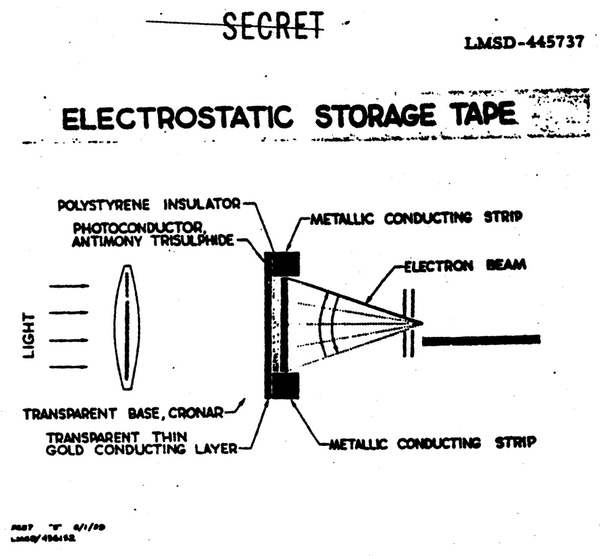 The Samos E-3 would have used a new electrostatic tape system for recording images onto a tape storage medium. The images would then be extracted from that tape and transmitted to the ground. The tape was intended to be reusable. (credit: NRO) |
For the Samos E-3, an image would be recorded on photoelectric-sensitive electrostatic tape. It would then be read out “by deflecting the modulation of an electron beam to scan a portion of the tape, and the view signal amplified and then applied as a modulating signal for transmission to ground stations.” Using a transmission system with a bandwidth of 12 megacycles per second—which would require new tubes to be developed—the system could achieve a readout time of 8.7 seconds per frame. On the ground, the images would then be read on to film for the best possible reproduction.
 Images taken by a Samos E-3 satellite in space would be transmitted to the ground and then directly read-onto film. Film was a storage medium capable of holding a tremendous amount of data. (credit: NRO) |
One of the limitations of the Samos E-2 was that the film supply was finite: once it was used up, the satellite could no longer operate. In contrast, the Samos E-3’s electrostatic storage tape could be reused. This, combined with a higher orbit, meant that the Samos E-3 satellite could operate for a year in space.
The goals for the E-3 Visual Reconnaissance System were:
- Active life of approximately one year.
- Ground resolution of five feet, or 2.5 feet (0.75 meters) with a power changer [unexplained].
- Optics of 144 inches (366 centimeters) effective focal length, with F/4.5 optics.
- Sensor electrostatic storage tape, which would be 60 feet (18 meters) long and reusable.
- Readout would be an electron beam directly from tape.
- Ground reconstruction would be an electron beam film recorder operating in vertical, oblique, and stereo modes.
The Samos E-3 satellite would operate in a nominally circular orbit at an altitude of 483 kilometers (300 miles). This was a tradeoff. It would be easier to achieve higher resolution in a lower orbit. But a lower orbit would have greater atmospheric drag, decreasing the satellite’s lifetime. The 483-kilometer orbit therefore required a more powerful optical system because the satellite was farther from the targets it was photographing. Samos E-3’s proponents expected that having an all-electronic visual reconnaissance equipment would also maximize optical resolution.
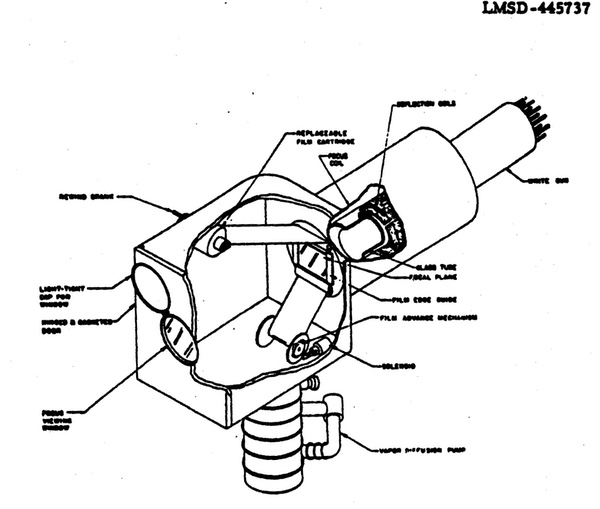
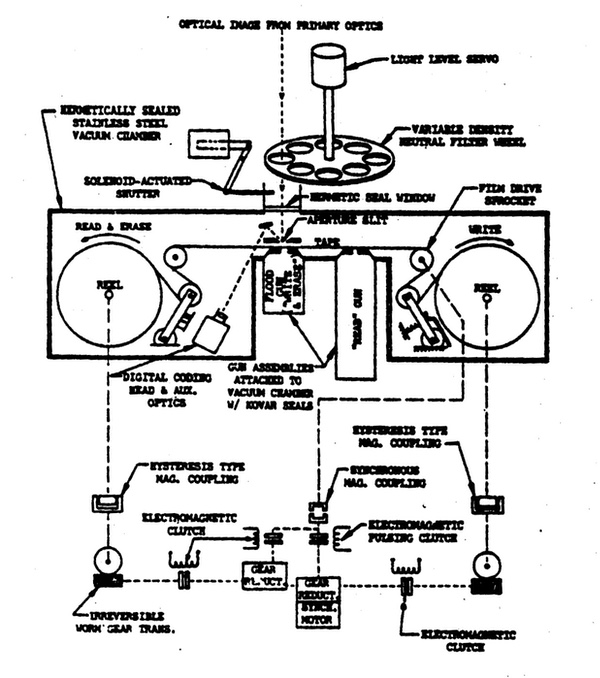 A schematic showing the Samos E-3's camera system. Lockheed's illustrations omitted the optics that would focus the image onto the storage medium. Lockheed referred to this as an "all electronic" design because it did not require the film and chemicals used for the E-1/E-2 film-readout technnology. (credit: NRO) |
As a satellite moves over the Earth, the image inside its camera system also moves. Reconnaissance satellites required some method of compensating for the image motion inside the camera. For the Samos E-3, the exposure period would be only one millisecond, which would hopefully simplify the vehicle attitude control and the camera image-motion compensation.
According to Lockheed, the approach provided a very high degree of flexibility in operational use and performance capability. “The system provides a very high resolution capability and, through the use of the reusable image storage medium, permits a payload design of minimum size and weight.”
“Breadboard designs of this camera have already been built and tested by Radio Corporation of America, Astro-electronic Products Division.” Lockheed claimed that they determined that it was “technically feasible.” The proposal contains no discussion of the payload optics other than the bare basics.
| The Samos E-3 was the ultimate liminal system, caught between two worlds: the readout technology that was fading due to its limitations and the film-return technology that would dominate US satellite reconnaissance for the next two decades. |
The available technical schematics for the proposed satellite payload are simple and difficult to read due to poor reproduction. The “primary optics” that would have gathered light and sent it to the electrostatic tape camera are not described. The overall proposal reads like the kind of reconnaissance payload one would expect from a spacecraft designer rather than a camera designer: for instance, Lockheed lists the focal length as 44 inches (112 centimeters) in one part of a document and 144 inches in another part. That was one of the problems that plagued the Samos program, particularly the E-5 which had a camera that was compromised from the start. In contrast, CIA-led reconnaissance programs like the CORONA tended to maximize camera performance over other criteria.
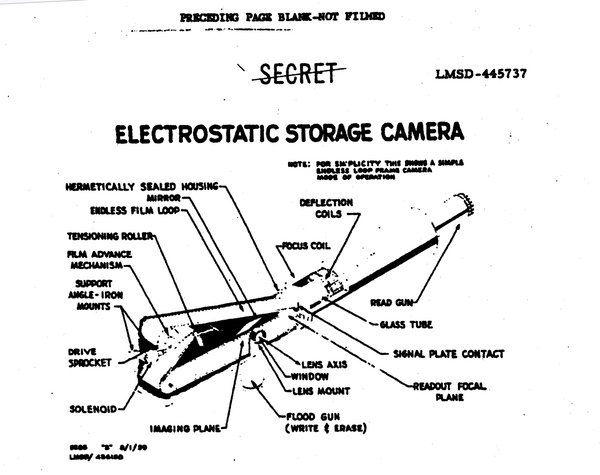 The system for converting the images to stored data in the E-3 camera. Unfortunately, the source documents are blurry and not high quality, making some of the labels difficult to read.(credit: NRO) |
A short life, a quick death
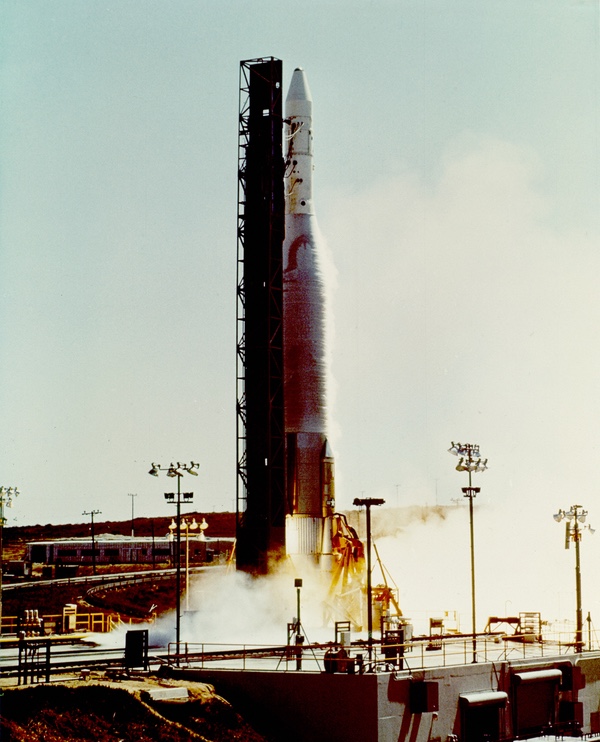
The Samos E-3 would have used the same Atlas rocket that was used for the E-1, E-2, E-5, and E-6. The Air Force’s view was that the Atlas was available, and capable. But Atlas was not cheap, which is why both CORONA and later signals intelligence satellites used the less expensive Thor instead.
In December 1959, the Air Force approved the recoverable Samos E-5 to satisfy the five-foot ground resolution requirement and ordered Lockheed to cancel any work on the Samos E-3. ARPA had annoyed the military services with its overall management of military space programs and was removed from having any control over Samos by the middle of 1960.
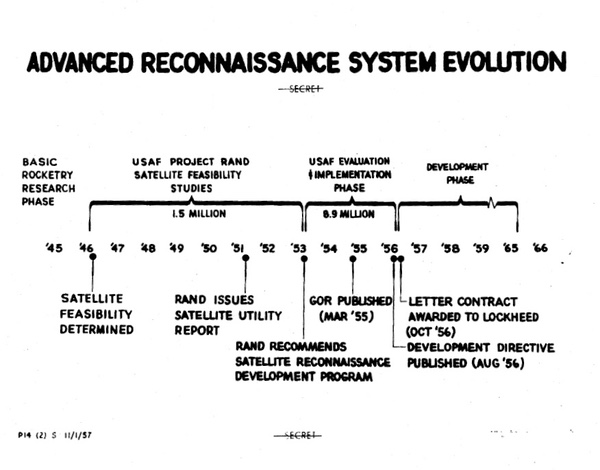 A general early timeline for the American reconnaissance satellite program. Although a major contract was awarded to Lockheed in 1956, it was not until after the October 1957 Sputnik launch that the program began to receive the necessary funding to proceed. (credit: NRO) |
The first Samos E-1 launched in October 1960 but failed to reach orbit. The second launched in January 1961 and had limited success. A Samos E-2 blew up on its launch pad in September 1961, putting an end to the film-readout program. Three Samos E-5s and five Samos E-6s were launched between November 1961 and November 1962, and all suffered various launch, operational, or recovery failures. But Samos E-3 never even got that far, being canceled while still in the laboratory stage, and quickly forgotten.
Sources
HEXAGON Mapping Camera History, National Reconnaissance Office, June 1979, pp. 43-44.
LMSD Satellite Systems Briefing Part II, The SAMOS Program, September 14, 1959.
Note: we are now moderating comments. There will be a delay in posting comments and no guarantee that all submitted comments will be posted.