Beyond the spacecraft: how space exploration became a design languageby Syed Hasan
|
| Technologies developed to operate in space influence the way people imagine the future, while that cultural image of the future subsequently influences the products and designs created here on our planet. |
I have spent more than two decades working in the space program, and that experience has given me a somewhat unusual perspective on this relationship. I am currently employed by KBR as a contractor supporting NASA. From 2004 through 2014, I worked at NASA’s Goddard Space Flight Center in the Flight Dynamics Facility, where I served in lead roles supporting human spaceflight, expendable launch vehicle support, and spaceflight trajectory analysis. Since 2014, I have worked as a lead satellite collision avoidance engineer supporting NASA’s Earth Science Mission Operations fleet. Across those positions, my work has required me to understand spacecraft not simply as objects in orbit, but as integrated systems operating within a demanding physical environment.
That perspective has made me increasingly interested in what happens after the engineering problem has been solved and the spacecraft becomes an image. The public does not necessarily see the equations, subsystem constraints, thermal requirements, orbital mechanics, or operational considerations behind a spacecraft. Instead, people see the finished object and its operation. They see the shape of a spacecraft, the reflective surface of a thermal blanket, the visor of an astronaut, or the silhouette of a launch vehicle against the sky. Over time, those images become cultural references, and eventually designers begin incorporating the visual vocabulary of space exploration into products that have nothing to do with spaceflight.
The result is a feedback loop between engineering and culture. Technologies developed to operate in space influence the way people imagine the future, while that cultural image of the future subsequently influences the products and designs created here on our planet.
Spacecraft are unusual objects because nearly every aspect of their design is constrained by an engineering requirement. Mass matters because getting anything into orbit requires enormous amounts of energy. Thermal behavior matters because spacecraft can transition between sunlight and darkness while operating in an environment where heat transfer occurs differently than it does on Earth. Radiation, structural loads, power generation, communications, guidance, navigation, propulsion, reliability, and maintainability all affect how a spacecraft is designed and operated.
Consequently, many features that appear futuristic to the public are simply visible consequences of engineering decisions. The aesthetic began as a solution to a problem. Reflective materials provide a good example. Spacecraft use specialized materials and coatings to manage the absorption and emission of energy, helping maintain temperatures within the limits required by spacecraft systems. Multilayer insulation, reflective surfaces, and optical coatings are all familiar parts of spacecraft thermal-control engineering.
To an engineer, a reflective surface can therefore represent a thermal-control solution. To a photographer looking at a spacecraft against the blackness of space, however, that same surface becomes part of an immediately recognizable visual identity. The engineering solution becomes an image, and the image eventually becomes part of popular culture, mostly because space engineering represents one of the highest levels of technological achievement.
The spacesuit example
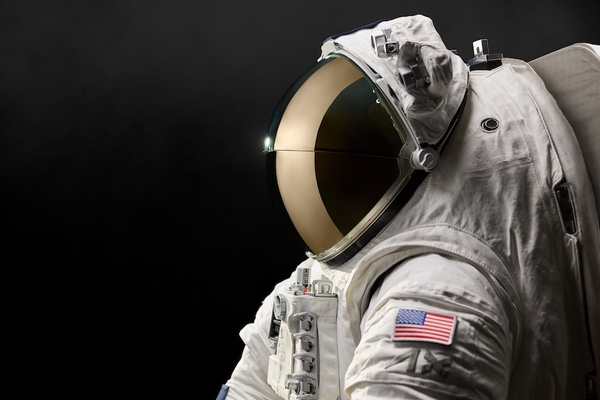
This transformation from engineering solution to cultural symbol has happened repeatedly throughout the history of spaceflight. Perhaps the clearest example is the spacesuit. A spacesuit is fundamentally an environmental-control and life-support system designed around the human body. It must provide pressure, thermal protection, mobility, communications, and protection from the surrounding environment while allowing an astronaut to perform complex tasks. The spacesuit can effectively be considered a personal spacecraft, and its development has involved continuous tradeoffs among protection, mobility, visibility, weight, and reliability.
Yet the spacesuit has also become one of the most influential fashion images associated with the Space Age. The reason for this is relatively simple. Unlike a spacecraft, the spacesuit is designed around a person. It is therefore already halfway between industrial equipment and clothing. When the Apollo astronauts appeared on television and in photographs, millions of people saw human beings wearing equipment that looked unlike anything previously associated with ordinary clothing, and they were struck by the style.
| A designer does not need to reproduce a spacecraft component to be influenced by spacecraft. The designer can instead borrow the visual language created by aerospace engineering and reinterpret it for a completely different purpose. |
The helmet and visor were particularly important. The visor provided protection and visibility in an environment where the unprotected human eye could not simply function as it does on Earth. Some astronaut visors have incorporated specialized coatings, including gold, to help manage solar radiation. To the engineer, the coating is functional. To the public, the gold visor became an icon.
That distinction helps explain why reflective visors continue to appear in fashion and industrial design decades after the Apollo era. The cultural meaning of the visor has expanded beyond its original technical purpose. It now communicates ideas of exploration, technology, protection, and the future even when it is attached to an object that never leaves our planet’s atmosphere.
The Apollo program was particularly influential because it arrived during a period when designers were already fascinated by new materials, modern manufacturing, automation, and the possibilities of technology. The Space Age gave those trends a powerful visual impact.
The public saw spacecraft constructed from materials and shapes that had previously existed primarily in engineering environments. They saw astronauts wearing highly technical garments, launch vehicles with immense geometric structures, and photographs of Earth taken from beyond the atmosphere. Spaceflight provided a tangible representation of technological progress.
Fashion responded to that imagery. The influence did not always involve directly copying spacecraft. Instead, designers adopted characteristics associated with aerospace, such as metallic finishes, reflective surfaces, streamlined forms, synthetic materials, geometric construction, and a preference for functionality that could be expressed visually.
This is an important distinction. Cultural influence does not require technological duplication. A designer does not need to reproduce a spacecraft component to be influenced by spacecraft. The designer can instead borrow the visual language created by aerospace engineering and reinterpret it for a completely different purpose.
That process is common throughout industrial design. Automotive designers have borrowed aerodynamic ideas from aviation. Architecture has incorporated structural forms associated with aerospace. Consumer electronics have adopted the visual language of precision engineering. Clothing has incorporated technical materials originally associated with industrial applications. Space exploration fits naturally into this history because it represents perhaps the most concentrated expression of engineering ambition in the modern era.
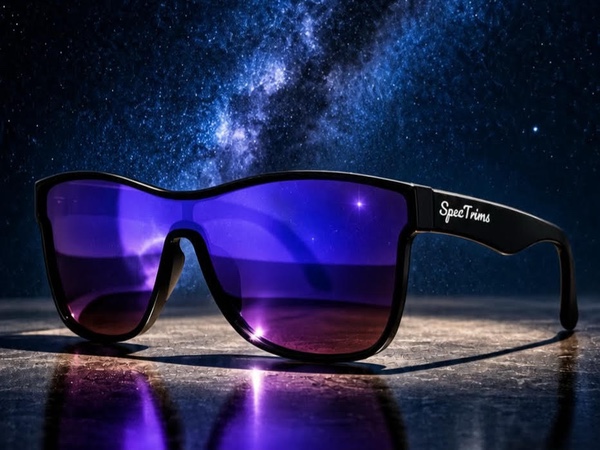 SpecTrims sunglasses with space-related design features. (credit: SpecTrims) |
Influence on eyewear
Eyewear occupies an interesting position within this design history because sunglasses already combine fashion and function. A pair of sunglasses is simultaneously a consumer accessory and a device intended to interact with sunlight and protect the eyes. The lens has a functional purpose, while the frame and overall shape communicate style and identity. That makes eyewear unusually receptive to the visual vocabulary of aerospace.
The relationship becomes especially apparent with continuous shield designs. Traditional sunglasses generally divide the optical field into two separate lenses connected by a bridge. A shield design instead creates a broad, continuous visual surface across the face. The result naturally recalls the visor of a helmet, even though the two products are obviously engineered for completely different purposes.
The connection is therefore cultural rather than technological. A pair of shield sunglasses do not become aerospace hardware simply because they resemble a visor. Rather, they borrow an established visual association. The shape suggests protection, technology, and the future, while reflective finishes reinforce the connection to the mirrored surfaces that have become so familiar in images of spacecraft and astronauts.
This makes eyewear an unusually effective medium for translating the space aesthetic into an everyday object. Unlike a spacecraft displayed in a museum or an illustration of a planet hanging on a wall, eyewear is worn. The person becomes part of the design.
My interest in this relationship eventually led me to explore the concept through my own independent eyewear company, SpecTrims. I recently developed a small space-inspired collection that uses celestial bodies and the visual language associated with space exploration as design references. The collection can be viewed at spectrims.com/space.
The collection currently consists of six designs: Galaxy, Mars, Neptune, Terra, Luna, and Sol. Each uses the same general category of product, a continuous-shield sunglass, but interprets the celestial reference differently through color, lens finish, and geometry. The intent was not to reproduce spacecraft or claim that the products are aerospace equipment. Instead, the designs explore how a familiar set of space-related visual cues can be translated into a contemporary consumer product.
| That difference is part of what makes aerospace design so culturally powerful. The objects look purposeful because they are. |
Galaxy uses a purple mirrored lens and a broad shield silhouette that references the deep-space imagery familiar from astronomy and space exploration. Mars uses a red mirrored treatment, drawing on the distinctive visual identity of the planet that has occupied such a prominent place in human exploration plans and popular culture. Neptune takes a blue planet approach, while Terra uses the concept of Earth’s greenery itself as the reference point rather than an extraterrestrial destination. Luna draws on the silver-gray appearance associated with the Moon, and Sol uses striking gold as a visual reference to the Sun and to the solar reflective materials that have become strongly associated with space hardware and astronaut visors.
What interests me most about the feedback I have received regarding the collection is how little information is necessary to establish the connection with space. A color, a reflective surface, a particular silhouette, and a name can be enough to evoke decades of imagery associated with spaceflight. That is the power of space design language. Once a visual vocabulary becomes sufficiently established, people no longer need an explanation for every reference.
The cultural power of aerospace design
My professional experience has also changed the way I interpret that aesthetic. During my first decade working at Goddard’s Flight Dynamics Facility, my work required thinking about spacecraft and launch vehicles in terms of trajectories, operational constraints, mission objectives, and the physical realities of getting a vehicle from one point to another. My work for the last 12 years, however, has focused on satellite collision avoidance and operations, and that role has required an even broader understanding of spacecraft because collision-avoidance decisions cannot be made by considering orbital trajectories alone. Understanding the spacecraft involved requires familiarity with their operational characteristics, maneuver capabilities, configuration, and the broader systems that allow them to perform their missions.
Over the course of this career, I have had to learn about spacecraft subsystems and the space environment in which those systems operate. That experience makes it difficult for me to look at a spacecraft purely as an aesthetic object. A solar array is not simply an interesting geometric feature, but rather it is part of a spacecraft power system. A reflective surface is not simply visually striking, as it may have a thermal purpose. A particular spacecraft configuration can reflect constraints imposed by launch, communications, power, thermal control, attitude determination and control, propulsion, or mission operations.
The public sees the result. Engineers see the chain of decisions that produced it. That difference is part of what makes aerospace design so culturally powerful. The objects look purposeful because they are. Their appearance is often inseparable from the constraints that produced them.
Another recurring characteristic of space-inspired design is the visual suggestion of protection. This makes sense because spacecraft are designed around the problem of surviving an environment that is fundamentally different from Earth’s surface. Astronauts require pressure and thermal protection. Spacecraft require protection from radiation, temperature extremes, micrometeoroids and orbital debris, and numerous other environmental hazards depending on their mission and location.
Consumer products obviously face much less extreme conditions, but designers frequently borrow the visual language associated with protection. Wraparound eyewear suggests a larger field of coverage. The consumer does not necessarily know what engineering problem inspired a particular shape, but the design simply communicates an impression that this object has been engineered for a purpose. That impression is closely related to the cultural image of spacecraft.
Space as a cultural representation of the future
There is also a deeper reason that space continues to influence design. Space exploration has become one of the strongest cultural representations of the future. Every generation has its own version of that future. For one generation, it was Apollo and the promise that humans would walk on the Moon. For another, it was the Space Shuttle and the idea of reusable spacecraft. For another, it has been the International Space Station, robotic exploration of Mars, images from the James Webb Space Telescope, and the development of increasingly capable commercial launch systems.
The hardware changes, but the cultural association remains. Space represents a place where familiar limitations are challenged. That makes it particularly attractive to designers who want an object to communicate progress, technical sophistication, or a departure from conventional forms.
| The space program did not simply produce machines. It produced images, ideas, and expectations about the future. |
This also explains why the influence of space can persist even when the original technology is no longer new. The Apollo spacecraft are more than half a century old, yet the visual language associated with Apollo remains recognizable. The same is true of astronaut visors, launch vehicles, mission patches, spacecraft silhouettes, and planetary imagery.
The technology may age, but the symbolism does not necessarily age with it. The relationship between space exploration and design therefore moves in both directions. Spaceflight creates new technologies and images. Those images enter popular culture, where designers reinterpret them. The resulting consumer products, clothing, architecture, films, and artwork then reinforce the public’s visual understanding of what space and the future are supposed to look like.
The same basic process applies more broadly to space imagery itself. An astronaut’s visor may have originated as a technical solution to a problem involving visibility and environmental protection, but after decades of photographs and television coverage, the visor has acquired an independent cultural meaning. Once that happens, a designer can reference the visor without expecting the consumer to understand its engineering history. The reference works because the cultural association already exists.
It may seem insignificant to consider the influence of space exploration on something as ordinary as sunglasses when compared with the scientific and technological accomplishments of the space program. Satellites provide communications and Earth observations, robotic spacecraft explore other worlds, and human spaceflight has expanded our understanding of what people can accomplish beyond Earth.
But cultural influence is part of the legacy of exploration as well. The space program did not simply produce machines. It produced images, ideas, and expectations about the future. Those ideas have become embedded in everyday life in ways that can be difficult to trace back to a specific mission.
A reflective surface on a consumer product may have no direct technological relationship to a spacecraft, yet the reason that reflective surface can communicate “space age” to a consumer is connected to decades of aerospace imagery. A shield-shaped pair of SpecTrims sunglasses may have no functional relationship to an astronaut’s helmet, but the reason the shape can suggest exploration and technology is partly because the public has learned to associate broad reflective visors with human spaceflight. The influence is therefore not necessarily a transfer of technology. It is a transfer of meaning.
After more than two decades of working with spacecraft and spaceflight operations, I find that aspect of the space program very interesting. Much of aerospace engineering is necessarily focused on highly specific technical problems, such as how to control a spacecraft, how to protect it from its environment, how to navigate it, how to communicate with it, how to maintain it, and how to operate it safely.
Yet the finished spacecraft inevitably becomes something more than an engineering solution once people see it. It becomes an image of possibility. That image can travel surprisingly far from the launch pad. It can appear in fashion, industrial design, architecture, transportation, entertainment, and consumer products. Sometimes the connection is explicit and other times it is so subtle that the original source is almost invisible.
Eyewear happens to provide this example clearly because the relationship between vision, protection, reflective surfaces, and the human face makes the analogy to the astronaut visor almost immediate. My own Space Collection is simply one small attempt to explore that relationship from the perspective of someone who has spent his career working with the real systems behind the imagery.
The larger story, however, is not about sunglasses. It is about what happens when engineering becomes culture. Space exploration has given humanity new technologies and new scientific knowledge, but it has also changed our visual vocabulary. The shapes and materials developed to help machines and people survive beyond Earth have become symbols of modernity and exploration. The astronaut’s visor, the reflective spacecraft surface, the streamlined vehicle, and the technical garment all communicate ideas that extend well beyond their original functions.
In that sense, the Space Age did not remain in space. It returned to Earth with us, embedded not only in the technology we use, but in the way we design and imagine the objects around us.
The next time a product looks futuristic, it may be worth asking why. Sometimes the answer is not that the designer invented a new vision of the future, but rather the past has already taught us what it should look like.
Note: we are now moderating comments. There will be a delay in posting comments and no guarantee that all submitted comments will be posted.