From debris mitigation to orbital sustainabilityThe next stage of space governanceby Graham Turnock
|
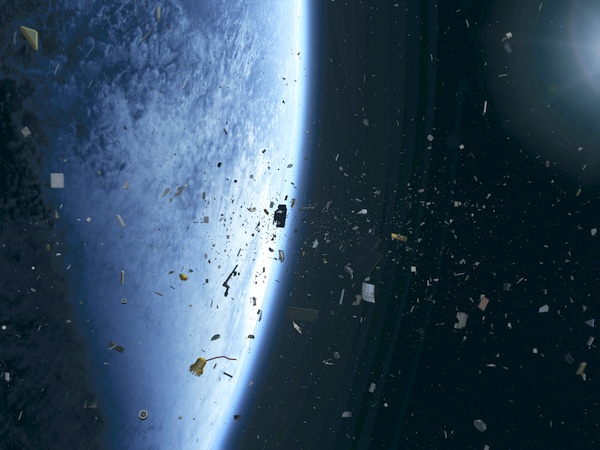
| Debris mitigation is improving, but the orbital environment is continuing to deteriorate. |
That model has achieved a great deal. Debris mitigation is now an accepted element of responsible space activity. Standards for post-mission disposal, passivation, and collision avoidance have become progressively more demanding. National regulators increasingly expect satellite operators to demonstrate how they will limit debris generation and dispose of spacecraft after their missions.
Yet there is an uncomfortable paradox at the center of the system: debris mitigation is improving, but the orbital environment is continuing to deteriorate.
The European Space Agency’s 2025 Space Environment Report concludes that adherence to mitigation standards is slowly improving, particularly in the commercial sector, but that this is not sufficient to halt growth in the debris population. More fundamentally, ESA concludes that even if no further spacecraft were launched, collisions and fragmentations among objects already in orbit would cause the debris population to continue growing.
The Inter-Agency Space Debris Coordination Committee, or IADC, has reached a similarly troubling conclusion. Its 2026 Report on the Status of the Space Debris Environment examines the long-term evolution of the debris environment under scenarios including a continuation of current launch traffic, fragmentation and disposal behavior, as well as a hypothetical no-further-launches case. The results reinforce a central point: improved mitigation remains essential, but the future condition of the orbital environment cannot be understood solely through the behavior of future missions.
This is not an argument that mitigation has failed. On the contrary, the standards have tightened significantly, and that progress deserves recognition. The problem is that the orbital environment has changed faster than the governance system designed to protect it.
The next stage of space debris governance therefore cannot simply consist of persuading more operators to comply with existing standards. The international community increasingly needs to ask a different question: what constitutes a sustainable orbital environment, and how should regulation be adjusted over time to keep us within it?
Answering that question requires a shift from governing individual spacecraft towards governing the orbital environment as a system.
A governance system built around mitigation
The present international framework emerged largely through the work of the IADC. Its members are national and multinational space agencies and other governmental bodies, and its principal purpose is technical cooperation on space debris.
Since 2002, the IADC has developed and periodically revised technical guidelines intended to limit the creation of orbital debris. These address issues including objects released during normal operations, on-orbit break-ups, collision avoidance and post-mission disposal.
| The governance challenge has evolved from preventing unnecessary debris creation to managing the cumulative environmental consequences of intensive orbital activity. |
The IADC’s work provided the technical foundation for the Space Debris Mitigation Guidelines adopted by the UN Committee on the Peaceful Uses of Outer Space, or COPUOS, in 2007. COPUOS subsequently broadened its approach, adopting 21 Guidelines for the Long-Term Sustainability of Outer Space Activities in 2019.
The result is an unusual but broadly coherent governance structure. Technical norms are developed through international cooperation and COPUOS provides wider political legitimacy, but implementation occurs primarily through national regulation.
That architecture reflects the underlying legal structure of outer space. Article VI of the Outer Space Treaty makes states internationally responsible for national space activities and requires the activities of non-governmental entities to be authorized and continually supervised by the appropriate state.
There is consequently no international space regulator equivalent to a national aviation or telecommunications authority. Internationally agreed principles and guidelines are instead translated into national licensing and regulatory requirements.
The number of objects placed into orbit has increased rapidly. The growth of large satellite constellations has transformed activity in low Earth orbit, particularly in the altitude bands used for Earth observation, communications, and broadband services. ESA now estimates based on data collected to the end of 2024 that around 40,000 objects are tracked in Earth orbit, including approximately 11,000 active payloads, while the estimated population of debris larger than one centimeter exceeds one million objects.
The result is a progressively more crowded and operationally demanding environment. Collision-avoidance maneuvers are becoming more frequent. Operators must increasingly respond to conjunction warnings involving objects whose trajectories are uncertain or whose future behavior is difficult to predict. A single fragmentation event can create thousands of trackable objects and many more smaller fragments, imposing risks on every other operator using the same orbital region.
The governance challenge has therefore evolved from preventing unnecessary debris creation towards managing the cumulative environmental consequences of intensive orbital activity.
Progress has been real—and standards have tightened
The international community has progressively strengthened its expectations. The original IADC guidelines and the 2007 COPUOS mitigation guidelines established a baseline for responsible behavior. The 2019 Long-Term Sustainability Guidelines broadened the focus to include issues such as space-weather information, conjunction assessment, registration, information sharing and the safety of operations throughout the life cycle of a mission.
The United States Federal Communications Commission adopted a five-year post-mission disposal rule in 2022 for space stations ending their missions in, or passing through, low Earth orbit below 2,000 kilometers and planning disposal through uncontrolled atmospheric reentry. The United Kingdom’s licensing framework has incorporated debris-mitigation expectations and requires operators to address end-of-life disposal and collision risk. France has applied debris-related requirements through its national space-operations legislation. Other states and regional institutions have developed their own licensing standards, technical guidance and supervisory practices.
The standards themselves have also become more ambitious. For large constellations, the relevant objective is no longer simply that most spacecraft should be removed from orbit. Recent technical work has increasingly focused on disposal success rates approaching 99%.
| A regulatory regime can achieve high compliance with its rules while still failing to achieve its underlying environmental objective if those rules are inadequate. |
That ambition reflects the mathematics of large constellations. A 90% disposal success rate may sound high, but applied to a constellation of several thousand spacecraft it could still leave hundreds of objects in orbit at the end of their missions. A 99% success rate would still leave some failures, but it would substantially reduce the number of large objects remaining in the environment.
The tightening of the standard is therefore rational and necessary. It demonstrates that the technical community has recognized that requirements developed for a smaller and less crowded orbital environment cannot simply be applied unchanged to modern constellations.
But it also reveals the limits of a mitigation-centered approach. If the environment continues to deteriorate despite progressively stricter recommendations, the question is not only whether operators are complying. It is whether the standards are sufficiently ambitious, sufficiently comprehensive, and sufficiently responsive to changing conditions.
Compliance is only half the problem
If operators reliably passivate spacecraft and remove them from congested orbital regions after completing their missions, debris generation can be substantially reduced. Conversely, poor disposal performance leaves large intact objects in orbit where they may subsequently collide or fragment.
But there is a second question that may ultimately be more important: are the standards themselves sufficient to achieve a sustainable orbital environment?
A regulatory regime can achieve high compliance with its rules while still failing to achieve its underlying environmental objective if those rules are inadequate.
The IADC’s latest assessment reinforces this concern. Its 2026 Report on the Status of the Space Debris Environment models the future evolution of objects larger than ten centimeters under both a continuation of current behavior—including present launch traffic, fragmentation rates, and disposal performance—and a hypothetical scenario in which no further launches occur. The results underline that improved mitigation remains essential, but that the long-term condition of the orbital environment cannot be understood solely through compliance by future missions.
ESA’s modelling illustrates this through its projections of collision activity. Under a continuation of current behavior, the number of collisions is expected to increase over time as the population of large objects grows. The increase is not simply a matter of more conjunction warnings. Collisions generate new fragments, which in turn increase the probability of further collisions. This is the mechanism behind the possibility of a self-sustaining debris-growth process.
This is why the 99% ambition for constellation disposal is so important—but also why it cannot be the whole answer. A 99% success rate would sharply reduce the number of new large objects left behind by future missions. It would not remove the legacy population, prevent every fragmentation event or eliminate the collision risk created by objects already in orbit.
The implication is not that mitigation is pointless. It is that mitigation needs to sit within a broader approach that also considers improved tracking and coordination, spacecraft design, remediation of legacy debris and other measures directed at the condition of the environment as a whole.
ESA has taken this thinking a stage further. In 2025 it introduced a Space Environment Health Index designed to quantify how present behavior affects the future orbital environment. Associated with it is an “orbital sustainability threshold”—an attempt to distinguish potentially manageable environmental risk from an unsustainable trajectory.
| Space governance needs mechanisms capable of reinforcing international standards beyond the immediate relationship between an operator and its licensing state. |
ESA’s analysis indicates that continuation of current behavior would take the orbital environment well beyond this threshold. This represents an important conceptual development. It changes the central question from: “Are individual operators complying with debris-mitigation rules?” to: “Are the combined activities of all operators producing a sustainable orbital environment?”
But an ESA sustainability threshold is not an internationally agreed sustainability threshold. COPUOS has adopted the long-term sustainability of outer space activities as a broad policy objective and remains the principal international forum for dialogue on the implementation and review of its sustainability guidelines. What it has not done is establish an internationally agreed quantitative definition of a sustainable orbital environment against which collective performance can be assessed.
Nor does the current system yet provide a sufficiently strong institutional feedback loop through which changes in the measured condition of the orbital environment systematically result in reassessment of internationally recommended mitigation standards.
Lessons from the high seas
Both contain areas beyond national sovereignty in which states nevertheless retain important responsibilities for activities conducted under their jurisdiction. Maritime governance has consequently developed around flag-state responsibility, internationally agreed standards, and national implementation.
Flag-state regulation is supplemented by international monitoring, liability regimes and, importantly, port-state control. A foreign ship entering a national port can be inspected for compliance with applicable international standards.
The International Maritime Organization describes port-state control as a “second line of defense” against substandard shipping: primary responsibility remains with the flag state, but other states can use access to their ports as an additional means of enforcing agreed standards.
A purely jurisdictional system creates the possibility of regulatory arbitrage. If the regulatory burden imposed by one licensing state becomes substantially greater than that imposed by another, operators may have incentives to seek more permissive jurisdictions.
Space governance therefore needs mechanisms capable of reinforcing international standards beyond the immediate relationship between an operator and its licensing state.
Access to national markets and ground infrastructure offers one possible analogue to port-state control. States can condition access to earth stations and other domestic facilities on compliance with recognized debris-mitigation requirements.
Lessons from spectrum management
The radio spectrum is a finite shared resource in which the actions of one user can impose substantial externalities on others through harmful interference. International management is centered on the International Telecommunication Union and its Radio Regulations, a binding international treaty governing use of radio-frequency spectrum and satellite orbit resources.
Implementation, however, remains substantially national. ITU member states license satellite systems and are responsible for ensuring that their operators comply with the international rules as well as domestic requirements.
The FCC’s 2020 Orbital Debris Mitigation Report and Order provides a useful example. It comprehensively updated the Commission’s debris rules and established requirements applicable to both US-licensed systems and foreign-licensed systems seeking US market access. For foreign systems, the rules allow an applicant to demonstrate that its debris-mitigation plan is subject to “direct and effective regulatory oversight” by its home regulator. In its 2024 Order on Reconsideration, the FCC clarified that this does not amount to automatic recognition: Commission staff may examine the foreign regulatory regime and the Commission may impose additional conditions where necessary for space safety.
The analogy should not be pushed too far. The ITU’s mandate concerns radiocommunications and associated orbital resources, not environmental regulation of physical objects in space.
The lesson is therefore not that debris governance should simply be transferred to the ITU. It is that access to valuable national markets and infrastructure can provide leverage for enforcing internationally recognized standards even in the absence of a supranational regulator.
COPUOS could encourage wider use of this approach through recommended regulatory practices accompanying its existing Long-Term Sustainability Guidelines.
Lessons from climate governance
Orbital debris and greenhouse gases share a fundamental collective-action problem. Individual actors receive most of the benefits from their own activities while bearing only part of the long-term environmental costs.
Both problems are also cumulative. The important question is not simply whether one emission—or one abandoned spacecraft—causes identifiable harm. It is whether the accumulated activity of many actors pushes the shared environment towards an undesirable state.
| In the present geopolitical environment, agreement on an ambitious new treaty governing orbital sustainability would be extremely difficult. A more realistic approach would be to strengthen progressively the institutions and regulatory mechanisms that already exist. |
The Paris climate regime has developed institutional mechanisms specifically intended to address this problem. States report information under an enhanced transparency framework, submitted information is subject to technical expert review, and a periodic global stocktake assesses collective progress towards agreed objectives.
Climate governance has hardly solved climate change. But its architecture contains a principle that is highly relevant to orbital sustainability: regulatory ambition should be assessed against the measured condition of the shared environment rather than assumed to remain adequate once standards have been adopted.
ESA’s orbital sustainability threshold demonstrates that a comparable environmental indicator is technically conceivable for space. Work within the IADC community on environmental and sustainability metrics likewise points in this direction, but no internationally agreed quantitative sustainability objective has yet emerged. The challenge is therefore not simply to devise a metric, but to connect technical assessment to an internationally legitimate institutional process.
A roadmap for strengthened governance
None of this requires the immediate creation of a new international organization or negotiation of a comprehensive new space treaty. Attempting either at the outset may be counterproductive. In the present geopolitical environment, agreement on an ambitious new treaty governing orbital sustainability would be extremely difficult.
A more realistic approach would be to strengthen progressively the institutions and regulatory mechanisms that already exist. First, COPUOS should move from a general commitment to long-term sustainability towards an explicit objective of maintaining a sustainable orbital environment, defined in measurable terms.
The existing Long-Term Sustainability Guidelines provide the political foundation. The next step should be to determine what success means at the level of the orbital environment.
That objective should not be limited to a single number. It might include indicators for the population of large objects, the rate of fragmentation, collision probability, the number of objects in particularly sensitive orbital regions, and the reliability of post-mission disposal.
The 99% disposal ambition for large constellations could form part of this framework, but it should be treated as a means of achieving environmental sustainability rather than as sustainability itself.
Second, the relationship between COPUOS and the IADC should be strengthened and formalized. The IADC already provides important technical material to COPUOS. But it should be explicitly tasked with advising COPUOS on quantitative indicators of orbital sustainability and periodically assessing whether existing mitigation standards are sufficient to achieve the agreed objective.
That assessment should examine not only compliance with disposal requirements but also whether the requirements remain adequate in light of changing launch rates, constellation sizes, collision statistics, and the condition of the existing debris population.
The important principle is that technical standards should follow from an agreed environmental objective rather than the environmental objective simply being inferred from existing technical standards.
Third, the IADC’s emerging annual environmental-reporting cycle should be institutionalized, made more transparent, and explicitly connected to the review of international mitigation standards.
The 2026 IADC Report on the Status of the Space Debris Environment is the latest iteration of this assessment process, while ESA’s annual Space Environment Report provides a complementary and more detailed public environmental analysis. Together they demonstrate much of what is technically possible.
An international assessment should report both the condition of the orbital environment and the adequacy of existing mitigation metrics. It should include projections under different assumptions, including continued current behavior, improved compliance, very high disposal reliability and no-new-launch scenarios.
Where projected debris levels or collision rates diverge from an agreed sustainable state, the assessment should identify the scale of that divergence and the principal options for closing it.
Institutional independence would also matter. As environmental assessment becomes more consequential for national and commercial activities, consideration should eventually be given to how technical assessment can be insulated from the interests of the agencies whose activities it is assessing.
Fourth, national compliance reporting should progressively be introduced. States should publish aggregate information on compliance by operators under their jurisdiction with internationally recognized debris-mitigation standards.
This should include, where possible, information on post-mission disposal success, the number of spacecraft and rocket bodies remaining in protected orbital regions, failures to comply with disposal plans, and the treatment of fragmentation or loss-of-control events.
This need not require disclosure of sensitive military capabilities or commercially confidential information. The purpose would be to establish whether international standards are actually being implemented and to identify where deficiencies lie.
Initially such reporting could be voluntary and standardized through COPUOS. Over time it could become an expected element of responsible national supervision of space activities.
| The central question in space debris governance should therefore no longer be simply: “Are we mitigating debris?” It should be: “Are we maintaining a sustainable orbital environment—and if not, what must change?” |
Fifth, the evidence underlying international environmental assessment should be as open as practicable. Data and methodologies feeding international assessments should be publicly available except where genuine security or commercial considerations require confidentiality.
Independent researchers should be able, as far as possible, to reproduce, test, and challenge international assessments. This is particularly important because debris projections are sensitive to assumptions. Different models may produce different estimates of collision rates, disposal performance, and long-term population growth. Transparency about those assumptions would make disagreement more productive and help distinguish scientific uncertainty from political reluctance to strengthen standards.
Over time, COPUOS could also consider an independent periodic review of gaps in national monitoring, reporting and verification, borrowing selectively from international environmental governance.
Sixth, states should make greater use of regulatory leverage points. Market access, satellite communications authorization, and access to ground-station infrastructure provide mechanisms through which responsible behavior can be encouraged even when an operator is licensed elsewhere.
The FCC model demonstrates that such leverage is not merely theoretical: market access can reinforce internationally recognized debris standards without replacing the primary responsibility of the licensing state.
COPUOS could develop recommended regulatory practices under which states recognize demonstrably equivalent regulatory regimes while retaining the ability to impose additional requirements where effective oversight cannot be demonstrated.
Over time, groups of states applying comparable requirements could perform a function loosely analogous to regional port-state-control regimes in maritime governance, reducing incentives for the emergence of orbital “flags of convenience”.
Finally, formal international law should consolidate successful practice rather than precede it. If a system of agreed sustainability objectives, technical assessment, national reporting, and coordinated regulatory practice gradually develops, it may eventually be appropriate to put elements of it on a stronger legal footing.
That might ultimately take the form of an international agreement supported by protocols, technical annexes, standards, and recommended practices, together with an appropriately independent technical body responsible for continuing assessment. But a treaty should be the culmination of institutional development, not its starting point.
From spacecraft regulation to environmental governance
The international community has made substantial progress on space debris over the past quarter-century. The IADC helped establish technical consensus around debris mitigation. COPUOS converted much of that consensus into internationally recognized guidelines. National regulators have progressively translated those norms into enforceable requirements. The technical recommendations themselves have tightened, with increasingly demanding expectations for constellation disposal and growing recognition that success rates approaching 99% may be necessary for large fleets.
The problem is that the nature of the challenge is changing faster than the governance system. In a lightly used orbital environment, regulating the behavior of individual spacecraft may have been sufficient. In an environment populated by large constellations and tens of thousands of tracked objects, the cumulative condition of the environment itself increasingly needs to become an object of governance.
That does not mean abandoning debris mitigation. It means placing debris mitigation within a wider system. We need to know what a sustainable orbital environment looks like. We need to measure whether we are achieving it. We need to know whether states and operators are complying with the standards intended to deliver it. We need to understand how current behavior affects future collision rates and debris growth. And when those standards prove insufficient, the institutional system needs to be capable of changing them.
Other global commons regimes suggest that such an evolution is possible. Maritime governance demonstrates the value of layered national and international enforcement. Spectrum governance shows how international coordination and domestic licensing can manage access to a finite shared resource. Climate governance demonstrates both the value and the difficulty of connecting scientific assessment, collective objectives, transparency and progressively stronger national action.
None provides a blueprint for space. But together they point towards a plausible next stage. The central question in space debris governance should therefore no longer be simply: “Are we mitigating debris?” It should be: “Are we maintaining a sustainable orbital environment—and if not, what must change?”
The institutions needed to begin answering that question largely already exist. The challenge is to give them the mandate, information and regulatory mechanisms to do so.
Note: we are now moderating comments. There will be a delay in posting comments and no guarantee that all submitted comments will be posted.