The tragedy of the orbital commons: Megaconstellations, space weapons, and debrisby Alexander William Salter
|
| I treated cluttered orbits as a common-pool resource problem and worked through why neither markets nor governments had solved it. Time has only made the difficulties more acute. |
In a footnote I wrote that militaries can destroy spacecraft, but that the reputational cost was high enough that the scenario “can safely be ignored in most circumstances.” Five years later Russia blew up one of its own satellites at 485 kilometers, scattering more than 1,500 trackable fragments and sending the space station crew into their capsules for two hours. The United States responded in 2022 with a unilateral pledge never to conduct destructive anti-satellite missile tests, and 155 countries voted at the UN to follow suit. China and Russia voted no. Now we have acknowledged weapons in orbit too.
Time has only made the difficulties more acute. When I wrote, about 1,400 working satellites orbited Earth. Today roughly 15,900 do. SpaceX’s Starlink alone accounts for about 11,000 of them. Last year 4,492 spacecraft reached orbit, up 62% from 2024.
I want to revisit the paper’s argument, update the figures, and say where the analysis needs to go next.
The problem
NASA defines space debris as all human-made objects in orbit that no longer serve a useful purpose: spent upper stages, slag from solid rocket motors, dead satellites, and the fragments produced when any of those collide or explode. The danger is velocity. Objects in low Earth orbit (LEO) move at seven to eight kilometers per second, so even a small piece can destroy a satellite.
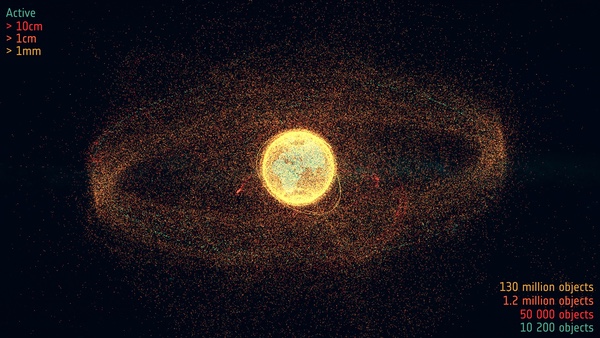
Various space organizations have tried to estimate the number of debris pieces too small to track. For example, the European Space Agency estimates there are about 68,000 objects larger than ten centimeters, 1.5 million between one and ten centimeters, and 230 million smaller than that, totaling more than 17,000 metric tons.
Some space debris is large enough to track. Surveillance networks give us reliable data about approximately 47,000 of them. The hardest category to deal with is in the middle, between one and ten centimeters in size: too small to track but large enough to ruin your day in the event of a collision.
Two events account for a high fraction of debris. In January 2007 China destroyed its Fengyun-1C weather satellite in an anti-satellite test, producing 3,534 catalogued fragments, of which about 2,300 remain in orbit. That’s close to a fifth of all catalogued debris objects circling Earth. In February 2009 a dead Russian military satellite collided with an operating Iridium communications satellite. Russia’s 2021 anti-satellite test made things worse still.
Atmospheric drag eventually pulls debris down. Within 200 kilometers of the surface that takes days; at 800 kilometers, near the peak of the debris population, centuries; in geosynchronous orbit, essentially forever. And those rates assume nothing new is added. The nightmare scenario, called the Kessler syndrome (after the NASA scientist Donald Kessler who described it in 1978), is a chain reaction in which collisions create debris and debris causes collisions until wide swaths of orbit become unusable.
An economic typology
Let’s dig into the economics. Many writers on space debris call orbit a public good. Economists mean something specific by that. Goods are classified by whether they are rivalrous, meaning one person’s use precludes another’s use of the good, and whether they are excludable, meaning it is feasible to prevent nonpayers from using the good. A good that is both rivalrous and excludable is a private good. Markets supply these just fine.
| When nobody can prevent others from enjoying a resource, nobody has an incentive to steward it. Nobody economizes on launches, and nobody bears the cost of the clutter they leave behind. |
The two goods relevant here are not private goods. Access to orbit, the ability to get a spacecraft from the pad to its intended trajectory, is nonrivalrous and nonexcludable. One party’s launch doesn’t prevent another’s, and it’s costly to prevent others from launching. That is a public good. Particular orbits are nonexcludable for similar reasons, but once a spacecraft occupies a given orbit, another cannot occupy the same space at the same time. In the crowded LEO shells, orbits are rivalrous. The combination of nonexcludability and rivalry makes orbits a common-pool resource.
Nonexcludability is the bigger problem. When nobody can prevent others from enjoying a resource, nobody has an incentive to steward it. Nobody economizes on launches, and nobody bears the cost of the clutter they leave behind. The resulting “tragedy of the commons” is an instance of market failure: the privately beneficial strategy diverges from the socially optimal one.
The standard economic remedy is a tax set equal to the harm imposed on others. Attractive in theory, corrective taxes run into two problems in practice. The first is a knowledge problem. Setting the tax right requires regulators to know the gap between the market as it is and the market in its perfectly efficient state, which is a heroic informational burden. The second is an incentive problem. Even assuming regulators had that knowledge, they may not have a reason to act on it efficiently. Public-sector actors are not angels. They respond to incentives, just like the rest of us. Regulators oftentimes have incentives not to solve the problems the public charges them with solving. After all, fixing things removes the justification for their jobs. They might even have an incentive to make things worse. And remember, unlike with markets, there’s no profit-and-loss discipline.
Another way of thinking about common-pool resource problems is to take a property rights approach. Every disagreement about resource use ultimately hinges on property rights: who can do what with which resources. Once rights are clearly specified the parties can bargain their way to an efficient outcome. If “that which nobody owns, nobody will care for,” the obvious move is to assign ownership of launch trajectories and orbital slots. Here the property rights approach runs into trouble. How would a property right in an orbit be defined? A volume of space? How large, and moving at what speed? When the cost of defining and enforcing property rights exceeds the benefit, it is efficient for the rights not to exist. Orbital property rights seem like a case in point.
That does not make the property rights paradigm irrelevant. A legal authority that decides who bears the burden of adjusting to orbital collision risks can promote efficiency even without creating property rights, because total costs fall when the burden lands on the party who can bear it most cheaply. Announcing who is responsible for debris is worthwhile even if nobody will ever hold a deed to an orbital slot.
Could the private sector handle it alone?
Suppose the law placed the burden of coping with debris entirely on private parties. That sounds irresponsible. But economists have a long list of public goods that were supposed to be impossible to supply privately and were supplied privately anyway. Lighthouses are a famous example. Hence private solutions are a reasonable baseline hypothetical.
Debris is a problem only because it destroys useful spacecraft. There are two margins of response: uncluttering orbit and building more robust spacecraft. A clear rule dictating that operators eat the loss when their satellites are destroyed would push investment toward shielding and maneuverability. Importantly, insurance markets already exist to price the residual orbital risk.
Yet even in an ideal institutional environment, a purely private response probably falls short. Shielding and insurance reduce the cost of collisions, but they don’t prevent them. Every collision adds debris, so the population grows on net. And the more probable collisions become, the less useful insurance is. Events that happen with high certainty are difficult to insure. The market’s recent trajectory illustrates the point. When I wrote, underwriters were collecting $750 million to $1 billion a year in premiums across roughly 50 insured launches, and coverage was a routine part of a satellite program. Claims approached $1 billion in 2023, major underwriters have exited the market, and as of last year only about 300 active satellites carried in-orbit coverage. Constellation operators have decided it’s cheaper to self-insure and replace.
| Because of a divergence of interests among the major spacefaring nations, the decision-making costs are exceptionally high: any major power can block a reform that doesn’t directly benefit it. |
Some roles for public authority seem warranted. End-of-life deorbit requirements are defensible. So, in principle, is a user fee on launches, subject to the knowledge problem and to capture by whichever incumbents reach the regulator first. However, geopolitical considerations tilt the scale against deliberately raising the costs of launch. I don’t foresee the United States or China hampering their own launch capabilities to address a global commons problem.
Mitigation versus removal
Everything so far concerns slowing the growth of debris. A complementary strategy is removing it. There are many intriguing engineering proposals to do this. But legal difficulties present many constraints.
The 1967 Outer Space Treaty is the foundational document of public international space law. Article VIII, concerning ownership of launched objects, is the largest barrier to cleanup. A state retains jurisdiction and control over objects it launches, indefinitely. A dead Russian satellite is still Russia’s. An American firm cannot remove Chinese or Russian debris without permission, and permission will not be forthcoming.
One reason is that debris is valuable. Most of the cost of putting mass into orbit is escaping Earth’s gravity well, so material already up there is positionally valuable. Spent upper stages alone contain roughly 1,000 metric tons of aluminum, which would cost on the order of $5 billion to $10 billion to launch from scratch. A new NIST report on an in-space circular economy puts the total recoverable mass near 10,000 metric tons. When a liability can become an asset, the owner holds out for the best terms possible.
A second reason is that there is no legally binding international definition of debris, so a state can always insist that its dead satellite is a dormant asset. And the 1972 Liability Convention makes a launching state liable for damage its objects cause through fault in orbit. If an American company nudges a Russian hulk into a Chinese satellite, the United States is obliged to pay. That likely makes mission authorization harder to obtain, even assuming away regulatory uncertainty about whose permission you need.
A comprehensive fix would require Washington, Moscow, and Beijing to overhaul the treaty. That, too, is a highly unlikely outcome. Because of a divergence of interests among the major spacefaring nations, the decision-making costs are exceptionally high: any major power can block a reform that doesn’t directly benefit it. Strategic bargaining would almost certainly spill over from celestial to terrestrial concerns. And ultimately, agreements among sovereigns must be self-enforcing. The best-sounding deal is rarely an incentive-compatible deal.
Fortunately, the goal isn’t a pristine orbit. We just need to stay below the Kessler tipping point. On some estimates, removing five large objects a year for a century would stabilize low Earth orbit, given compliance with deorbit guidelines and no new major collisions. That modest target is reachable unilaterally within existing law. A spacefaring nation could simply announce that maritime salvage law applies to its own debris: any party under its jurisdiction that removes a piece of national junk keeps whatever value it recovers.
The government could also contract for removal, as NASA contracts for cargo. But pricing a removal contract also has informational difficulties: too low a price and no supplier bids, too high a price and suppliers squander resources chasing it. One possible solution is to auction not the contract but the right to claim the debris. The market then prices the junk, and the public sector is relieved of the necessity of economic calculation, a responsibility that properly belongs to markets anyway.
My paper’s conclusion was that the rules of the game come first. No actor, public or private, will invest in cleanup until the rules are clarified where ambiguous. In some cases we need to create new rules from scratch. Commons problems are routinely solved by institutions that are neither markets nor governments. Whatever institutions emerge must begin with actors interacting within the existing rules while simultaneously bargaining to change them.
Looking ahead
Rereading my paper, I realize its biggest limitation is implied by its title. My argument was never really about debris. It was about congestion. Debris was simply the first form of congestion anyone worried about, because in 2015 the dead objects vastly outnumbered the live ones. The ratio has collapsed.
| Get the rules right, and the orbital commons becomes a governed resource with accountable users and clearly allocated costs and benefits. |
Starlink satellites performed 207,152 collision-avoidance maneuvers in the six months from December through May. Already in 2023, about half of the close approaches Starlink faced involved other working satellites rather than debris, and this week SpaceX itself called other operators’ undisclosed maneuvers the biggest collision risk in low Earth orbit, ahead of debris. Looking ahead, China’s Guowang constellation is planned at 12,992 satellites and Thousand Sails at 15,000. Orbit is rivalrous whether it is filled by a live satellite or a dead one. The common-pool resource analysis applies to the whole orbital population. The de facto property regime for that population is the ITU’s first-come, first-served filing system, which rewards whoever fills a shell first.
There’s a second important way my analysis was incomplete. I assumed states would be deterred from wrecking orbit by the reputational cost. Russia clearly wasn’t. The United States has now joined Russia and China in fielding counterspace weapons. The largest source of long-lived debris in the record is deliberate military action, and the most effective mitigation measure of the past decade was a unilateral American pledge not to repeat it, which most of the world then endorsed. But that promise seems less and less credible in our new era of great-power competition.
Insofar as preserving orbital integrity is in the national interest, it must overlap with national security considerations. The White House’s own National Security Science and Technology Strategy endorses the ban on orbital weapons of mass destruction, and lists “capabilities for orbital debris remediation” as a national-security priority. Perhaps we can enlist defense contractors to help address congestion and debris, keeping in mind that many technologies that can remove orbital liabilities can also be repurposed to neutralize orbital assets.
As a third point, the private sector has done more than I predicted on one margin and less on another. LeoLabs, Slingshot Aerospace, and ExoAnalytic have built businesses selling tracking data, which I doubted markets would adequately supply. But the insurance mechanism I emphasized has eroded. Operators have concluded it is cheaper to replace a satellite than to insure it, which is fine for the operator and bad for everyone sharing the shell.
Thankfully, my chief takeaway stands: Get the rules right, and the orbital commons becomes a governed resource with accountable users and clearly allocated costs and benefits. Get them wrong, and the first orbital conflict may degrade the operating environment for generations.
Note: we are now moderating comments. There will be a delay in posting comments and no guarantee that all submitted comments will be posted.