The surprising case for space miningby Alex Wood-Osterwald
|
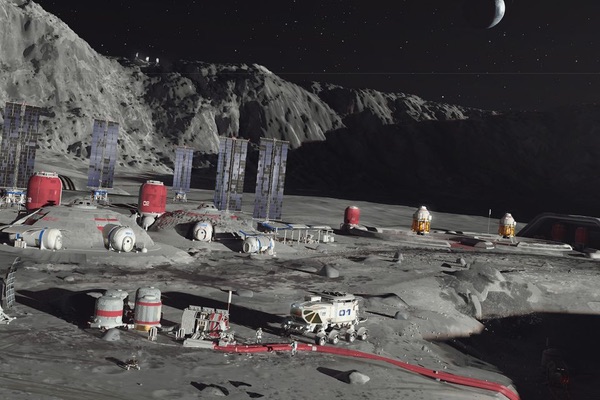
| There are now several plausible scenarios in which space mining will occur much more quickly than is usually considered realistic, perhaps within the next five to ten years. |
The approaches to mining, material processing, and logistics will be different for each location and material. Many potential methods have been discussed, studied, and designed for more than a half-century. Each has its own advantages, disadvantages, and limitations. The choices made in designing any mining operation will be essential factors in its ultimate success or failure.
Many industrial techniques that work on Earth will either be difficult, less effective, or impossible away from Earth, where gravity and atmospheric pressure are either different or completely absent. Nevertheless, several major heavy equipment manufacturers have expressed interest or conducted research in space mining in recent years, including Caterpillar, Komatsu, and Vermeer. This suggests that space mining is possible, but that it requires further investment, effort, research, and development.
Given the number of possible locations, materials, and extraction methods, there is a variety of possible forms that a space mining operation could take. Many of these have not been studied equally and few of them have been subjected to rigorous economic analysis. One example of this lies in the different types of materials: those which could support crewed missions or (re)filling spacecraft propellant tanks have been studied in great depth. The extraction of other materials, such as metals, has been studied far less.
Why has space mining seemed unlikely?
There are three key issues which have made space mining seem unlikely:
- Lack of purpose: there are many philosophical and theoretical reasons why spaceflight and space exploration are fundamentally sound concepts. While space mining would support these, until recently it has been unclear how it could be made economically practical. Its ability to generate revenue and financial returns seems much more probable now than was the case only a few years ago.
- Limited knowledge: we still know relatively little about potential targets for space mining. Even on Earth, where geologists have studied the planet for over 100 years, much of what lies below the surface remains unknown. Uncrewed probes investigating other planets, moons, or asteroids provide a limited amount of information about what lies beneath their surfaces. Only a small area of the Moon has been physically investigated in detail and few asteroids have been visited by robotic spacecraft. For each, while we have large bodies of information about what materials we think should be there and what is there, detailed data about how much, where and in what form remains limited.
- High costs: leaving Earth’s surface, moving beyond Earth’s orbit and building machines which can operate unmaintained in such hostile environments—all of these press the limits of technology and are extremely costly. Space mining, which requires industrial equipment, processing techniques and logistics networks, will be even more expensive. Nevertheless, expensive is not impossible. Space mining has the tantalizing promise of both generating revenue and supporting other valuable space-based activities.
What has changed to make space mining seem likely
Recent years have seen vast changes within the space industry. From having been an ossified and largely sclerotic industry in the 1990s and 2000s, it is now one of the most dynamic sectors of the global economy.
Nine factors make space mining more achievable:
1. Clearer purposes: in contrast to previous decades, the levels of interest and investment in space are now far higher. The number of use cases for space mining has expanded and plans for space exploration are now both more advanced and are being pursued with greater vigor. These will lead to a wide range of applications and requirements for resources in space.
2. Decreasing launch costs: relatively young space companies (often known as NewSpace) have successfully lowered the barrier of access to space. This has been pioneered by SpaceX. Though no other company has yet replicated its successes or abilities, there are several close followers. Within the USA, the most notable are Blue Origin (with the semi-reusable New Glenn launch system) and Rocket Lab. China seems to be SpaceX’s closest competitor in the quest for full reusability and low costs, with a wide range of rockets under development. Other groups, such as ESA and ArianeGroup, are making promising steps towards reusability. They will need more time to reduce their costs and show results.
3. Further cost decreases on the horizon: launch costs are certain to decrease even further. This will take place in two steps:
- The first to occur will be when SpaceX’s Starship launch vehicle enters commercial service as the world’s largest and first fully reusable rocket. The company’s internal cost to launch could drop as low as $67 per kilogram, with Elon Musk suggesting an ultimate aim of $10 per kilogram.
- The second will be when other countries and companies produce reusable rockets, lowering costs within their respective markets. The USA will almost certainly continue to lead in lowering launch costs (and prices) across the board. Within the USA, this will be accelerated when competitive pressure requires SpaceX to reduce its profit margin and charge prices closer to breakeven. Once other countries begin to operate fully or partially reusable rockets, an even sharper drop in launch costs will result. It seems inevitable that, in turn, more economic opportunities beyond Earth will emerge.
4. Launching physically larger payloads: there are several rockets in development with the ability to launch heavier and larger payloads than ever before. This combination means that payload weight need no longer be such a limiting design constraint. This, in turn, opens up new possibilities for the use of space, as has been seen with megaconstellations such as Starlink.
| While it still seems unlikely that extraterrestrial materials can compete on cost with those currently being extracted on Earth, there are several new scenarios which will soon make space mining plausible. |
5. A shift in perception: space now seems more realistic and accessible than at any previous time. Public support for spaceflight, particularly in the context of a return to the Moon, seems to have increased. This is in part due to the increasing ease of access, which is mainly due to SpaceX’s rockets, the Falcon 9 and upcoming Starship—the former having lowered costs and the latter likely to do so more radically. Space has become more present in everyday life over time from space tourism to GPS, direct-to-device satellite internet, and Starlink. The Overton window has shifted and increasingly, activities involving space mining, data centers in space, space-based solar power, and more seem more plausible than ever before. This perception shift makes it easier to gain support, to plan, and to design—and, most importantly, easier to raise the funding necessary to make these designs a reality.
6. Demonstrated track records: the rise of NewSpace has been driven by highly talented individuals and organizations which have demonstrated the ability to tackle difficult technical and engineering problems. Many of these companies were founded by alumni of SpaceX, Rocket Lab, and Blue Origin (among others), all of whom have a reputation for competence. Their track records give financiers and others confidence that challenges which have previously seemed impossible are actually solvable.
7. Real near-term demand: although space mining has long been considered a (tempting) solution in search of a problem, both public and private projects currently underway will benefit from it.
8. Perceived urgency and international competition: there is a growing perception of a new “space race.” The international space treaties surrounding the use of resources are not sufficiently precise to determine ownership of mineral rights and modes of behavior when conflicts arise between different countries and companies in space. While the potential resources are vast, they are not unlimited. The Moon, in particular, has a limited number of prime locations for mining water or helium-3. Similarly, it is possible that there are relatively few near Earth asteroids suitable for mining. In this sense, the first-mover advantage will give real benefits.
9. Increasing knowledge of destinations: there is more interest being shown by both government agencies and private companies in answering key questions about potential space mining destinations, such as what materials could be extracted, in what quantities, and how they could be used. Examples are the UAE Space Agency’s proposed MBR Explorer, to visit seven asteroids, NASA’s Psyche mission to the metallic asteroid of the same name, and AstroForge’s DeepSpace-2 mission to a near-Earth asteroid.
What is likely to shift space mining into reality?
For many years, discussion around space mining has mainly revolved around the use of resources to support human exploration away from Earth, or for activities on Earth (such as mining metals from an asteroid for sale in existing markets). While it still seems unlikely that extraterrestrial materials can compete on cost with those currently being extracted on Earth, there are several new scenarios which will soon make space mining plausible. For some of these, the requisite technologies have already been studied and developed. For others, there are preliminary or exploratory missions currently underway.
Human exploration
NASA’s plans for a human presence on the Moon have been rejuvenated under the Trump administration’s Artemis program, after languishing for several decades in the post-Apollo era. There is now a strong push by NASA Administrator Jared Isaacman for another human landing on the Moon by 2028, with the intention that a sustained presence will result. This is an international effort under the Artemis program, which is similar in aim to China’s Chang’e program and their International Lunar Research Station, which aims to put a base on the lunar South Pole.
Both programs contain in-situ resource utilization (ISRU) as part of their plans. Should either succeed in achieving their objectives of a sustained human presence on the Moon, it is all but certain that space mining and ISRU will be involved. This would be essential to provide consumables for life support (oxygen and water), propellants for rockets (hydrogen and oxygen), as well as structural material for shelters to protect astronauts and equipment from radiation and micrometeorites.
Many of the required technologies for ISRU have been designed, tested, and evaluated on Earth. With the next human landings targeted for 2028, it is entirely possible that lunar materials will be mined and used on the Moon within the next five years.
Data centers, solar panels, and space-based solar power
Solar power and data centers are common on Earth, with the latter becoming increasingly contentious. Recently, the possibility of deploying these in space has drawn a great deal of attention. Practical and usable capacity would require significant amounts of mass to be launched into orbit. This would have both advantages and disadvantages, the intricacies of which are too complex to discuss here. In brief: space-based data centers show a potential economic upside compared to terrestrial data centers. Space-based solar power also appears to be potentially viable, although the long-term benefits are less clear.
The effective use of non-terrestrial data centers would consume vast amounts of capital and launch capability, requirements which SpaceX, with their Starship program, seems uniquely well-placed to meet. Indeed, it has published hints of plans to build a data center satellite factory on the Moon.
| From being an industry dominated by a few large and mostly stagnant players, there is now a dynamic mix of large and small entities, innovating at a furious pace. |
It should be noted that while several companies are working towards space-based data centers, one has already briefly operated on the Moon, on board the partially successful Athena lander in 2025. This scenario could begin sooner than most people expect. SpaceX has signaled its intentions to start launching data center satellites as soon as 2027. Should this be successful and demand for computing power continues to increase, it seems plausible that large scale tests could be operating within a few years.
Space-based solar power involves solar arrays placed in orbit to transmit the generated power down to Earth in the form of microwaves or lasers. The manufacture of solar panels is a process requiring a great deal of energy and a variety of materials, all of which are available in large quantities on the lunar surface. A method of producing these from a simulated form of lunar regolith will soon be demonstrated on Earth by Blue Origin, under their Blue Alchemist program.
Should space-based solar power or data centers become a reality, it might in the long term be economical to produce some portions of the satellites in space. This would enable savings in launch costs, in exchange for the expense and investment in off-Earth production. While this may initially seem far-fetched, the logistical advantages are real.
It should be noted that super heavy-lift rockets—SpaceX’s Starship, China’s proposed Long March 10 and Blue Origin’s proposed “9x4” variant of the New Glenn rocket—will all be capable of carrying far larger payload volumes than ever before. This would enable heavy equipment and machinery to be lifted at a lower cost than has been possible.
Propellant depots
To date, satellites have been single-use: their operational lifetimes are often limited by the size of their propellant tanks, which cannot be refilled once empty. Several startups intend to change this by prepositioning propellant depots in orbit. Smaller vehicles would then be dispatched from these depots to refill satellites’ tanks and extend their useful lives. Demonstration missions have been launched and development continues.
Future versions could involve refilling the depot itself with propellants extracted from the Moon or from asteroids. This would enable spacecraft to operate for longer periods and remove the need for rocket launches from Earth to supply them.
Mining for use on Earth, including helium-3
One of the longest-lived debates behind space mining involves helium-3. This isotope of helium, while exceptionally rare on Earth, is found in significantly higher concentrations on the surface of the Moon. Given its potential value as a fuel for fusion reactors (a very promising though as yet unproven technology) as well as being an excellent coolant for quantum computing, there have been numerous proposals to mine helium-3 from the Moon. The economic benefits are uncertain, though the mining techniques are being developed by some companies, such as Interlune.
In addition, almost every other useful element is available in space, particularly on asteroids. It is certain that the quantities available would be sufficient to supply current global requirements for hundreds of millions of years. However, little is known about the mineralogy, chemical composition, accessibility, and concentrations of some of the materials in asteroids. Of these, perhaps the most interesting are the metals found on metallic asteroids. The largest, known as Psyche, is to be visited by NASA’s Psyche mission in 2029. A privately funded mission, built by the company AstroForge, is scheduled to launch in the coming months to a near-Earth asteroid. Such surveying missions are crucial for understanding the surfaces and compositions of asteroids.
The huge quantities of such resources make them particularly tempting objectives. The expected extraction costs make it seem unlikely that they could be sold on Earth at competitive prices. Increased knowledge and technology will reduce this uncertainty and help us understand when they might become economically viable. While the mining of common materials such as iron is unlikely, rare earth metals and other valuable elements are more plausible targets, particularly given current spikes in demand and supply shortages.
Mining materials for other uses in space
There have already been some early instances and examples of industrial activities being placed in Earth orbit. These have so far been limited to just a few experimental applications, mostly involving the growth of crystals for semiconductors and pharmaceuticals. Similarly, our ability to construct objects in space is currently restricted to the assembly of prefabricated structures and a few experiments in 3D printing. As launch costs decline and with improvements in technology, more uses and applications will certainly emerge. These would be enhanced by having low-cost supplies of material available, which is where space mining would yet again be a benefit.
In summary, though many of the technologies mentioned here may be expensive and not yet proven, this is very likely to change rapidly. With increased use, costs can be reduced-and so the activities that can be conducted economically in space will increase and become more widespread.
Conclusion
Recent changes in the space industry have been extraordinary. With decreasing costs and larger launch vehicles, demand has increased, giving rise to more competition and innovation. From being an industry dominated by a few large and mostly stagnant players, there is now a dynamic mix of large and small entities, innovating at a furious pace. As this generates more technical knowledge and ability, the range of potential activities in space has increased too.
When coupled with the developments outlined in this article, the changes are sufficient to take space mining from being in the realm of science fiction to something that will happen within the next few years.
Initial small-scale work on space mining will ramp up quickly, enabling other industries to move away from Earth. When this happens, it will reduce the environmental burden of similar activities on this planet.
Note: we are now moderating comments. There will be a delay in posting comments and no guarantee that all submitted comments will be posted.