A riddle, wrapped in a mystery, inside a payload container: the curious case of Defense Support Program Satellite F-11by Dwayne A. Day
|
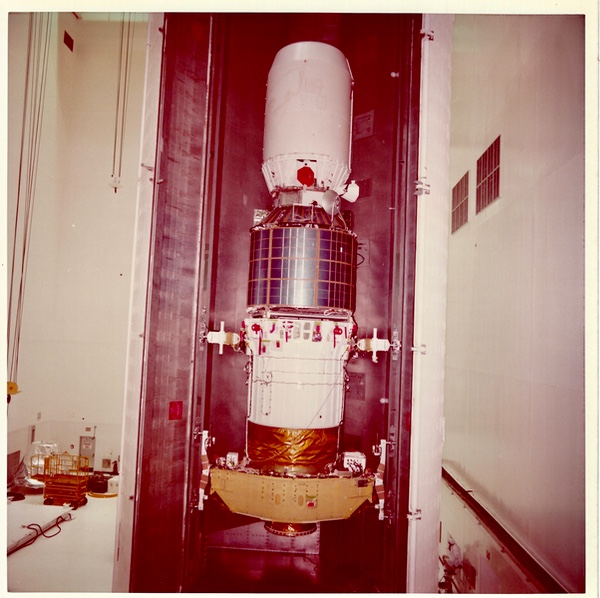
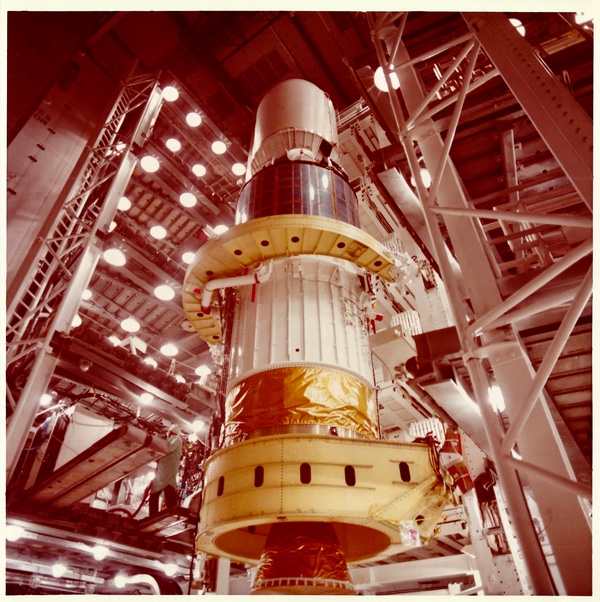 DSP satellite 12/F-11 in April, 1982, at the Vertical Processing Facility at Cape Canaveral, used to process space shuttle payloads. The IUS here is almost certainly a mockup. Two mockups were built and are still preserved at museums. This block of DSP satellites was not intended to use the IUS, so seeing it in this configuration is very curious. (credit: NASA) |
Mystery bird
Recently, two photos were discovered in an archive showing a DSP satellite at facilities in Cape Canaveral in April 1982. This discovery alone was significant, because there are very few photographs of early DSP satellites up through the late 1980s. When the program had an anniversary in the late 1990s, an Air Force officer sought to assemble a collection of satellite photos up to that time and discovered that few photos had been preserved. There were no photographs of some of the satellites in Air Force or contractor files, such as satellite 12, also known as F-11.
One of the newly discovered photos shows a satellite in a shuttle payload canister that was used to take Space Shuttle cargo to the launch pad for installation. The other photo shows a DSP satellite in the Vertical Processing Facility (or VPF) at the Cape, where payloads did shuttle interface verifications and satellites were mated to their upper stages. The satellite does not have its four extendable solar panels attached.
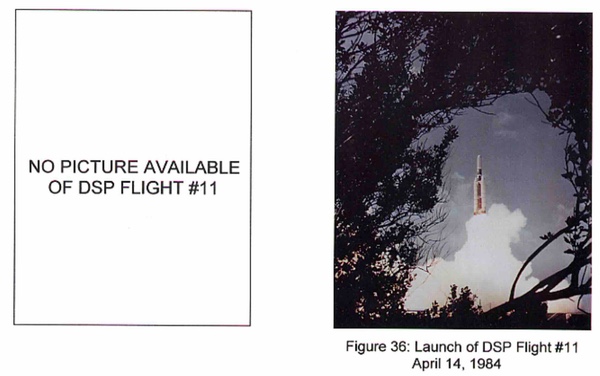 Illustration from the official US Air Force photographic history of the DSP program. Very few photos of the original satellites were preserved. (credit: USAF) |
Both photos show the DSP satellite attached to an Inertial Upper Stage (IUS). The IUS has “remove before flight” tags like a real one. It also has insulation like a real one, although the cradle does not. But the IUS was not ready at this time—the first one was launched in October 1982 and put two military communications satellites in orbit—and it is likely that this is just a mockup. There were two realistic IUS mockups manufactured: one now belongs to the National Museum of the United States Air Force and the other to the Cape Canaveral Space Force Museum. Both photos show a large cover over the telescope. Later DSP satellites used a draped fabric cover. The large cover may be the telescope’s shipping container.
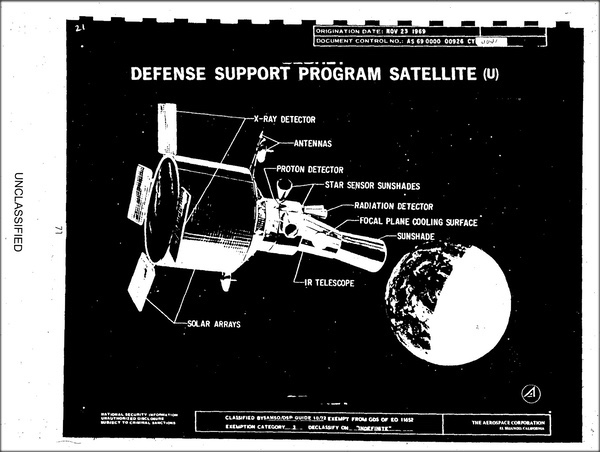 Artwork from 1969 depicting a DSP satellite in orbit. The first DSP satellite was launched in 1970. (credit: USAF) |
Curiouser and curiouser
The two photos contain multiple mysteries. For starters, early DSP satellites were not designed for shuttle launches, so why was one being handled in a Space Shuttle payload container and at the VPF? No early DSP satellite was launched on a shuttle. It was not until 1991, when a later, and larger, DSP satellite was launched on the STS-44 mission. The final mystery is the IUS. The DSP did not use an IUS until 1989, and in 1982 it was slated to use the liquid-fueled Transtage, which could not fly on the shuttle.
This satellite should not have been in this configuration or at this location at Cape Canaveral in April 1982. There is no record of it being there. A small additional mystery is that both photos have NASA stamps on them, indicating that a NASA photographer took them and NASA printed them, not the US Air Force. They were never classified, just not publicly released.
Based upon the date, this satellite is almost certainly DSP satellite 12, also known as F-11. In March 1982, a month before the photos were taken, satellite 11 was launched from the Cape on a Titan 34D-Transtage rocket and named Flight 10 in orbit. The next DSP satellites launched (F-12 and F-13) had significant changes—ironically, they had been built years earlier and placed in storage, then substantially upgraded. That these photos show satellite 12/F-11 is itself significant, because no photos of this satellite were known to exist. Even the official photographic history of the program states “No Picture Available of DSP Flight #11.”
Official histories indicate that the Air Force considered DSPs F-12 and F-13 for both IUS upper stages and shuttle launches. However, this was ruled out due to time and cost considerations and both satellites eventually used Titans and Transtages.
The obvious conclusion based upon the photographic evidence is that in 1982, the Air Force was considering launching DSP satellite 12/F-11 on a Space Shuttle using an Inertial Upper Stage. These photos showed a test, fitting the satellite to an IUS mockup and in a shuttle container at a NASA facility to see if it could be handled there. Usually this is done with non-flight hardware called a “pathfinder.” Why it was done with a flight-qualified satellite is another mystery.
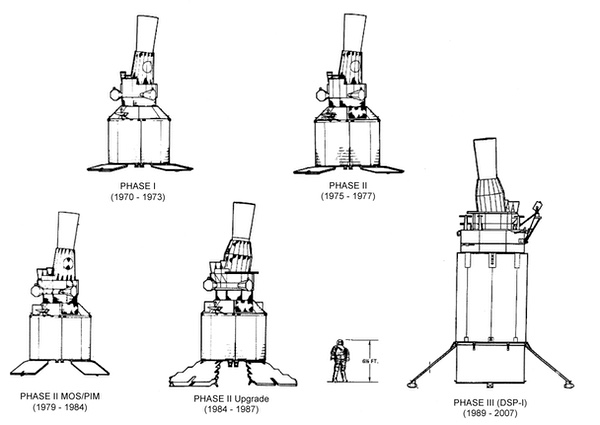 The Defense Support satellite program included over 20 satellites launched between 1970 and 2007. DSP F-11 was one of the MOS/PIM satellites. The final satellite block was generally known as "DSP-1" or the F-14 satellites. (credit: USAF) |
Flight 11
On April 14, 1984, DSP satellite 12 was launched into orbit atop Titan 34D-11. It reached geosynchronous orbit and was designated Flight 11. It replaced Flight 9 over the Pacific Ocean, with F-9 being moved to take the place of F-7 over the Indian Ocean. Flight 7 had been experiencing problems, so the Air Force replaced it with a newer satellite and moved it to a backup position.
It is not known when Flight 11 finally ended service. Available documents indicate that it was scheduled to be decommissioned in the later 1980s after suffering malfunctions. Perhaps now that the Defense Support Program has finally ended, the Space Force will release more records on this highly successful and vital program that operated for over half a century.
Special thanks to JB.
Note: we are now moderating comments. There will be a delay in posting comments and no guarantee that all submitted comments will be posted.