Is there in truth no beauty? Remastering Apollo with Andy Saundersby Dwayne A. Day
|
 |
There have been millions of photos taken of the early American space program, official government photos and media photographers and of course amateurs using their store-bought Nikons and Polaroid Instamatics taking grainy and blurry photos of rocket launches from Florida beaches. There were far fewer photographs taken by the astronauts themselves during the missions, and the media published a small fraction of these, taking the best photo out of a sequence of shots and using that to illustrate much of the mission. There was an inherent bias in this effort. Photo editors selected the images that looked best to them, ignoring the rest.
 |
Photos in the bin
But what has been little known or understood is that many photos were rejected even before editors ever looked at them. NASA technicians developed the original film, made copies of the useable images, and then retired the originals to deep cold storage. By selecting the “useable” images to share with the media, somebody was making a judgment call that would last for decades. What nobody understood at the time was that some images that looked terrible or even completely unusable could be saved. There was still truth to be found in the originals, buried in the chemical emulsion of the film, but that truth was out of reach, preserved in a cold vault.
It used to be that one of the arguments that silly people employed to prove that the Moon landings were fake was that the photographs were too good, always well-framed and in focus, as if master photographer Stanley Kubrick (who also sometimes directed movies) had taken them himself. This was balderdash, and most of those silly people moved on to other silly arguments. The Apollo astronauts took plenty of photographs that were out of focus or poorly exposed, but few people saw them, and nobody cared.
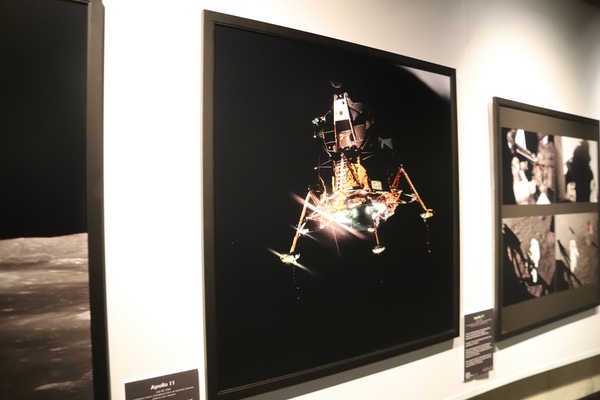
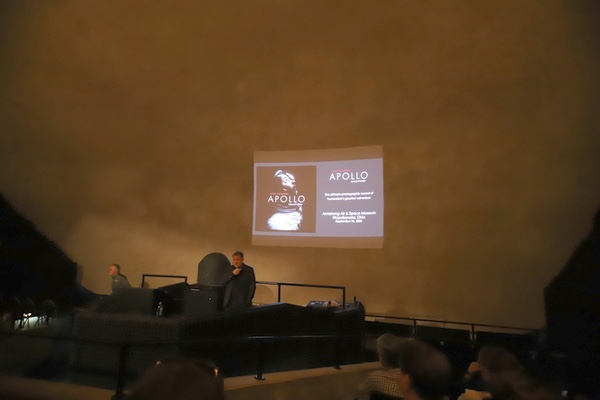 In late September, Andy Saunders gave a talk at the Neil A. Armstrong Air and Space Museum in Ohio about his work remastering Apollo-era photographs, now on exhibit at the museum. (credit: Dwayne Day) |
Decades after the original photos were sequestered away, they were removed from storage, thawed, and scanned at very high resolution before being sent back to the cold and the dark. The scanned files were made publicly available, and some people took advantage of that to publish much better looking versions of the photos that had been seen for decades.
Andy Saunders started looking at photos that nobody had paid any attention to, the ones that did not even look like photographs, the ones that were out of focus, or almost completely black. And sometimes he found something astounding in them.
 |
Light from darkness
In the late 1990s, Michael Light produced Full Moon, a book and museum exhibition of Apollo photos. Light was interested in what he called “landscape representation,” and the beauty of the very large format prints that he produced and exhibited in museums was that they made the viewer begin to experience the lunar surface. One could see the dust on an astronaut’s spacesuit and practically taste it. I remember looking at one photo of moonwalker Alan Bean’s leg covered in dust and feeling an oncoming urge to sneeze.
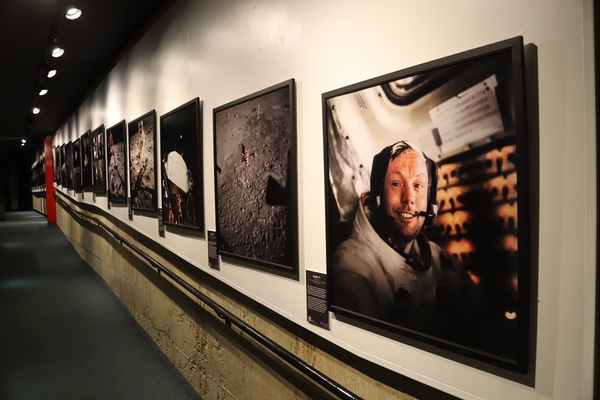
What Saunders realized was that many of the Apollo photographs were underexposed, meaning that they were too dark. That included even some of the most famous and most published photos, such as a photograph of Neil Armstrong in the Lunar Module smiling after returning from his moonwalk. The photo that has been published in countless books and articles has an orange hue, as if Armstrong was sitting by a fireplace, giving it an emotional warmth. Armstrong looks happy, friendly, almost as if he’s sipping bourbon at a party. That underexposure conceals some of the truth, however. Saunders took the high-res scan and adjusted the exposure, revealing the lines in Armstrong’s face and the redness of his eyes. The image changes subtly. Rather than joyfully happy, Armstrong looks more relieved, and exhausted, less like a man who has just accomplished something great, than someone happy he is still alive. He has survived—for now.
 |
One of the main reasons that Saunders can do this is because, especially for the Apollo program, the astronauts were equipped with the best cameras, the best lenses, and the best film that technology could provide. During the Mercury program, cameras were barely an afterthought, let alone a priority. Test pilots wouldn’t carry a camera into the cockpit of a high-performance aircraft. The first handheld camera on an American space mission was personally purchased by John Glenn at a drugstore, not provided by NASA. During the Gemini program, NASA began including cameras as part of the regular equipment and putting photography onto the mission agendas. Saunders has worked with both Mercury and Gemini photographs, achieving some stunning results.
Saunders has also taken some of the movie film from various missions and used a photographic technique known as stacking to produce higher quality still photos. Stacking essentially involves layering multiple frames on top of each other to improve the signal to noise ratio of a photo. Parts of an image can be laid on top of missing parts of an image. Still photographers do this regularly, particularly for subjects like astronomical photography, where so little light has been gathered in each shot that the photographers layer the captured photons on top of each other. The digital tools for doing it are powerful and did not exist a few decades ago, but still photographers are helped by the fact that their camera is in a fixed position. Saunders has taken movie frames where the camera, the subject, or both are moving, and rotated or moved the frames to layer the images, achieving a clarity impossible until now.
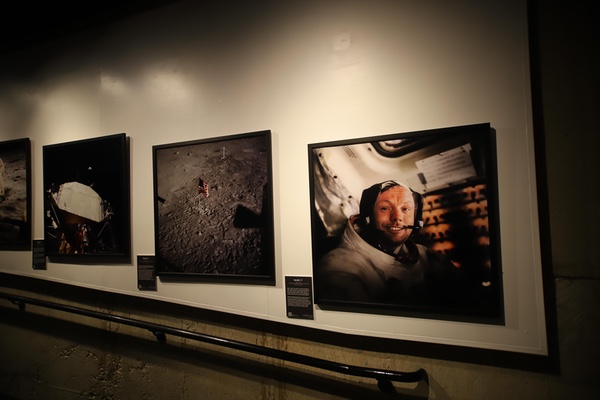 Saunders has remastered this famous photograph of Neil Armstrong in the Lunar Module. The new image reveals stress lines in his face, and bloodshot eyes. Previous versions of this photo had more warmth. Now, Armstrong looks like a man exhausted and relieved after a strenuous ordeal. (credit: Dwayne Day) |
Anybody who has looked at badly enhanced photos using AI techniques has seen how AI turns surfaces, including human features, into plastic. AI also hallucinates, adding things to the photo that were never there in the original: for instance, morphing blurry and indistinct letters and words on a sign so that it says something nonsensical, or even produces gobbledygook. Saunders does not use AI. He is not adding anything to an image that is not already there; he is drawing out the information—the truth?—that is there but may be obscured.
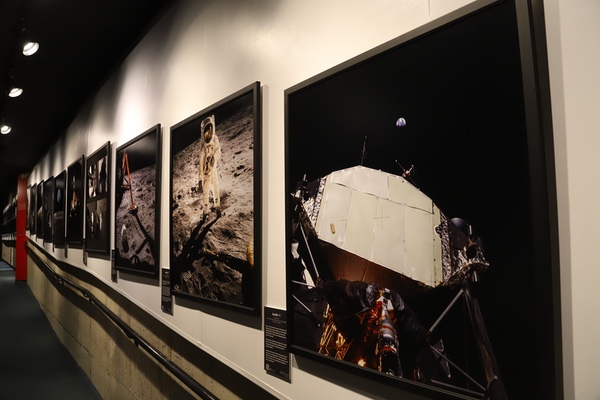
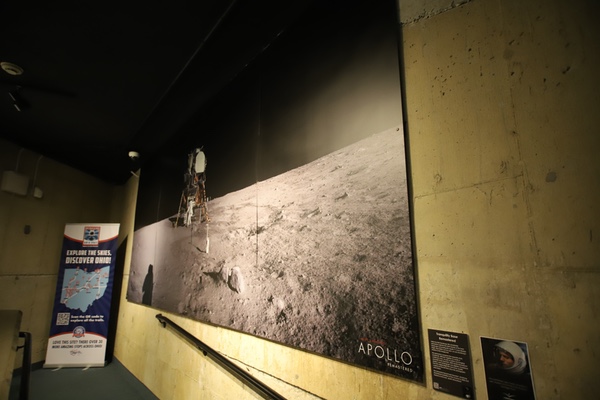
Saunders has published two books with photographs. One is from the Mercury and Gemini missions, and the other is Apollo photographs. He produced a video show narrated by Tom Hanks that has appeared in cities such as London and Washington, DC. The collection of large print photographs has also appeared in several cities and is now on display at the Neil A. Armstrong Air and Space Museum in Wapakoneta, Ohio.
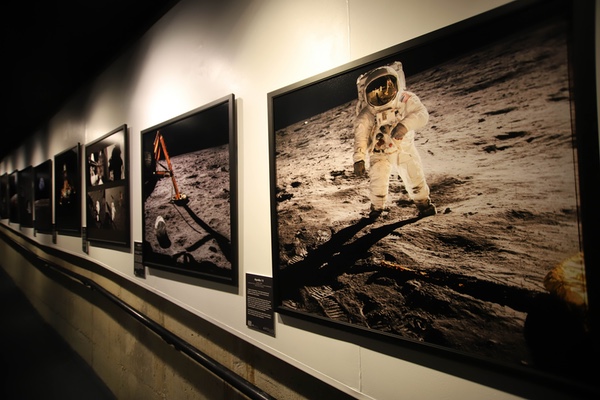 Another famous Apollo 11 photograph. The Apollo program used the best quality cameras, lenses, and film, recording far more data than can be easily conveyed in a book or a computer screen. A large format print reveals details you cannot otherwise see. (credit: Dwayne Day) |
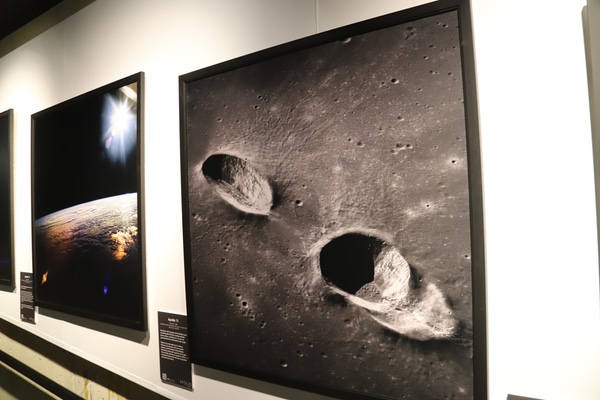
When the Apollo 11 astronauts first began walking around the Moon, Neil Armstrong remarked, “Magnificent sight out here,” prompting Buzz Aldrin to respond with “magnificent desolation,” a description so poetic he later used it as the title of a book. In most photos of the lunar surface taken either from above it or on the ground it looks grey, dull. But the reality is that there is color in the Moon: not only a million shades of grays and blacks but also browns and tans. Most photographic reproduction techniques have eliminated the subtleties. Saunders has gone looking for them.
The dozen or so photos Saunders has included in the show are mostly from Apollo 11. But during a recent talk about the exhibit, he showed many other photos from his books and talked about his techniques. One of the photos is of astronaut Rusty Schweikart on his spacewalk during the Apollo 9 mission. The photo, taken from inside the spacecraft, reveals most of Schweikart’s full body and it looks as if he is standing on the spacecraft, like a wingwalker atop an airplane. Although Apollo 9 has received less attention than the lunar landing missions, this photo has been published before. But Saunders has improved the exposure, enhancing the colors, turning Schweikart into a Greek hero challenging the universe.
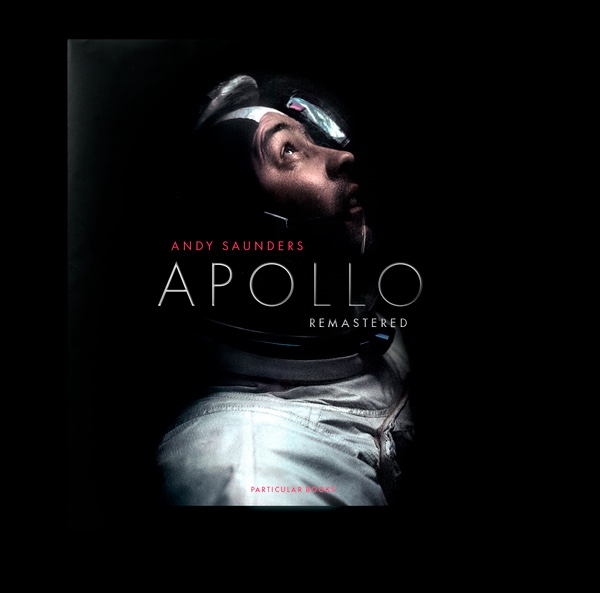 Andy Saunders has produced two books of remastered photographs from the early years of the space program. (credit: apolloremastered.com) |
Probably the most striking example of what Saunders has done is a photo that is on the cover of his Apollo Remastered book. It shows astronaut Jim McDivitt looking out a small window on the top of the Lunar Module during Apollo 9, staring up as if towards some great revelation. What is amazing is that the original photo was almost completely black except for a spot of light coming through the window. Saunders realized that the data—the very existence of McDivitt in the frame—was there in the blackness, it just had to be revealed.
One of my personal favorites is not in the show. It is a photo of Pete Conrad exiting the Apollo 12 Lunar Module. In the original photo, taken by Alan Bean, Conrad is dark against a brighter background, almost invisible. Saunders has lightened up the photo, revealing the details and the color. It almost looks fake, but it’s the truth that was waiting decades for somebody to find it. It belongs in the Pete Conrad and Alan Bean Museum, when somebody finally builds it.
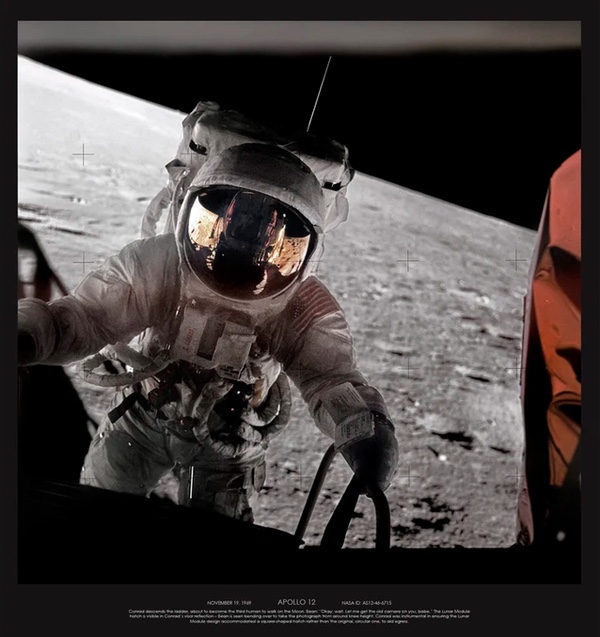 One of the author's personal favorites is this Apollo 12 photograph of astronaut Pete Conrad taken by Alan Bean and remastered by Andy Saunders. The original was very dark and Conrad was a shadow. The remastered version shows the Moon explorer. (credit: apolloremastered.com) |
The photography exhibit is at the Neil A. Armstrong Air and Space Museum in Wapakoneta, Ohio until spring 2027. Go see it, before this brief moment in time is gone.
Note: we are now moderating comments. There will be a delay in posting comments and no guarantee that all submitted comments will be posted.