Relearning movement beyond EarthWhat neurorehabilitation can teach us about human adaptation in spaceby Esha Ejaz
|
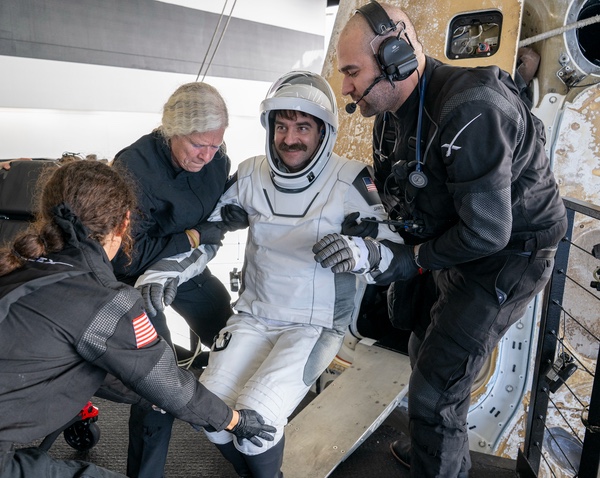
| What can rehabilitation science teach us about helping humans relearn movement when their environment changes? |
In microgravity, familiar gravitational cues used for orientation, posture, and movement are altered. After landing, these adaptations can temporarily affect balance, locomotion, spatial orientation and other aspects of sensorimotor performance. NASA identifies these changes as an important human performance concern during gravitational transitions, particularly when astronauts must perform critical tasks shortly after landing.
This raises an interesting question for space medicine: what can rehabilitation science teach us about helping humans relearn movement when their environment changes?
Rehabilitation is more than restoring strength
Scientists and clinicians have long studied how the nervous system adapts when normal movement is disrupted. Neurological rehabilitation provides one of the clearest examples.
When a person must regain movement after illness, injury, or prolonged physical disruption, recovery is not simply about strengthening individual muscles. Rehabilitation often involves practicing meaningful, functional activities so that the person can regain the ability to use movement effectively in everyday life.
One approach is task-oriented training, which focuses on practicing goal-directed activities that resemble the tasks a person needs to perform in everyday life. Instead of concentrating exclusively on isolated muscle movements, therapy may involve activities such as reaching, grasping, standing, transferring ,or walking. Research on task-oriented rehabilitation has examined how functional practice can support improvements in movement performance and daily activities.
The broader lesson is that movement should be practiced in relation to the function a person ultimately needs to perform. That principle becomes particularly interesting when applied not as a proven astronaut treatment, but as a question to spaceflight.
When gravity changes, movement changes
On Earth, gravity is an almost invisible part of every movement we make. The vestibular system, vision and proprioception work together to help the brain understand where the body is and how it should move. Microgravity changes these relationships.
| The nervous system’s ability to adapt is essential for functioning in space, but those adaptations may temporarily become less effective when the astronaut returns to Earth’s gravity. |
NASA identifies balance, locomotion, eye-hand coordination, gaze control, tactile perception, and spatial orientation as important components of human sensorimotor performance. During transitions between gravitational environments, astronauts can experience vestibular dysfunction, spatial disorientation, and changes in postural, locomotor, manual, and fine motor control. These effects can become particularly important during landing, spacecraft egress and other activities performed shortly after returning to gravity.
Yet astronauts do not simply lose the ability to move. They and their nervous system adapt. During spaceflight, the brain learns to interpret sensory information and control movement in an environment where the normal gravitational reference has changed. This adaptation allows astronauts to function effectively in space.
The challenge appears when they return. The movement strategies that became useful in microgravity are suddenly being applied to a 1g environment. Research conducted through NASA has documented post-flight disturbances in locomotor and postural control and has investigated ways to accelerate recovery following long-duration spaceflight.
This creates a fascinating physiological paradox: the nervous system’s ability to adapt is essential for functioning in space, but those adaptations may temporarily become less effective when the astronaut returns to Earth’s gravity.
What rehabilitation can teach us about adaptation
Rehabilitation cannot simply be transferred to astronauts. An astronaut returning from space and a person recovering from a medical condition experience fundamentally different physiological challenges. Evidence from one rehabilitation context therefore cannot be presented as evidence that a particular protocol will improve astronaut recovery. What rehabilitation can provide is a framework for thinking about functional recovery.
One important principle is task specificity. If a person needs to regain walking ability, walking-related practice is highly relevant. Similarly, if astronauts need to stand, walk, maintain balance or perform operational tasks after landing, it is reasonable to ask whether recovery should include practice that reflects those demands.
NASA’s own sensorimotor research already takes a functional approach. Post-flight assessments can include activities such as sit-to-stand, tandem walking, recovery from a fall, and obstacle negotiation. These tests reflect an important reality: astronaut readiness depends on the ability to perform meaningful tasks, not simply on isolated physiological measurements.
| Instead of asking only: “Has the astronaut recovered?” we could ask: “Is the astronaut ready to perform the tasks required in the environment they are entering?” |
Another rehabilitation principle is practice and adaptation. Research has examined how repetition, feedback, practice distribution, and task specificity influence motor learning outcomes during rehabilitation.
This reflects a broader principle: movement should ultimately be assessed in relation to what a person needs to do.
From recovery to functional readiness
This distinction could become increasingly important as human missions move farther from Earth. An astronaut returning from the International Space Station may need to stand, walk, and exit a spacecraft after experiencing a dramatic change in gravitational loading. A future lunar crew will encounter one-sixth of Earth’s gravity while a Mars crew will encounter roughly three-eighths of Earth’s gravity. The physical and sensorimotor demands of these environments will not be identical.
NASA’s exploration research therefore emphasizes the development of assessment tools and countermeasures that can help astronauts recover sensorimotor capabilities following transitions between gravitational environments. Researchers are investigating whether functional tasks can help predict operational performance and whether training can improve adaptation.
This suggests a different way of thinking about rehabilitation. Instead of asking only: “Has the astronaut recovered?” we could ask: “Is the astronaut ready to perform the tasks required in the environment they are entering?” That distinction matters because functional readiness is ultimately what enables an astronaut to work safely.
Space medicine is already looking beyond strength
Astronaut rehabilitation is not a completely new concept. Space agencies already recognize the importance of restoring physical and functional capabilities after spaceflight.
NASA’s current human performance requirements specify that post-mission sensorimotor reconditioning should aim to return astronauts toward baseline sensorimotor function. The agency also has specific requirements for post mission muscle and aerobic reconditioning.
NASA’s broader medical requirements call for individualized post-mission reconditioning programs beginning after landing, with the goals of protecting returning crew, restoring functional abilities and returning astronauts toward pre-mission fitness.
ESA’s Space Medicine Team similarly identifies the optimization of post-flight rehabilitation strategies as one of its areas of work, alongside exercise countermeasures and other strategies for maintaining astronaut health. This shows that astronaut rehabilitation is already broader than simply restoring muscle strength. The challenge is to restore the ability to function.
Preparing humans to move beyond Earth
The history of rehabilitation teaches us that restoring movement is not simply about rebuilding physical capacity. It is about helping the nervous system learn how to use the body effectively in the environment where that body must function. Spaceflight presents a new version of that challenge.
| As humans prepare to live and work farther from Earth, understanding how we relearn movement may become an increasingly important part of keeping explorers safe. |
Astronauts must first learn to move in an environment where gravity is greatly reduced. They must then readapt when gravity returns. Future explorers may have to repeat this process across multiple gravitational environments while remaining capable of performing complex operational tasks.
The goal of space rehabilitation, therefore, may eventually extend beyond simply returning astronauts to their pre-flight physical condition. It may be about preparing them to function effectively in the next environment they encounter.
Neurorehabilitation cannot provide a readymade solution for astronaut recovery. But its central ideas offer a valuable perspective: movement is learned, adaptation can be trained, and recovery is most meaningful when it restores the ability to perform real world tasks.
As humans prepare to live and work farther from Earth, understanding how we relearn movement may become an increasingly important part of keeping explorers safe.
The future of space medicine may not only depend on keeping astronauts strong enough to survive spaceflight. It may depend on helping them learn how to move wherever gravity takes them.
Note: we are now moderating comments. There will be a delay in posting comments and no guarantee that all submitted comments will be posted.