Argentina’s flattop: The aircraft carrier Veinticinco de Mayo spotted from spaceby Dwayne A. Day, Harry Stranger, and Mariano P. Sciaroni
|
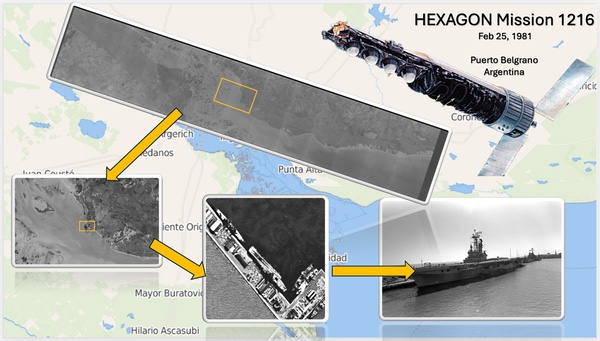
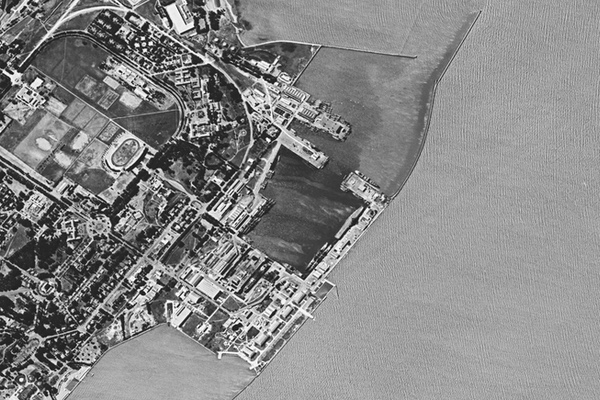 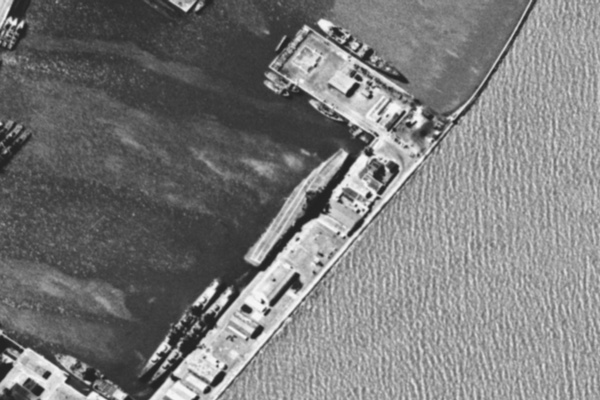 ARA Veinticinco de Mayo moored at Puerto Belgrano, the Argentine Navy’s main naval base (November 1972 by a HEXAGON reconnaissance satellite). The carriers’ berth was known as “Battleship Pier”: it had been home to the Navy’s huge dreadnoughts, ARA Rivadavia and ARA Moreno, whose draft of more than ten meters demanded deep water. The first Argentine carrier, ARA Independencia, took their place there in 1958. The two ships in line are the Brooklyn-class cruisers ARA General Belgrano and ARA 9 de Julio, and the ship furthest to the left is possibly the ARA Cándido de Lasala (Q-43), an Ashland-class dock landing ship. (credit: via Harry Stranger) |
Naval rivals in the South Atlantic
For years, there was a naval rivalry in the South Atlantic between two roughly equally matched opponents, Argentina and Brazil. In 1972, Argentina operated an aircraft carrier named ARA Veinticinco de Mayo, three light cruisers (soon reduced to two), eight destroyers, three frigates, and two corvettes. In November of that year, an American HEXAGON reconnaissance satellite overflew Argentina’s Puerto Belgrano and photographed the carrier, two cruisers, and other ships in port.
To Argentina’s north, Brazil also had a substantial navy at the time, including a carrier nearly identical to Veinticinco de Mayo, two World War II-era former US Navy light cruisers, eleven destroyers, five frigates, and ten corvettes. Both navies' destroyers were mostly upgraded US Navy World War II-era Fletcher, Gearing, and Sumner-class vessels—excellent ships in their day, by now all showing their age.
The two navies were thus roughly matched, with one important exception: Argentina’s carrier would soon operate Douglas A-4 Skyhawk attack jets, whereas Brazil’s carrier only operated the Grumman S-2A Tracker, flown by the Brazilian Air Force rather than the Navy. Both ships also operated helicopters (see “Carriers from space (part 2): Contemporary use of satellite imagery for open source intelligence,” The Space Review, August 12, 2024.)
The British Colossus-class light aircraft carrier HMS Warrior was sold to Argentina in 1958, becoming ARA Independencia (V-1). The ship operated until 1970 when she was placed in reserve and scrapped a year later. She was replaced by that country’s second carrier, ARA Veinticinco de Mayo (V-2), which had first served in the Royal Navy as HMS Venerable and then the Royal Netherlands Navy as HNLMS Karel Doorman. The ship was transferred to Argentina in 1968. Brazil´s Minas Gerais had been modernized at a Dutch shipyard in the late 1950s, so by 1970 both Argentina and Brazil were operating sister ships with very similar capabilities, both modernized by the Dutch.
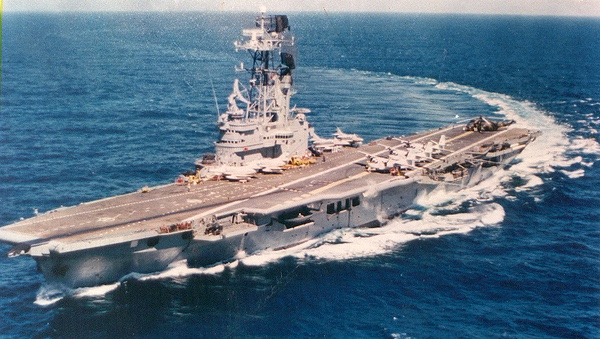 The Argentine aircraft carrier ARA Veinticinco de Mayo. The ship started life serving in Britain's Royal Navy as HMS Venerable, then in the Royal Netherlands Navy as HNLMS Karel Doorman. She was transferred to Argentina in 1968 and entered service in 1971. (credit: Wikimedia Commons) |
Veinticinco de Mayo’s air wing initially consisted of North American T-28P Fennec and Grumman S-2A Tracker ASW aircraft. But in the 1970s they were replaced with A-4Q Skyhawks, S-2E Tracker anti-submarine warfare aircraft, Sikorsky Sea King and Sud-Aviation SA.316 Alouette III helicopters. This gave Argentina the ability to attack other ships and submarines at distance, whereas Brazil only had an anti-submarine capability with its carrier. In February 1981, a HEXAGON satellite again overflew Puerto Belgrano. By this time, one of Argentina’s two cruisers had been retired, but the satellite photographed many ships in port, including the carrier and the ARA General Belgrano astern.
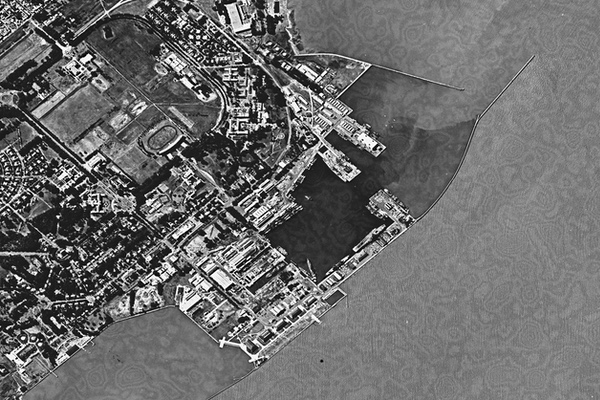 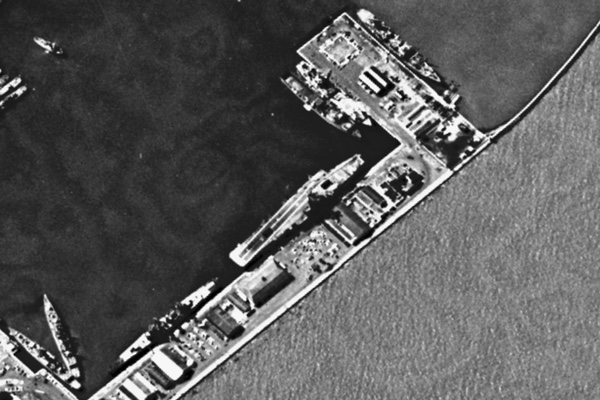 Veinticinco de Mayo photographed in February 1981 by an American HEXAGON reconnaissance satellite. ARA General Belgrano is astern of the carrier. She would be sunk in May 1982 by a Royal Navy submarine. (credit: via Harry Stranger) |
The 1982 war
When Argentina moved to seize the Malvinas (Falkland Islands) in April 1982, the aircraft carrier was the centerpiece of its navy. During Operation Rosario on April 2, she sailed with the covering force of Task Force 20, supporting the amphibious landing near Stanley. Her air group was built around three units: the A-4Q Skyhawks of the 3ª Escuadrilla Aeronaval de Caza y Ataque, S-2E Trackers for anti-submarine work and reconnaissance, and Sea King helicopters. The newly acquired Super Étendards had not yet been integrated for carrier operations.
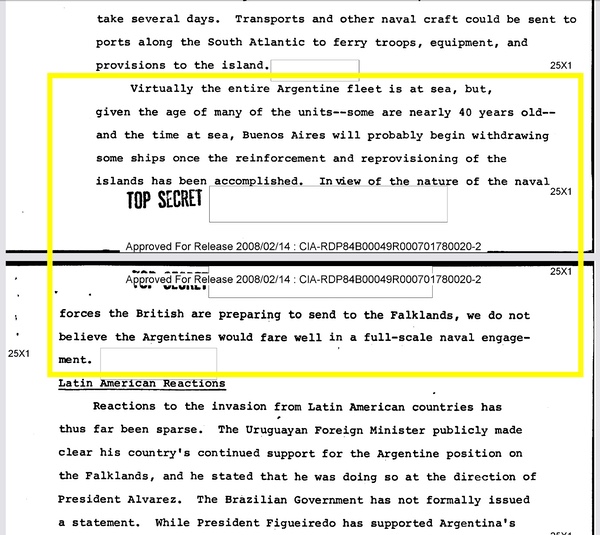 Excerpt from a Top Secret CIA report on the Falklands War, assessing the deployment of Argentina's fleet. (credit: CIA) |
Her decisive moment came in the first days of May. Rear Admiral Gualter Allara’s Task Group 79.1 was deployed north of the islands, while the cruiser General Belgrano group (TG 79.3) operated to the south, threatening the British Task Force from two directions. On May 1, after the first British attacks on the islands, the carrier’s S-2 Trackers located elements of the British fleet, and a Skyhawk strike was prepared for dawn on May 2. Nature intervened. A near-total calm, combined with the carrier’s limited speed, meant she could not generate enough wind over the deck to launch the Skyhawks with a useful bomb load, and the strike was called off. Later that day, submarine HMS Conqueror sank the Belgrano, and the nuclear submarine threat became the overriding factor in Argentine naval planning.
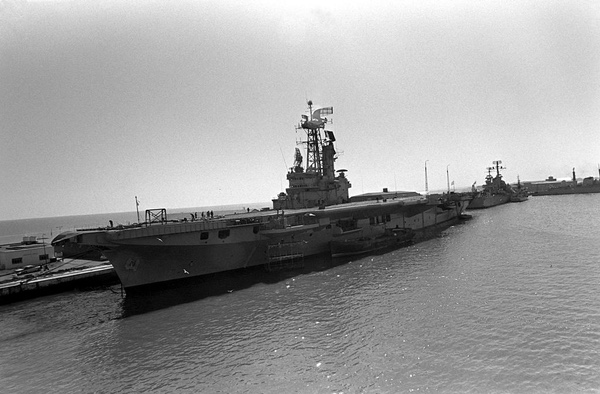 The ARA Veinticinco de Mayo at dock in 1979 with the ARA General Belgrano moored astern. (credit: Mariano Sciaroni) |
The carrier’s own war became an anti-submarine one. On May 5, two Trackers and two Sea Kings from ARA Veinticinco de Mayo detected a submerged contact near the carrier, held it, and attacked it. It was not a British submarine. With the surface fleet ordered back to shallow coastal waters, where British nuclear submarines could not operate freely, the carrier entered port on May 10 and took no further part in operations at sea. Her Skyhawks still flew extensively in combat, operating from the naval air base at Río Grande (see “Satellite reconnaissance and the Falklands War,” The Space Review, November 4, 2024.)
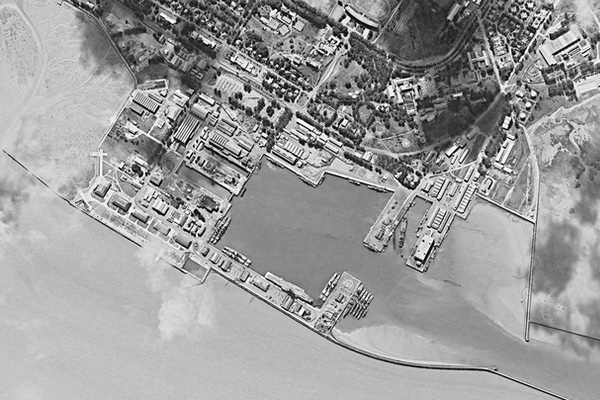 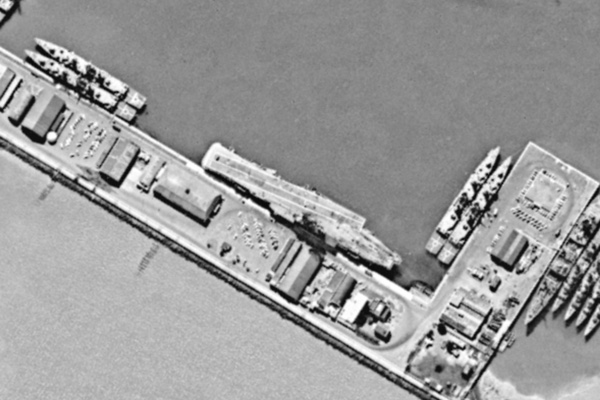 Veinticinco de Mayo photographed by an American HEXAGON reconnaissance satellite in September 1984. By this time the ship had been modified to carry Super Étendard attack planes, which had proved to be highly capable during the 1982 Falklands War. But by 1986, the ship was no longer operable. (credit: via Harry Stranger) |
In recent years, newly-declassified information from British archives indicates that British forces evaluated a long-range aircraft strike against the ship while she was in port. However, the war ended before such an operation entered advanced planning stages (see: “Buccaneers of the high frontier: Program 989 SIGINT satellites from the ABM hunt to the Falklands War to the space shuttle,” The Space Review, November 7, 2022.)
In 1984, another HEXAGON satellite—the last one to ever fly—overflew Puerto Belgrano and photographed the carrier in port. In place of the cruiser Belgrano were two destroyers moored astern.
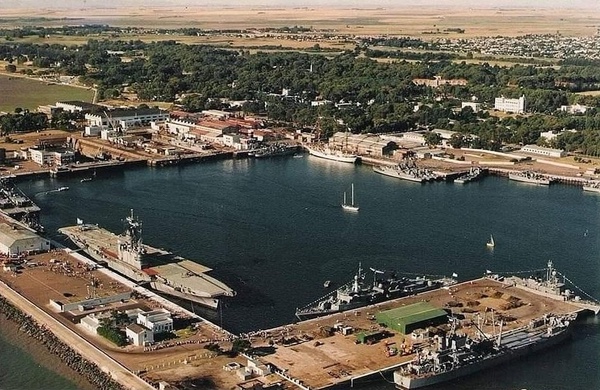 The naval base in 1996. The Veinticinco de Mayo is still there, but no longer operable. She was soon stricken and towed to India for scrapping. (credit: via Mariano Sciaroni) |
The end of an era
In the 1940s and 1950s, the United Kingdom had sold off its smaller, so-called light carriers to countries like Australia, Canada, India, and the Netherlands. By the 1980s, many of those carriers were worn out and being retired. As those World War II-era carriers were decommissioned and scrapped, the number of aircraft carriers around the world rapidly diminished.
Veinticinco de Mayo was mostly confined to port by 1986. Plans to modernize her stalled due to lack of funds, and by 1996 she had been stripped of many parts, some of which were used to service Brazil’s aircraft carrier, Minas Gerais. In 2000, she was towed to Alang, India, for scrapping.
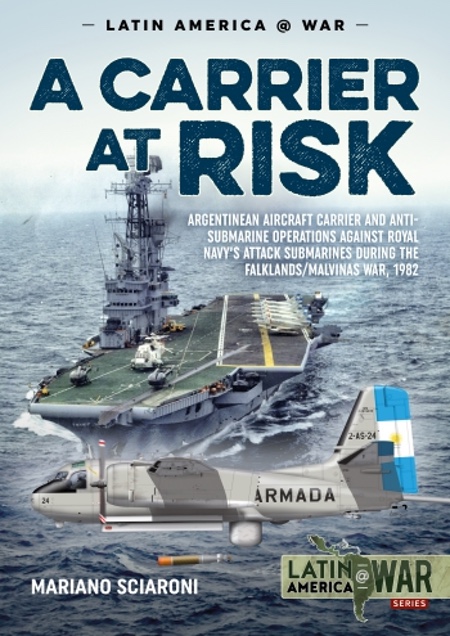 A Carrier at Risk is Mariano Sciaroni's account of the cat and mouse game between the ARA Veinticinco de Mayo and a Royal Navy submarine in 1982. (credit: Helion Press) |
Note: we are now moderating comments. There will be a delay in posting comments and no guarantee that all submitted comments will be posted.