Aiming for the stars while stuck in the mudApple TV’s demoralizing For All Mankind spinoff Star Cityby Dwayne A. Day
|
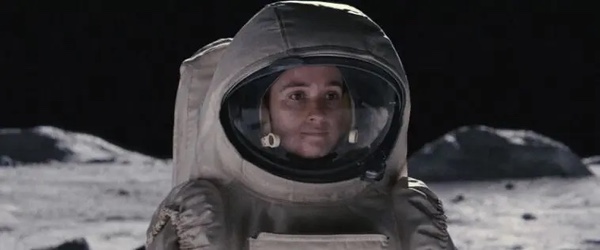
| Rather than depicting these events as exciting, challenging efforts to extend human presence into the solar system, Star City portrays them as the actions of an authoritarian government that grinds down and crushes even its best people. |
For All Mankind has now spawned a spinoff, Star City, that debuted this spring. But unlike the hope and ambition and excitement of its predecessor, Star City is the kind of storytelling that is often labeled as grimdark, a subgenre of speculative fiction defined by a bleak, dystopian, violent, and amoral tone or setting. Ideals like hope, honor, and easy redemption are scarce. But like getting stuck talking to a goth teenager at a holiday party, it’s just not any fun, and you’ll soon find yourself pining for something a little more cheerful. (see “Wasn’t the future wonderful?” The Space Review, March 9, 2020).
The first season of For All Mankind consisted of ten episodes covering the period of roughly 1969 to 1975, with NASA establishing a rudimentary outpost at the Moon’s south pole, facing off against a similar station built by the Soviet Union. The series began with a bold premise: what if only a few weeks before the planned Apollo 11 mission, the Soviet Union landed a man on the Moon? And then what if the Soviets followed this up by landing a woman on the Moon? How would that affect the American space program? In that show, it set in motion some interesting sexual politics where women walked on the Moon and even became president.
The first episode of Star City begins at exactly the same spot, with Alexei Leonov’s walk on the Moon. Except that the first scene is of a woman being taken from her apartment by armed soldiers without explanation and led to what we quickly assume is going to be a prison, only to discover that she is Leonov’s wife, being shown her husband on the Moon’s surface. This sets the tone for the entire series—even in triumph, there is oppression and fear and danger.
The first season of Star City tells the story of the early human lunar missions from the Soviet perspective, set primarily at the sprawling Soviet space design and engineering complex that in real life is named Star City. Its eight episodes cover the period from 1969 to 1971, starting with the first successful Soviet landing on the Moon but quickly moving on to the story of the first woman on the Moon, and then the events following her flight, including an effort to start a base on the Moon, a mission to Venus, and the Salyut 1 Earth orbiting space station.
But unlike For All Mankind, rather than depicting these events as exciting, challenging efforts to extend human presence into the solar system, Star City portrays them as the actions of an authoritarian government that grinds down and crushes even its best people. Nobody is happy, nobody is joyful, nobody has any agency. Life is pain and hardship, the best you can do is stay out of prison, and then you die. The show has a limited color palette of greys, drab greens, and washed-out blues. You won’t see any yellow or orange, just life-sucking dreariness. It is an unattractive, muddy slog of a show, visually, and narratively.
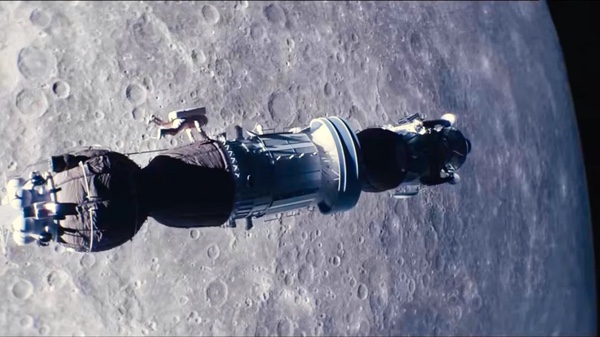 There is not a lot of spaceflight in Star City, an alternate history covering the years 1969–1971. What little there is usually involves somebody dying, and not in a good way. (credit: Apple TV) |
Cosmonauts don’t get to have any fun
For All Mankind did not delve into the activities of the Soviet space program except as initiating events for the Americans. We mostly learned about them by seeing news broadcasts about the latest Soviet space triumph. The startling revelation in Star City is that those bold Soviet accomplishments were horrible for their actual participants. Anastasia Belikova is the first woman on the Moon, a great propaganda victory for the Soviet Union. But in Star City, we learn that she was not the first choice for the mission—the outstanding female cosmonaut was shot in the head due to a clerical error, and a brutal government that never admitted to mistakes. Belikova was considered a bit of a loser by everybody, did not want to go on the mission, and then messed up. Afterwards she is given a blunt ultimatum: go on a worldwide publicity tour or a lookalike will take her place, and she too will be shot in the head.
Life doesn’t get any better for Belikova during a propaganda trip to Paris. She’s a prop, a puppet on the world stage. Like all the cosmonauts, and like everybody else involved in the space program, she is under constant surveillance. She is then forced to marry a fellow cosmonaut, a cocky playboy who despises her.
| Star City has decided that Russians never experienced joy or knew how to laugh, and the misery is shoveled on with a trowel, to the point where it works against the premise of space exploration. |
Behind much of the action is the unnamed Chief Designer, played by Rhys Ifans, probably the only actor you will recognize (even if you only remember him in his underpants as the “masturbating Welshman” in the 1999 romantic comedy Notting Hill). Other characters include Star City’s stoic and brutal head of security and chief executioner, her mousy but clever assistant, a brilliant engineer, the head of cosmonaut training, his lonely wife, and the cocky hotshot former MiG pilot she’s sleeping with. They’re all miserable, all the time. Even when they’re accomplishing great things nobody is enjoying themselves. Everybody is just a cog in an authoritarian machine, struggling to survive, even if that means reluctantly walking on the Moon.
Dramas can go dark places—Breaking Bad was about a man’s pride and ego leading to his transformation into a monster. But that show also had a sense of humor. Star City has decided that Russians never experienced joy or knew how to laugh, and the misery is shoveled on with a trowel, to the point where it works against the premise of space exploration. There is even a scene where two mud-covered peasants stare up from their collective farm to see a spacecraft falling to Earth. It’s hard to believe that the people who built the Soviet spacecraft and rockets in the 1960s didn’t sometimes enjoy their jobs, or never found them exciting, and didn’t take delight in beating the pants off the Americans. For so many people involved in spaceflight, it’s a calling. They do it because they want to do it, because it’s cool, and because other professions are less appealing. In Star City, nobody is inspired to explore space, they’re motivated by the barrel of a gun.
Many of the subplots revolve around surveillance, espionage, blackmail, and betrayal, and the writers clearly took some of their cues from the outstanding 2013–2018 series The Americans, a taut psychological drama about Soviet spies in the 1980s living in the suburbs of Washington, DC across the street from an FBI agent. A major theme of that show was the complications and moral compromises of working for—and fighting against—the brutal Soviet system. The Americans was far better written and had more interesting characters. One gets the sense that the writers of Star City were from former Soviet occupied territories and really hate the Russians.
Yes, the Soviet government was oppressive and often brutal. The problem is that this makes for boring television, and after a couple of episodes it became tiring. I kept watching because space history is one of my callings, and because I enjoyed the first several seasons of For All Mankind before gradually losing interest because of the soap opera elements and the introduction of an arrogant, aloof billionaire space explorer only slightly less insufferable than Elon. It seems like a cruel trick to make a show about exploring space so brutal and dark. In space, maybe no one can hear you scream, but they can probably hear you snore.
Note: we are now moderating comments. There will be a delay in posting comments and no guarantee that all submitted comments will be posted.