Burning Falcon: the death of a Russian laser ASAT planeby Dwayne A. Day
|
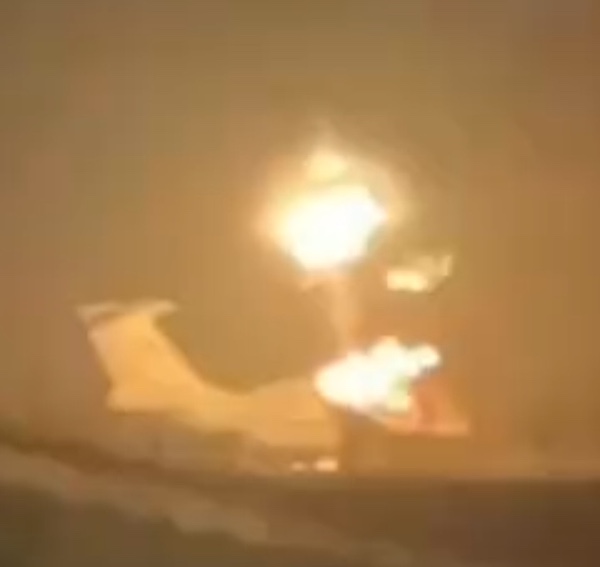
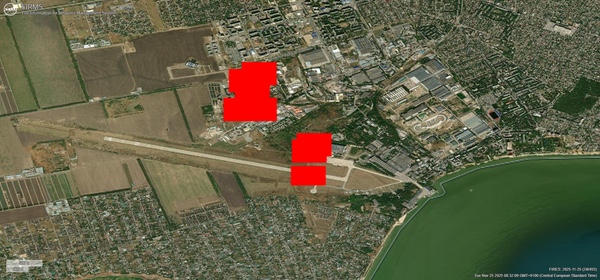 The night of the attack, the NASA FIRMS infrared sensor showed infrared events at the Taganrog airfield, later confirmed by satellite images. (credit: NASA) |
Popping balloons
In the very early 1980s, CIA analysts at the agency’s headquarters outside of Washington received an odd bit of intelligence. According to a former analyst, a Russian who emigrated to Israel had reported on a new aircraft that the Soviet Union was developing. It was a modified Il-76 transport aircraft equipped with a laser to shoot down American “spy balloons”.
The Russians had an active laser weapon development program, as did the United States. What surprised the analysts was that they were unaware of any American “spy balloons” for the Soviets to shoot at.
| The aircraft, which was designated the Beriev A-60, was an awkward-looking bird featuring a bulbous nose and several other large bulges to the fuselage. |
It is possible that the information was compartmented and the CIA analysts didn’t have the need to know about it. The United States had certainly flown reconnaissance balloons over the Soviet Union in the 1950s and apparently had a program to disguise signals intelligence receivers as weather balloon equipment during the 1960s. But the émigré’s story did not make sense in the early 1980s, long after the programs were supposedly discontinued (see “The truth is up there: American spy balloons during the Cold War,” The Space Review, April 17, 2023.)
A few years later, the CIA, checking periodic imagery of the airfield where the aircraft was based, saw that it had burned up. Analysts reviewing the evidence concluded that there had probably been an accident involving the reactive chemicals used in the gas-dynamic laser. It would be many years before they learned the truth. A second aircraft was converted, but it was not finished until the early 1990s and was placed in storage without starting test flights.
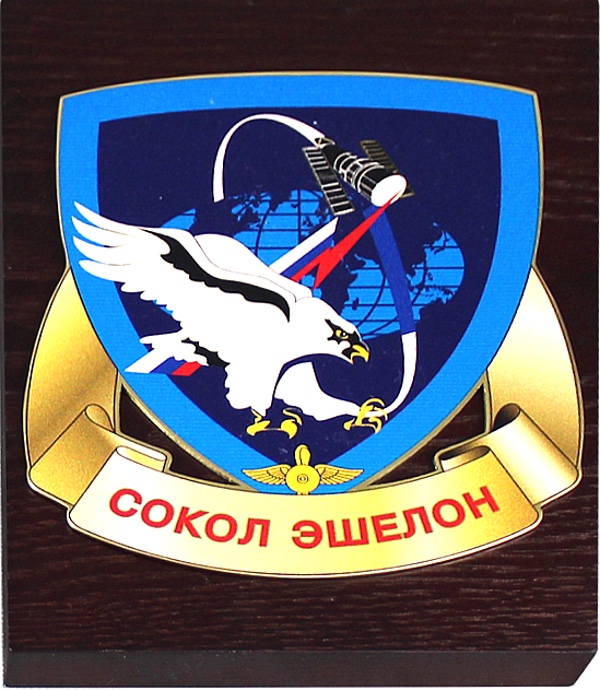 The badge for the SOKOL-ESHELON project, which shows a lightning bolt striking what looks like the Hubble Space Telescope, symbolizing an American reconnaissance satellite, and making it go dark over Russian territory. (credit: Russian internet) |
Misshapen Falcon
By the 2000s, the Russians began flight testing a converted Il-76 transport aircraft equipped with an onboard laser. Painted on the side of the aircraft were the words “SOKOL-ESHELON,” which translate to “Falcon Echelon”, and an image of the Hubble Space Telescope being zapped by a lightning bolt and going dark over Russian territory.
The aircraft, which was designated the Beriev A-60, was an awkward-looking bird featuring a bulbous nose and several other large bulges to the fuselage. Although some reports stated that the nose housed a tracking laser in a turret, like the US Air Force’s 747-based Airborne Laser, close up photographs of the nose revealed no openings or indications that it rotated to expose a laser emitter. A December 2010 Russian article indicated that this was a “Ladoga-3” radar for detecting aerial targets. Two bulges on either side of the lower fuselage reportedly housed auxiliary power unit generators for the laser. A large bulge on the upper back of the aircraft, which was not easily visible in photos from the ground, was apparently a sliding port for a one-megawatt laser turret. The laser was clearly intended to fire upwards, at something above the plane, rather than to the sides or down, to engage ground targets or other aircraft. It apparently had an effective range of 300 to 600 kilometers. It was that distinctive bulge on the upper side of the plane that quickly led observers to believe that it was this aircraft that was blown up in the Ukrainian attack.
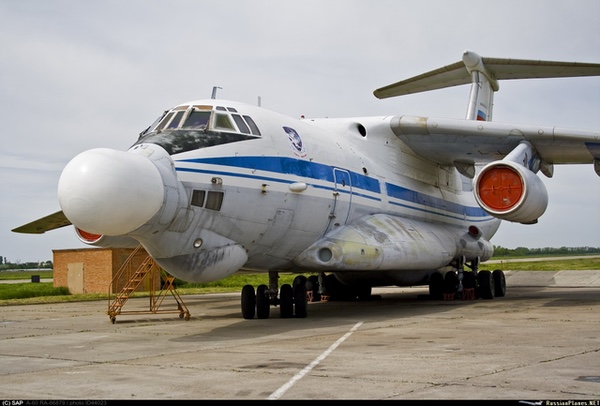 The A-60 was equipped with a tracking radar in the nose. The plane was parked for a long time before it was destroyed. (source) |
| The first Russian airborne laser aircraft, the one spotted by the CIA and later destroyed by fire in the 1980s and designated LL1A, had a somewhat stereotypically Russian demise. |
Although a Russian artist chose to paint the Hubble on the plane, it was clearly meant to symbolize an American reconnaissance satellite. The satellite’s path indicated a polar orbit that goes black over Russian territory—the obvious implication being that the laser was intended to blind or otherwise disable American surveillance satellites over Russia.
It is likely that this was somewhat fanciful and that Falcon Echelon was a test program and not an operational laser system.
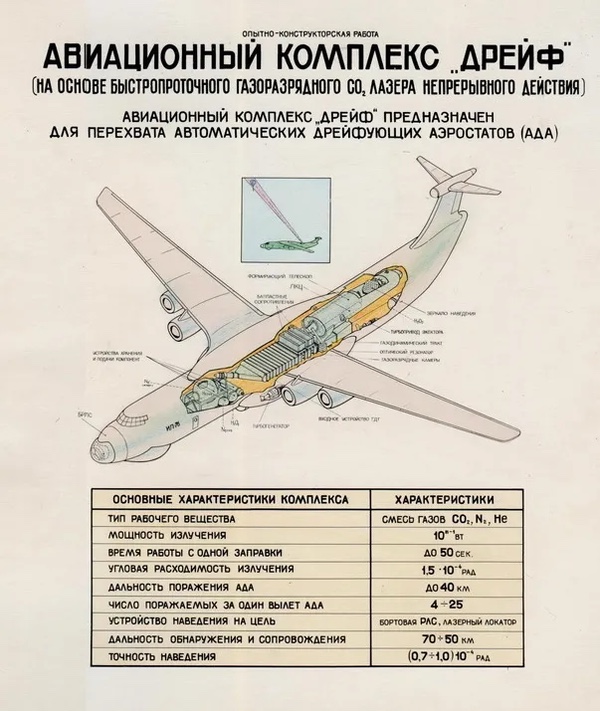 Internal cutaway of the modified Il-76 aircraft. This depicts the first laser test system, which was destroyed in a fire in the late 1980s. Another airplane was converted in the late 1980s and was the one destroyed in 2025. (credit: Russian internet) |
Cold War origins
The original airborne laser program was started in 1977 and used a modified IL-76(MD) aircraft renamed the Beriev A-60 for the Beriev aircraft company that modified the airframe. The first aircraft was designated 1A and first took flight on August 19, 1981. The second aircraft, designated 1A2, did not fly until August 29, 1991. According to Pavel Podvig, a researcher on Russian strategic weapons systems, the project was originally called Dreif (“Drift”).
The first aircraft began laser tests against airborne targets in late 1983–1984 and fired against high-altitude balloons at 30 to 40 kilometers altitude. The plane later was used to attack an airborne La-17 drone aircraft.
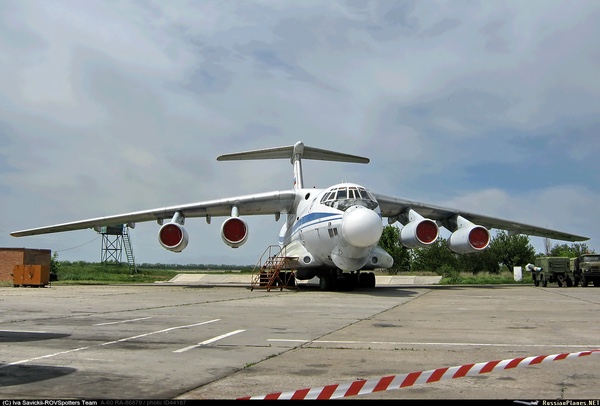 The A-60 was a modified Il-76 transport plane. (source) |
The first Russian airborne laser aircraft, the one spotted by the CIA and later destroyed by fire in the 1980s and designated LL1A, had a somewhat stereotypically Russian demise. No James Bond snuck onto a military installation late at night and planted plastic explosives to destroy a Soviet superweapon. Instead, it was a story that is all too Russian. According to one account, the aircraft was being prepped for flight. Early one morning two technicians snuck out to the aircraft to siphon alcohol out of its de-icing system so that they could party. This is not exactly news—MiG pilot defector Viktor Belenchko discussed this practice in the 1980 book MiG Pilot and noted how it was common for enlisted personnel to suffer alcohol poisoning from drinking the nearly toxic brew that was used in aircraft de-icing systems. But the system was pressurized, and while the men were in the plane they somehow started a fire. They jumped out, closed the hatch, and ran away. When a fire crew finally showed up, the firemen did not have permission to open the hatch on the secret aircraft to get inside with their fire hoses. Unfortunately, the aircraft apparently exploded on the ground, killing one person. The airplane was lost, and later photographed by American reconnaissance satellites.
A second aircraft, designated LL1A2, was built and first flew in 1991, but the program was ended by 1993. The aircraft was preserved for another decade before being called into service.
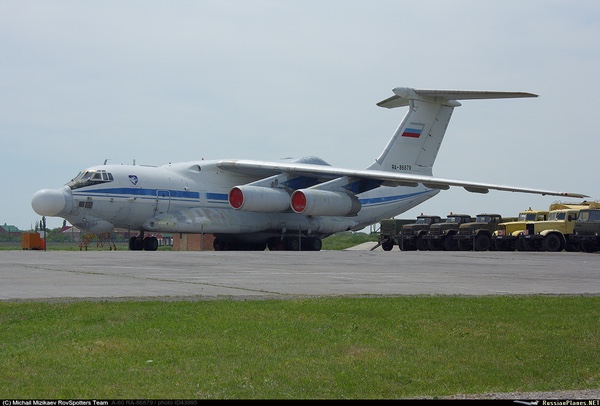 The modifications to the aircraft included a hump behind the wing for the laser aperture. (source) |
Laser sword
The Russian military started the SOKOL-ESHELON program in 2002. NPO Almaz was the prime contractor. The Chemical Automatics Design Bureau (KBKhA) in Voronezh started development of the laser system. Russian language articles about SOKOL-ESHELON referred to it as being in the “OKR” or “Experimental Design Work” stage, a well-established R&D category that follows “NIR”, “Scientific Research Work.” One of the subcontracts let under SOKOL-ESHELON is for a precision system for imaging “exoatmospheric objects”, which tends to support the ASAT application theory that was confirmed by the satellite on the aircraft’s emblem.
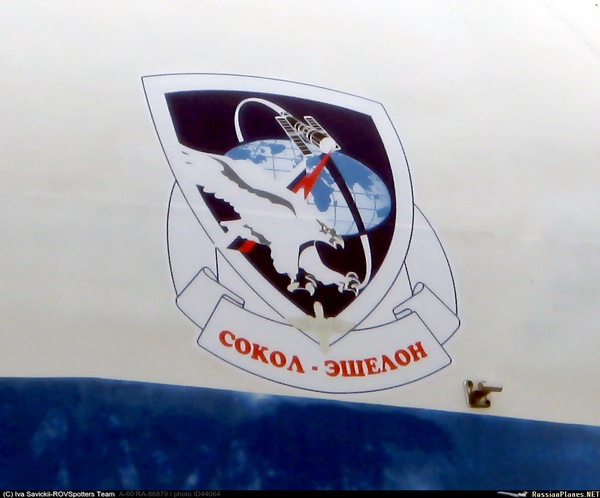 The logo on the aircraft indicating that its intended target was an American satellite. (source) |
Test flights of the LL1A2 aircraft started in the second half of the decade. On August 28, 2009, the aircraft fired a laser at Ajisaj, a Japanese geodetic satellite equipped with reflectors, making it a good target for a test.
By 2011, a new Il-76 aircraft was ordered to continue tests. It was built in 2014 and delivered to the Ministry of Defense in 2015. According to Russian space analyst and historian Bart Hendrickx, who kept track of the program by searching for obscure Russian military procurement documents, SOKOL-ESHELON continued throughout the 2010s, but remained an experimental test program during this time, not transitioning into an operational weapon system. The older LL1A2 aircraft was to be a test aircraft, with the newer modified Il-76 intended to carry an operational laser. One illustration emerged allegedly of this third aircraft modified with a bulbous structure mounted behind the cockpit, apparently the aperture for the upward-shooting laser. This was different than the rear-mounted laser aperture on the LL1A2 aircraft.
Rather than destroy satellites, it was intended to “dazzle” or blind them. Dazzling means obstructing their optical sensors, like somebody shining a flashlight in your eyes at night. Blinding involves permanently destroying the optical sensor. Significant information on the LL1A2 aircraft, including an internal cutaway of what was apparently the preliminary design, is on a Russian website.
The program gathered a lot of media attention in Russia, but not all of it positive. One article referred to it as “pointless and not so ruthless.” Although the Beriev A-60 was photographed in flight and the Russian media reported on several test successes, by 2011 it was photographed by amateur military buffs, looking slightly weather-beaten. It was parked at an unguarded location.
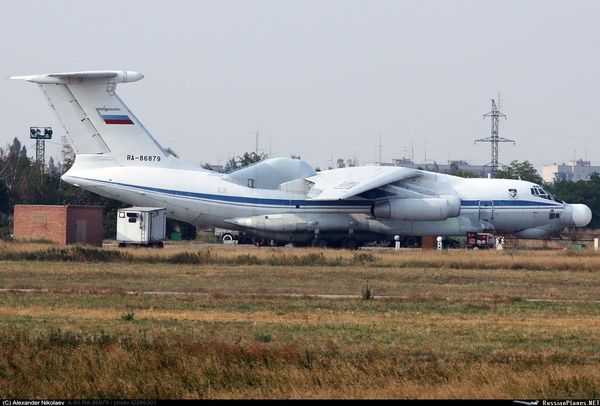 The A-60 parked at the location where it was destroyed in November 2025. (source) |
By 2015, the aircraft was parked at a location at Taganrog near the end of an apron and outside of a large maintenance building. According to Google Earth photos, it sat there for the next ten years, occasionally moved to another spot before moving back, but apparently never leaving the airport or the ground. The last flight was apparently in 2016. There it sat, until Ukraine blew it up last week.
By 2020, SOKOL-ESHELON was apparently canceled. As Hendrickx noted in 2022, the decision to terminate the program was made in 2017, but it took another three years to actually terminate it, with some minor experiments still taking place. There were plans to remove equipment from the LL1A2 aircraft, but no indications that this ever occurred.
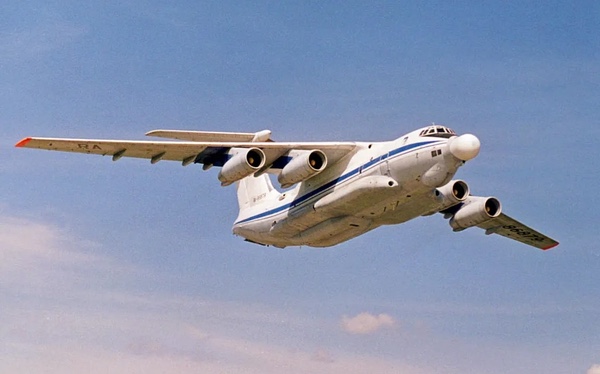 TThe A-60 was tested in the later 2000s. Its last flight was apparently in 2016. It is unclear why Ukraine targeted it. (credit: Russian internet) |
Russia has long had ground-based laser programs. During the Cold War they were based at a sprawling missile test complex at Sary Shagan, in Kazakhstan. Even by the mid-1970s the CIA undertook a project called LAZY CAT to put a telescope with a laser detection sensor on an Iranian mountaintop to detect the reflection of lasers fired at satellites over Sary Shagan (see “Lazy Cat on a mountaintop,” The Space Review, April 29, 2024.)
| The attack on the A-60 is puzzling. The aircraft was no longer in use. Even if the laser equipment was stripped out, it is unlikely the plane would have had much military value as a transport. |
Russia was also pursuing development of a ground-based laser ASAT system. Peresvet and Kalina are ground-based laser dazzling systems, with Peresvet apparently now operational (see “Peresvet: a Russian mobile laser system to dazzle enemy satellites,” The Space Review, June 15, 2020, and “Kalina: a Russian ground-based laser to dazzle imaging satellites,” The Space Review, July 5, 2022.)
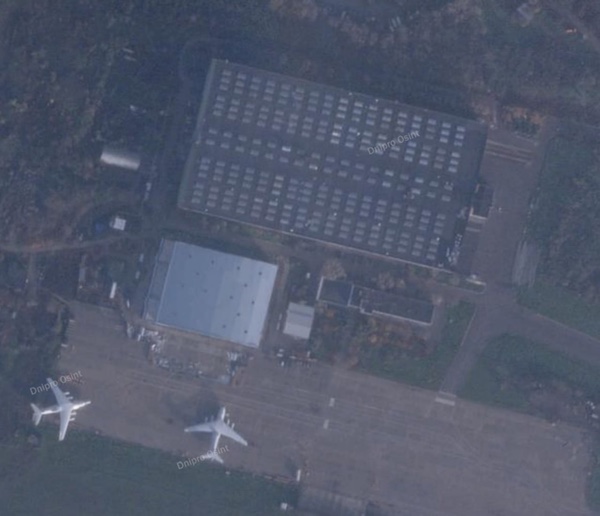 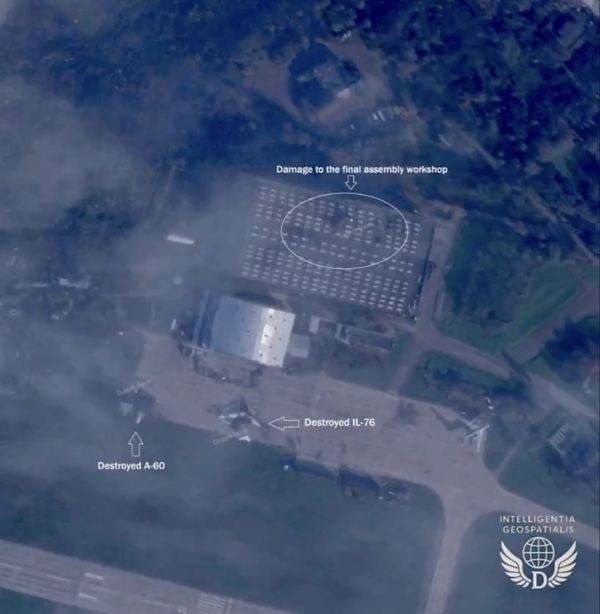 Planet satellite photos showing the airfield before and after the attack. The A-60 and an Il-76 modified as a radar plane were destroyed. Surprisingly, the Tu-95 Bear bomber was not attacked. (credit: Planet, via Intelligentia Geosptialis) |
A mysterious target
The Ukrainian attack destroyed the A-60 and another aircraft nearby designated A-100. The A-100 was an experimental airborne warning and control aircraft that had apparently not achieved much success. Nearby a Tu-95 Bear bomber remained unscathed. Additional Ukrainian missiles hit part of an aircraft maintenance building. According to a Ukrainian report, an important target inside that building was hit.
The attack on the A-60, and to lesser extent, the A-100, is puzzling. The aircraft was no longer in use. Even if the laser equipment was stripped out, it is unlikely the plane would have had much military value as a transport, because it would have required substantial structural modification. The Bear would have been a more significant target because that type of aircraft is involved in launching missiles at Ukraine, and Ukraine destroyed several of them in a daring raid in June. Perhaps another aircraft was parked nearby earlier in the day and moved before the nighttime attack. Perhaps at some point the Ukrainian military will reveal why the plane was targeted.
Note: we are now moderating comments. There will be a delay in posting comments and no guarantee that all submitted comments will be posted.