Review: Gemini: Stepping Stone to the Moonby Jeff Foust
|
| When a reporter asked Gus Grissom a “damn-fool question” at a press conference ahead of the Gemini 3 launch, “Grissom regarded him the way he’d regard a fly that had gotten through the screen door of his Houston home and was buzzing peskily around his head.” |
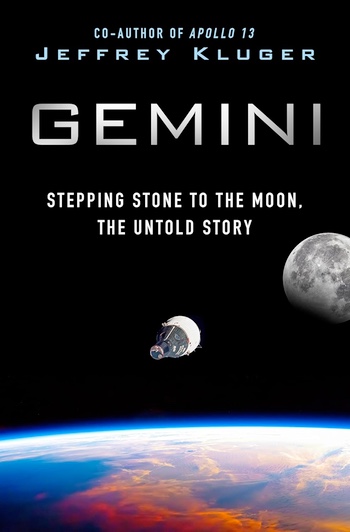
Adding to that pile of books is Gemini: Stepping Stone to the Moon, the Untold Story, by Jeffrey Kluger, the longtime space writer for Time and perhaps best known for coauthoring Lost Moon with Jim Lovell more than 30 years ago, telling the story of Apollo 13. Kluger is among those who think Gemini has gotten short shrift over the years and plans to remedy that oversight.
“The gripping and glittery tale of the Gemini program—one defined by its successes, yes, but also by its tragedies and losses and deaths and near deaths—has never been fully told before,” he argues in the book’s introduction.
The book is, at one level, an entertaining history of Gemini. Kluger takes the reader through the decision to develop Gemini to test capabilities needed for Apollo and the challenges the development faced (including plans, later abandoned, to land the capsule using a parafoil, an effort covered in great detail in a series of articles here last fall.) The missions themselves follow, giving Kluger an opportunity to profile the astronauts as well as the missions’ achievements.
Kluger is a talented writer, and that skill makes the book a fun read with a turn of a phrase. He notes NASA calls a spacewalk an extravehicular activity in the “arid argot” of the agency. When a reporter asked Gus Grissom a “damn-fool question” at a press conference ahead of the Gemini 3 launch, “Grissom regarded him the way he’d regard a fly that had gotten through the screen door of his Houston home and was buzzing peskily around his head.”
The book offers tantalizes the reader with part of its subtitle: “The Untold Story.” However, it’s here where the book falls short. Readers going in expecting to find something truly new—untold—about the Gemini program are likely to come away disappointed. Any new details about Gemini are on the fringes, rather than at the core of the Gemini program story.
That is not surprising since it appears there was little in the way of new material available for Kluger for the book. In the book’s acknowledgements, he noted that, unlike his previous books, he could not do fresh interviews for this: the 60 years since the Gemini missions means few people who worked on the program are around today. He instead relied in older interviews as well as a wide range of sources, from NASA oral histories and documents to other books on Gemini. That makes it difficult to finding something truly untold.
And, despite the argument that Gemini has not gotten the attention due to it, the program has to share space in the book. Kluger gradually builds up to Gemini, including offering a capsule history (no pun intended) of Mercury along the way; only halfway through the book does Gemini 3, the first crewed mission, finally lift off.
The end of the book includes an extended epilogue after the final Gemini mission that is, in effect, a short history of Apollo, from the Apollo 1 fire through the lunar landings. Ironically, even in a book dedicated to Gemini, the program still has to fight for attention with Mercury and Apollo.
Note: we are now moderating comments. There will be a delay in posting comments and no guarantee that all submitted comments will be posted.