Gala time! The Chinese New Year narratives of the space programby Krzysztof Karwowski
|
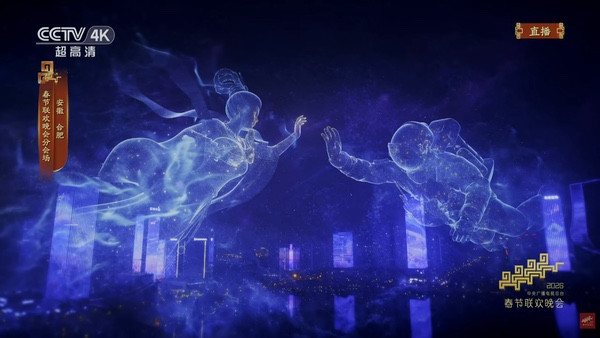
| CCTV’s flagship New Year program functions not merely as an entertainment show, but as a fledgling instrument of Chinese soft power. |
The phenomenon of Chunwan lies in its distinctly Chinese cultural core, interwoven with state messaging and a carefully curated narrative of national success. The event spans the achievements of the Chinese state, economy, and political leadership. The Gala presents a broad spectrum of performances, such as the traditional stage arts (including lion and dragon dances and martial arts), classical and popular music, contemporary genres with a strong emphasis on Chinese Pop. Comedy sketches address selectively framed social issues through humor, maintaining alignment with official narratives.
A permanent and highly promoted component of the show is the performance by military artistic troops, with the prominent presence of the PLA General Political Department Song and Dance Ensemble. This large military performance group is composed of artistically trained soldiers, many of whom graduated from the former Military Academy of Arts in Beijing (now the PLA National Defense University’s College of Military Culture). Among its most famous members was Peng Liyuan, the current First Lady of China and spouse of Chairman Xi Jinping, who served as the ensemble’s commander from 2009 to 2012 before leaving the military with the rank of general.
Military segments often resemble drill-like, choreographed spectacles. The dancers frequently appear with military equipment or against backdrops featuring the latest defense technologies like newly commissioned naval vessels, advanced combat fighter jets, and even ballistic missiles.
As such, CCTV’s flagship New Year program functions not merely as an entertainment show, but as a fledgling instrument of Chinese soft power. It is designed to cultivate national pride domestically and foster a sense of community among the overseas Chinese diaspora. At the same time, Chunwan has attracted a growing global audience, serving as channel for communicating China’s economic, infrastructural, and high-tech achievements beyond its immediate sphere of influence in Africa, Europe, and the Americas.
Recurring lyrical themes include contemporary political slogans such as the “Chinese Dream,” the “innovative society,” and “green development.” They are accompanied by the colorful visualizations and scenes inspired by rapidly expanding Chinese cities. A modern transport infrastructure, including metro networks, high-speed rail, and domestically manufactured ships, is also popular. Motifs drawn from traditional art: floral symbols, birds, and mythical creatures, are interwoven with narratives highlighting China’s indigenous wind and solar energy, advances in robotics, and even progress in nuclear fusion research. The Chinese space program has repeatedly occupied a prominent position during the Gala, as examined below.
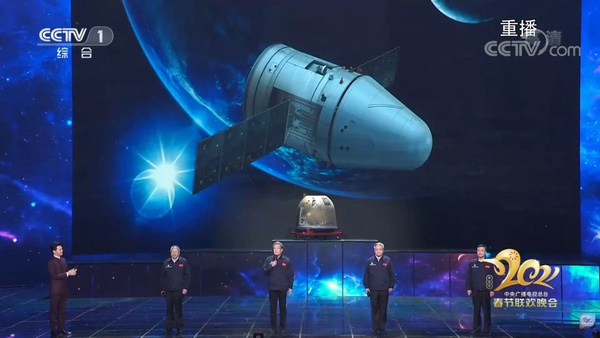 The 2021 Gala sequence presenting the engineers of the space program. (credit: CCTV-1, screened by K. Karwowski on February 16, 2026) |
Pop culture spaceflights?
The mythology of the Middle Kingdom is particularly rich in lunar motifs. The Moon occupies a central place in the Chinese civilizational imagination. It is structuring the traditional calendar still in use today and anchoring China’s most important festivals: the Spring Festival, inaugurating the New Year, and the Mid-Autumn Festival dedicated to the moon goddess Chang’e. In her honor, the China Lunar Exploration Program (CLEP) probes have been named. Chang’e also became a symbolic patroness of China’s broader space endeavor, frequently featured in promotional materials. Cosmic and cosmological symbolism is therefore not new to Chinese art. What is new, however, is its deliberate fusion with the promotion of the indigenous aerospace innovations.
On the Chunwan Gala—broadcast annually since 1983—the space program made its first appearance in 2009. The segment followed China’s first-ever spacewalk, conducted during the Shenzhou 7 mission. The crew members, Zhai Zhigang, Liu Boming, and Jing Haipeng, were ceremonially introduced on the stage, dressed in their navy blue spacesuits and waving a national flag carried back from orbit.
The Shenzhou program returned to CCTV in February 2013 during a performance titled “Chang’e The Moon Fairy Song“. An opera soprano dressed as Chang’e performed in the scenery of a starry sky and a floating taikonaut. Following the musical segment, a Tiangong 1 laboratory module appeared on screen from which the crew of Shenzhou 9 emerged, including Liu Yang, the first Chinese woman in space. When asked by the TV host whether she represented a contemporary incarnation of Chang’e, Liu modestly declined this comparison.
| Cosmic and cosmological symbolism is not new to Chinese art. What is new, however, is its deliberate fusion with the promotion of the indigenous aerospace innovations. |
In 2017, the crewed spaceflights were granted an extended, highly symbolic part. A large national flag rose from the stage, revealing all members of the PLA Astronaut Corps to date, including Yang Liwei, the first Chinese citizen to travel into space. The taikonauts introduced themselves, delivered New Year’s greetings, and placed handprints on commemorative plaques later exhibited at the National Museum in Beijing, ritualizing their status as national icons.
Recognition at the Gala has not been limited to flight crews only. In 2021, the engineers from major state-owned aerospace corporations addressed the nation. Among them were Zhang Zihui (associated with Chang’e program), Zhang Bainan (Shenzhou program), Xie Jun (BeiDou navigation constellation), and Sun Zezhou, the chief engineer of China’s first Mars mission, Tianwen 1. The Gala coincided with the probe’s arrival on Mars a week earlier. The 2021 show reinforced the narrative of China as a civilization of engineers and astronomers in the making.
In 2022, following the midnight countdown, the taikonauts Zhai Zhigang, Wang Yaping, and Ye Guangfu delivered live New Year’s wishes from the Tianhe core module in orbit. During one of the digital sequences, a visualization of the completed Tiangong space station was presented too. The space program reappeared in 2023 through musical performances interspersed with footage of the space station, Martian mission, and the Yuanwang space tracking and telemetry ship. Similar midnight greetings were broadcast again in 2025 from both a Yuanwang and the fully operational Tiangong station.
The 2026 edition continued this trajectory. That year’s Spring Gala was hosted by Anhui Province (southeastern China). Its capital, Hefei, located in the Jianghuai subregion, has emerged as a major hub for advanced research. At the center of this ecosystem stands the University of Science and Technology of China (USTC), a premier public research university founded in 1956 “to develop a high-level science and technology workforce, as deemed critical for the development of China’s economy, defense, and science and technology.”
| The integration of space exploration into Chunwan reflects Beijing’s broader strategy: embedding high-quality achievement within civilizational continuity, aligning legendary symbols, national rejuvenation, and aerospace ambition into a single, pop culture narrative of state-led progress. |
The USTC choir performed in a segment titled “Harmony Transforms the Jianghuai Region,” which integrated traditional dance and historic architecture of the province with its high-tech achievements. Interludes showcased smart city development, Chinese electromobility, fusion energy experiments, and space-related research. USTC plays an active role in national space industry. Among its contributions are participation in the Mozi QUESS (Quantum Experiments at Space Scale) quantum science satellite, components instrumentation for BeiDou and Chang’e probes. Hosting the School of Earth and Space Sciences and the renowned TianduLAB aerospace research platform, USTC has also contributed to the crewed and lunar programs, including the design of the Lanyue lunar lander, featured likewise during the Gala.
New Year’s conclusion
It is self-evident that states leverage scientific and technological advancement to project an image of stability, prosperity, and attractiveness. In this way, the integration of space exploration into Chunwan reflects Beijing’s broader strategy: embedding high-quality achievement within civilizational continuity, aligning legendary symbols, national rejuvenation, and aerospace ambition into a single, pop culture narrative of state-led progress. Drones, traditional paper-cutting art, high-end computer graphics, Cantonese opera, and spacefaring are mixed together into an annual display of PRC’s industrial and technological might. The result is a spectacle that merges culture, innovation, and statecraft.
The Gala also embodies Joseph Nye’s concept of soft power. The case of China, given its deep historic heritage, rich traditions, and contemporary digital dynamism, illustrates the particular sophistication and scale. Exchanging greetings for the New Year of the Fire Horse, it is worth watching Chunwan with analytical curiosity. The Gala is not only a platform for show business celebrities or social media influencers. It is also a narrative vehicle highlighting rising investments in STEM education, scientific research, and aspirations for ever more ambitious deep-space missions. Such discourse underpins Chinese science diplomacy as a strategic instrument of influence, increasingly complementing traditional diplomatic engagement with the promise of partnership, infrastructure development, and collaboration.
Note: we are now moderating comments. There will be a delay in posting comments and no guarantee that all submitted comments will be posted.