Review: Why Space?by Jeff Foust
|
| Space advocacy has shifted over the last few decades, from trying to convince people that there were more commercial approaches to space to trying to convince people that the growth of commercial space, led by billionaire-backed companies, is not a bad thing. |
Years ago, that statement was aspirational, at best; today, it’s closer to reality. SpaceX performed as many orbital launches in 2025 as the rest of the world combined, while its Starlink constellation now approaches 10,000 satellites, an order of magnitude more than the total number of operational satellites in orbit when SpaceX started launching that constellation. More companies developing various other space capabilities focused on government and commercial customers: last Thursday, for example, Sierra Space announced it raised $550 million for satellite production at the same time Vast announced a $500 million round to help advance its commercial space stations. Even the administrator of NASA is someone who funded and commanded two private astronaut missions.
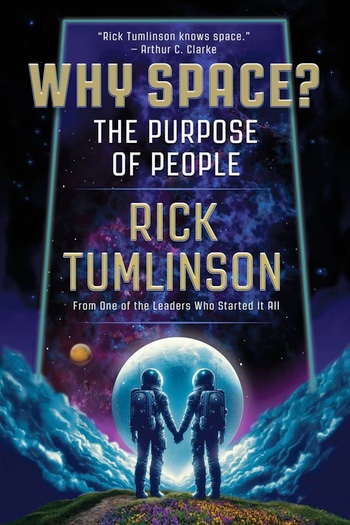
So, what do you do with that revolution? That is the underlying theme of Why Space?, Tumlinson’s new book. As the title suggests, it explains why he believes space is important for humanity’s future, but for reasons far beyond traditional explanations.
Why Space? is a bit difficult to categorize: is has elements of a traditional book examining space markets and the potential for startups to establish new ones. However, it also has aspects of a memoir, as Tumlinson discusses his life and the long, twisting path that he took in the space field. It even approaches the realm of self-help, as he urges the reader to find their purpose in life.
In the book, he espouses what he calls the “Principles of Purpose” for humanity: to protect and expand the domain of life, to honor and evolve humanity, and to explore and experience everything in the universe. Achieving these requires humanity to go into space, he argues, taking advantage of the growing commercial capabilities to do so.
It is interesting to contrast the arguments made in this book with those in another recent book, Becoming Martian (see “Review: Becoming Martian”, The Space Review, March 2, 2026). In that book, Scott Solomon argues that it may be possible for humans to live beyond Earth but that that “we must learn how to get along with one another” first. Tumlinson, by contrast, sees that not as a prerequisite for permanent space settlements but an outcome of them, since the harsh conditions will require humans to learn to get along with one another to survive. “Going up is how we grow up,” he concludes.
Space advocacy has shifted over the last few decades, from trying to convince people that there were more commercial approaches to space to trying to convince people that the growth of commercial space, led by billionaire-backed companies, is not a bad thing. A section of the book is devoted to that backlash to people like Elon Musk and Jeff Bezos, with Tumlinson arguing that “whether you see them as heroes or villains, in this one area, they are on the side of progress.”
He concludes the book by stating he is more energized than ever about what the future may hold for humanity in space, with no plans to retire, seeing opportunities “to help shape the incredible future that is rushing towards us at light speed.”
Note: we are now moderating comments. There will be a delay in posting comments and no guarantee that all submitted comments will be posted.