Igniting a new vision for NASAby Jeff Foust
|
| “The difference between success and failure will be measured in months, not years,” Isaacman said. |
Last week, in the same auditorium, was one of the biggest announcements since then. Rather than a brief presidential speech, NASA leadership spent a full day going through a major revamp of its exploration, science, and space technology plans. Some of the announcements at the “Ignition” event were surprising, while others were widely anticipated. The combination, though, represented the effort by NASA’s administrator, Jared Isaacman, to quickly put his stamp on the agency just months after being sworn in, with the backing of the White House.
He opened the event with discussing the competition with a “real geopolitical rival”—China—to land the next humans to the Moon. “The difference between success and failure will be measured in months, not years. They may be early, and recent history suggests we might be late,” he warned.
“This is why it is imperative we leave an event like Ignition with complete alignment on the national imperative that is our collective vision,” he told an audience of industry executives and representatives of national space agencies.
Replacing Gateway with a moon base
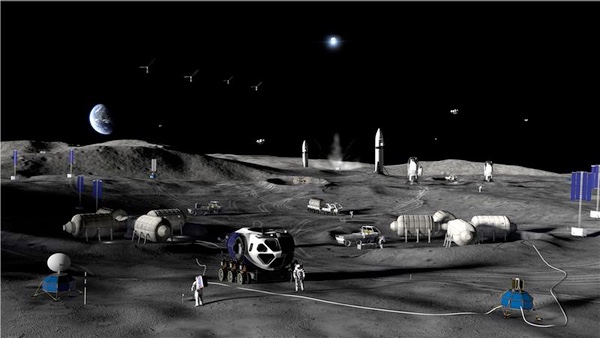
One major element of NASA’s plans at Ignition was also one of the least surprising. NASA confirmed it would not continue development of the lunar Gateway, electing instead to develop a lunar base.
The Gateway had already been targeted for cancellation in last year’s budget and, despite funding in last year’s budget reconciliation bill, was notably absent in the sneak preview of NASA’s exploration plans announced a month earlier (see “Accelerating Artemis”, The Space Review, March 2, 2026.)
“While that is still relevant for future exploration goals, it is not required to accomplish our primary objectives,” said Carlos Garcia-Galan, who previously had been a top manager of the Gateway. “As a result, we are announcing today that NASA is pivoting from the Gateway architecture to focus on building the Moon base.”
Garcia-Galan’s new title is program executive for what NASA simply calls “Moon Base”; Isaacman, at a press conference at the end of the day, dubbed him the “lunar viceroy.” In his talk, Garcia-Galan outlined the plans NASA has quickly developed to create a moon base. “Starting today, we’re building humanity’s first deep space outpost,” he said.
That plan involves three phases from now through the mid-2030s. Phase 1, from 2026 to 2028, “is all about getting to the Moon reliably,” he said, increasing the cadence, but also the reliability, of robotic lunar landers. It will also focus on developing enabling technologies and getting “ground truth” for potential base locations at the lunar south pole.
Phase 2, from 2028 through 2031, would start building the base, using larger cargo landers and twice-yearly crewed missions. The infrastructure there would include communications, power, navigation, and other systems needed to support a human presence there.
Phase 3, starting in 2032, will enable “long distance and long duration human exploraiton” on the moon, he said, with routine logistics missions to the Moon and uncrewed cargo return missions from the Moon.
| “Starting today, we’re building humanity’s first deep space outpost,” Garcia-Galan said. |
It would be by far the most ambitious lunar exploration effort yet, with dozens of missions to orbit and land on the Moon. He estimated Phases 1 and 2 would cost $10 billion each while Phase 3 would cost at least $10 billion, one of the few cost estimates provided throughout the day.
Besides redirecting Gateway, the lunar base plan would affect other programs. Last year, three companies—Astrolab, Intuitive Machines, and Lunar Outpost—submitted proposals to NASA for the Lunar Terrain Vehicle (LTV) program, where NASA would support commercial development of unpressurized rovers for future Artemis missions.
The companies had expected NASA to announce its selection late last year, but months passed with no updates from the agency. At Ignition, Garcia-Galan said NASA was pivoting on the LTV program. Instead of selecting one of the proposals, it asked the companies to revise their proposals to offer a smaller, simpler rover that could be ready earlier.
There will be plenty of other procurements and requests for information, some of which were released last week. “I hope this is a signal that we want to work with you,” he said. “We’re going back to Moon. We’re going to stay there.”
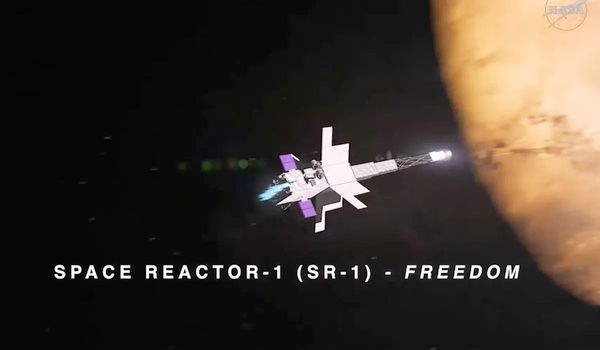 SR-1 Freedom would demonstrate nuclear electric propulsion on a mission to Mars launching in late 2028. (credit: NASA) |
Propelling nuclear
Later in the day, NASA outlined a new nuclear propulsion initiative. The effort replaced a program that started last fall to develop a fission reactor for the lunar surface, for which NASA issued a couple of draft solicitations but never a final version to industry.
That approach involved a partnership with industry that the agency later concluded was too ambitious. “We realized that when we went out and said, ‘Industry, you do it all,’ that was a big ask,” said Steve Sinacore, program executive for NASA’s Fission Surface Power program. The challenges, he said in an interview, went beyond technology to financial and regulatory issues, like indemnification.
“This really is a NASA near-impossible thing. Let’s trailblaze, let’s be the pathfinder, and then hand off to them,” he said.
That resulted in what NASA announced at Ignition: Space Reactor 1 (SR-1) Freedom, a spacecraft that will demonstrate nuclear electric propulsion. The spacecraft will feature a 20-kilowatt fission reactor generating power for the Power and Propulsion Element (PPE), a spacecraft originally built for the Gateway, using solar power for its electric thrusters, but was being repurposed for this mission.
“PPE gives us a huge leg up. That’s the only thing that makes this achievable,” he said. “That’s a very capable spacecraft bus that is going to be adaptable.”
| “This really is a NASA near-impossible thing. Let’s trailblaze, let’s be the pathfinder, and then hand off to them,” Sinacore said. |
One of the challenges for making it achievable is the schedule. NASA wants to launch SR-1 Freedom to Mars in the launch opportunity in late 2028. As proposed, it will spend a year going to Mars, and upon arrival drop off three small helicopters modeled on Ingenuity, the Mars helicopter that accompanied the Perseverance rover, to scout a future landing site.
SR-1 Freedom is designed to kickstart space nuclear power at NASA. Sinacore, in his presentation, noted the billions of dollars spent on past efforts, blaming their failures on several managerial and technical factors like those identified in a report last year (see “From advice to action on space nuclear power”, The Space Review, September 22, 2026).
“SR-1 Freedom is designed to break every one of those patterns,” he said. NASA would lead development of the reactor, rather than industry, with the agency giving those technical plans the agency develops to companies for future reactors, including one for the lunar surface.
Commercial space station redirect
Ignition was focused on more than Moon and Mars exploration. The agency, in a more controversial move, said it wanted to reconsider how it supported the development of commercial space stations.
NASA’s Commercial Low Earth Orbit Destinations, or CLD, program was working with several companies on initial designs of stations. The agency has planned to issue a solicitation last fall for the next phase of the program, backing one or more companies on development and demonstration of those stations with the goal of having them ready by the time the International Space Station is retired in 2030.
NASA revealed at the event it had doubts that was the right approach. “Though we have seen investor interest, there’s no independently verifiable market research indicating the economic viability of a commercial station that is only partially funded by NASA,” said Dana Weigel, NASA ISS program manager.
The agency was also concerned about the ability of companies to handle what associate administrator Amit Kshatriya called the “incredibly complicated” logistics and operations of a space station. “Right now, the current industry that we have that’s proposing to build destinations does not have direct experience with that, or the resources.”
NASA said it was considering an alternative approach. The agency would procure a “core module” that would be installed on the ISS. Additional commercial modules developed by space station companies could be docked to it, giving them access to power, life support, and other resources. That could then become the basis of a commercial space station that separates from the ISS.
“A NASA-procured core would serve as a hub for commercial module expansion, allowing for maturation of industry and continued demand growth after the station detaches from ISS,” Weigel said.
It was a return to concepts first presented a decade ago where NASA offered to make a docking port on the ISS available for a commercial module. The agency selected Axiom Space in 2020 to access that port, to which Axiom originally planned to attach a series of modules that would later become a commercial station. More recently, Axiom planned to use the ISS only briefly, testing a core module there before separating to dock with other modules for its station.
NASA issued an RFI seeking feedback on the concept, but it was clear that industry was opposed to this change in the CLD program.
“Yesterday, NASA announced it is considering yet another major change to the Commercial LEO Destination program, sowing concern and, really, sowing confusion among the commercial space companies I represent,” Dave Cavossa, president of the Commercial Space Federation, said at a House Science Committee hearing on CLDs the next day but scheduled in advance of the Ignition event.
He argued there was strong demand for commercial space stations, based on investment Axiom and Vast recently raised and Starlab Space’s announcement that it had fully booked commercial payload space on its proposed station.
“The commercial market is there. We’ve been building it,” he said. “NASA’s stated rationales for changes to the program are flawed and, ultimately, not addressed by their proposal yesterday.”
Joel Montalbano, NASA’s acting associate administrator for space operations, also testified at the hearing and defended the alternative approach.
| “NASA’s stated rationales for changes to the program are flawed and, ultimately, not addressed by their proposal yesterday,” said Cavossa. |
“We expected a launch market that was going to take off. We expected tourism to take off. We expected the ability to do research and technology development on the International Space Station, bring it back to Earth and mass produce it,” he said. “We’re not seeing any of those three things.”
One member of the committee, Rep. George Whitesides (D-CA), also was concerned about NASA’s potential change of plans. “Based on the old plan, several companies raised probably in excess of $2 billion in private capital and did so on the expectation that NASA would follow through,” he said.
“My concern is that if NASA is not a reliable partner for private investors, we’re not going to get that money and we’re not going to then save money by being able to cost-share with the private sector,” he warned.
Montalbano said that NASA wants to move quickly on any changes to its CLD plans. Responses to its RFI are due April 8, and he said NASA would follow up with a “final RFI” in late April and potentially a request for proposals in June.
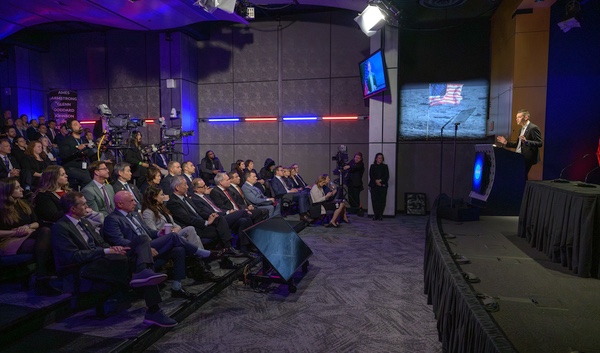 NASA administrator Jared Isaacman discusses the agency’s proposed new programs to an audience of industry and international officals and legislators. (credit: NASA/Bill Ingals) |
Reaction
The Ignition event features more announcements that, had they been made on their own, would have captured headlines. Lori Glaze, NASA acting associate administrator for exploration, hinted at potential changes in Artemis beyond Artemis 5, which might include replacing the SLS with commercial vehicles. (Notably, there was little news about how Blue Origin and SpaceX are accelerating work on their human lunar landers to be ready for a landing as soon as early 2028.) Nicky Fox, the associate administrator for science, talked about two new Earth science mission concepts that would leverage commercial capabilities and sensor technologies that could also be used for future Moon and Mars missions.
There was a lot to digest at the event. Some companies, speaking privately, said they were overwhelmed by the announcements, including the many RFIs NASA issued along with them. They said they would have to pick and choose which ones they had the time and resources to respond to.
International partners had a muted reaction. For major partners like the Canadian Space Agency, ESA, and JAXA, tearing up the Gateway means uncertainty about their investments in Artemis and future roles; many elements designed for the Gateway may not be easily repurposed for a lunar base.
However, the UAE, which planned to develop an airlock module for the Gateway, expressed its support for the new approach. “Following NASA's recent announcements on establishing a sustained lunar presence, MBRSC reaffirms that its engagement with the Artemis program and partnership with NASA continue, as it advances its own lunar capabilities with a clear sense of purpose,” the Mohammed bin Rashid Space Centre said in a statement.
| “NASA does not have a topline problem,” or the size of its overall budget, Isaacman said. “This is just where we choose to concentrate our resources.” |
There is also the need to win over stakeholders on Capitol Hill. “We try to have a ‘no surprises’ policy,” Isaacman said, which include conversations with members of Congress as well as White House and industry in advance of the announcement. “Everybody understands what’s at stake right now, meeting the moment.”
Despite his “no surprises” comment, some in industry as well as among foreign agencies said privately that they had been taken by surprise by some of the announcements at Ignition that will affect their plans.
The announcements come just days before the White House is expected to release its fiscal year 2027 budget proposal. The 2026 budget proposal sought major cuts to science and space technology, along with a nearly 25% overall budget cut for NASA, which Congress largely rejected. Some fear the White House’s Office of Management and Budget will make similar proposed cuts in 2027.
Beyond the estimates for the lunar base, NASA said little about the costs of the initiatives it rolled out at Ignition. “NASA does not have a topline problem,” or the size of its overall budget, Isaacman said. “This is just where we choose to concentrate our resources.”
He suggested that budget, whatever its topline size, will focus on the priorities rolled out in Ignition. “You’re basically looking across the various mission directorates and making sure that, if you have a component and resources, they contribute to one of the major objectives in the president’s national space policy, like the moon base,” he said.
He also made clear he wants to move quickly, making his mark before the end of the Trump administration and thus likely his tenure as NASA administrator. That contrasted with past plans, like those offered by President Bush on the same stage 22 years ago, that deferred the milestones well beyond his time in office.
“This is what it takes if we’re going to get the job done, to go to Moon, do so before our rivals, build the base, and do the other things,” he said.
Note: we are now moderating comments. There will be a delay in posting comments and no guarantee that all submitted comments will be posted.