Accelerating Artemisby Jeff Foust
|
| “Launching a rocket as important and as complex as SLS every three years is not a path to success,” Isaacman said. |
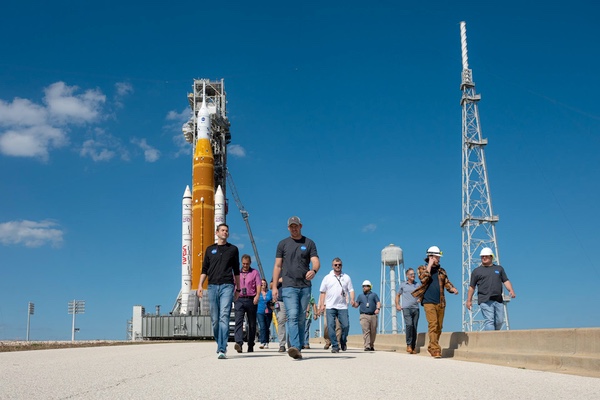
Just 24 hours after that briefing, though, NASA reversed course. Overnight, helium flow in the rocket’s upper stage, the Interim Cryogenic Propulsion Stage (ICPS), stopped. Engineers weren’t sure why, although the problem looked similar to one seen during Artemis 1. The only way to fix it would be to roll back to the Vehicle Assembly Building, ruling out a March launch.
The problems, and their similarities to issues seen more than three years ago with Artemis 1, have clearly frustrated NASA administrator Jared Isaacman. “A lot of similarities between the two,” he said at a briefing Friday after recounting the issues shared by Artemis 1 and 2.
“Why is that essentially the case? A three-plus-year launch cadence,” he said. “Launching a rocket as important and as complex as SLS every three years is not a path to success.”
Even before the latest problems with Artemis 2, he had decided to revamp the overall Artemis architecture—at least as much as he could given the constraints of engineering, resources, and policy. The result is the biggest change to NASA’s plans to return humans to the Moon since the early days of Artemis, back when Artemis 2 was still known as EM-2.
That involved changes to the SLS. “We’ve got issues with low flight rate, and I would say a great way to exacerbate that problem further is to start making changes to vehicle configuration,” he said. “SLS is a very impressive vehicle. We don’t want to turn every one of them into a work of art.”
He announced that NASA would stick with what he called a “near Block 1” configuration for the SLS for the foreseeable future. The first three SLS launches are using the Block 1 with the ICPS for the upper stage, but starting with Artemis 4 NASA had planned to switch to the Block 1B version, replacing the ICPS with the more powerful Exploration Upper Stage (EUS). Later, NASA planned a shift to the Block 2 with new solid rocket boosters.
“The idea is that we want to reduce complexity to the greatest extent possible. We want to accelerate manufacturing, pull in the hardware, and increase launch rate, which obviously has a direct safety consideration to it as well,” he said.
The goal, he said, was to reduce the time between launches from the current cadence of more than three years to a year or less; he later gave a goal of an Artemis launch every ten months.
| “A wide objective gap between missions is also not a pathway to success,” Isaacman said. “We didn’t go right to Apollo 11.” |
That would start with Artemis 3, which will launch in 2027. But rather than go to the Moon for the first crewed landing, Orion will remain in low Earth orbit. There, it will rendezvous and potentially dock with lunar landers launched by Blue Origin and/or SpaceX. It would also be an opportunity to test the lunar spacesuits being developed by Axiom Space.
Part of that change is pragmatic: if NASA wanted to launch Artemis 3 in 2027, there was no chance that either lunar lander would be a ready for a crewed landing that year. The change, though, also addresses criticism that there was too big of a leap from Artemis 2 to Artemis 3 in terms of the number of new events, a concern raised by the Aerospace Safety Advisory Panel, among others.
Turning Artemis 3 into something like Apollo 9—a test of the Lunar Module in Earth orbit—responds to those complaints. “A wide objective gap between missions is also not a pathway to success,” Isaacman said. “We didn’t go right to Apollo 11.”
If the revised Artemis 3 launched on schedule and was successful, he said, NASA could attempt a lunar landing on Artemis 4 in early 2028. He suggested Artemis 5 could follow with another lunar landing attempt before the end of 2028.
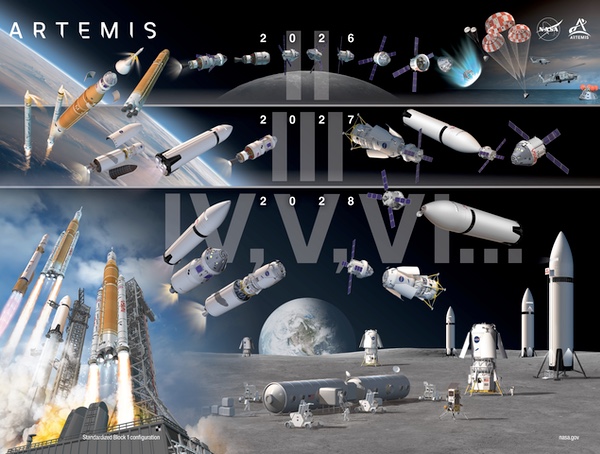 An infographic released by NASA Friday showing the revised plans for upcoming Artemis misisons. (credit: NASA) |
Unanswered questions
In about seven minutes of comments at the start of the briefing, Isaacman shook up Artemis plans. But for the rest of the hour, he and other agency officials offered few additional details about the changes.
There was, first and foremost, the question of what a “near Block 1” SLS would be. The ICPS used on the Block 1 SLS is based on the second stage of the Delta 4. That rocket, though, has been out of production for years, and there are no more upper stages available that could be repurposed into additional ICPS vehicles.
NASA declined to say what will replace the ICPS on those future vehicles, or how it would even select it. “We’re not going to talk about contractual issues,” Amit Kshatriya, NASA associate administrator, said at the briefing. “We have the full support of our industry partners to make sure we standardize the configuration and do the right thing.”
The most likely option is using a version of the Centaur upper stage in place of the ICPS. It has the advantage of already being in production, using a version of the RL10 engine that also powers of the ICPS. It has also been approved for use on crewed missions, launching Boeing’s Starliner on an Atlas 5.
However, there would be significant engineering work to replace the ICPS with a Centaur, from interfaces to loads analyses, all of which would need to be done within two years to be ready for an early 2028 Artemis 4 launch with astronauts on board.
Eliminating the Block 1B of SLS also has implications for the Gateway orbiting the Moon. While the first two modules—the Power and Propulsion Element and the HALO habitat module—will launch together on a Falcon Heavy, future modules from international partners were intended to launch on Block 1B SLS launches, taking advantage of its additional payload capacity. Orion would then transport the modules to the near-rectilinear halo orbit around the Moon, docking them to the rest of the Gateway.
| NASA declined to say what will replace the ICPS on those future vehicles, or how it would even select it. |
Asked about the Gateway at the briefing, Isaacman offered only a lukewarm endorsement of it. “By focusing a lot of time, energy and resources across lots of grand endeavors is why you end up in a situation where you’re launching incredibly important but complex vehicle every three-plus years,” he said. “I say that not to make a statement towards Gateway because we are doing this to get back to the Moon and have the capability to stay, certainly to build a moonbase.”
One solution, of course, would be to launch future Gateway modules on vehicles like Falcon Heavy or New Glenn. But, notably, an infographic released by NASA Friday illustrating its plans for future Artemis missions did not feature the Gateway even while including a notional lunar base. (If NASA wants to convert the Gateway into a lunar base, there are not just technical challenges in adapting modules for use on the lunar surface but also the fact that $2.6 billion provided in last year’s budget reconciliation bill for the Gateway specifically defines the Gateway as an “outpost in orbit around the Moon.”)
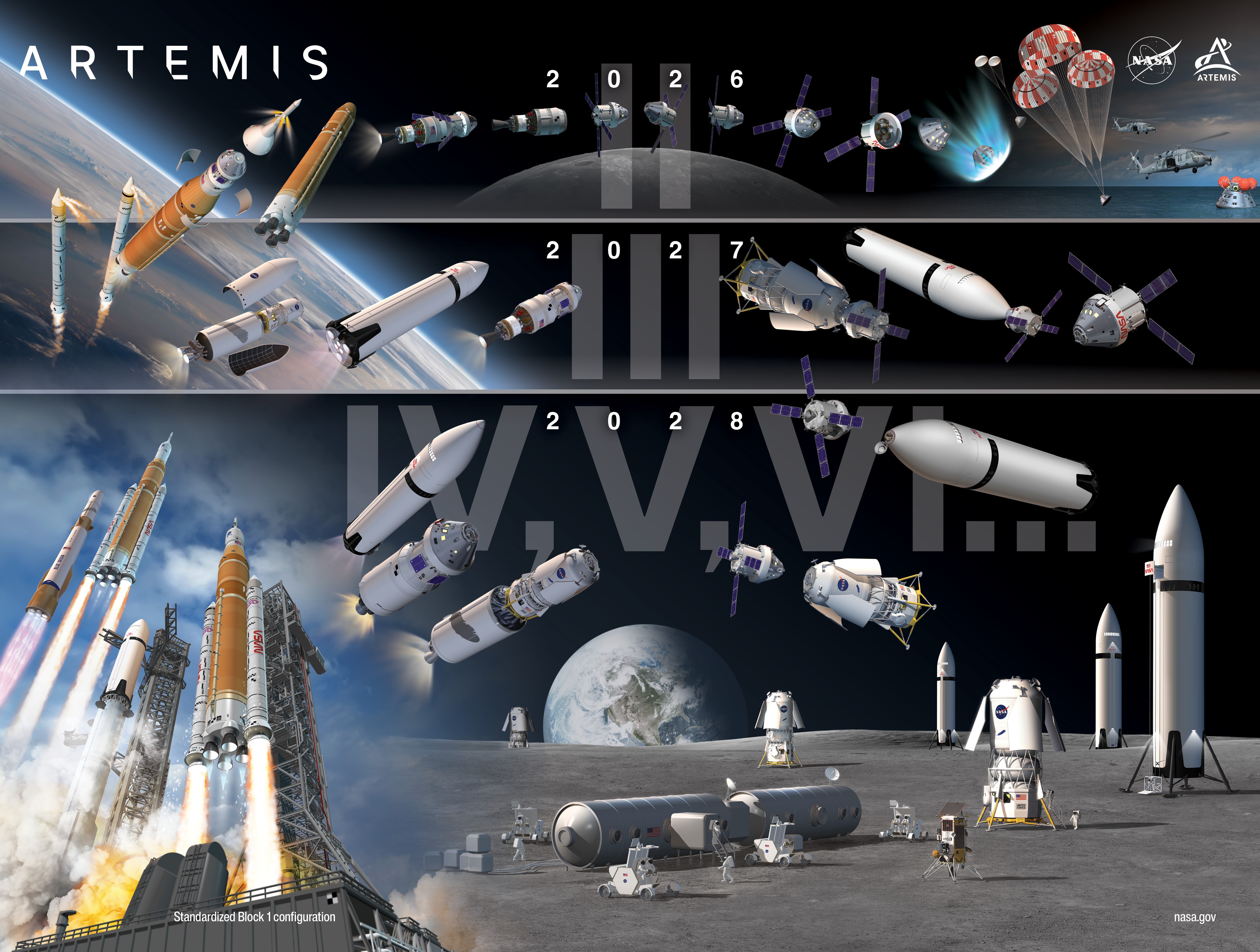
Then there are the landers that Orion would dock with on Artemis 3 in low Earth orbit. In that infographic, the landers look just like the designs for Starship and Blue Moon Mark 2 previously released by SpaceX and Blue Origin, respectively, for the Human Landing System (HLS) program. But it is unclear what exactly will be available from either company in a low Earth orbit test in about a year or so.
Last fall, after NASA’s acting administrator at the time, Sean Duffy, said he would reopen the competition for the Artemis 3 lander because of delays by SpaceX, both Blue Origin and SpaceX submitted “acceleration plans” they said would speed up the availability of a lander for that mission (see “The (possibly) great lunar lander race”, The Space Review, November 3, 2025.) Neither company has released details of those plans, though, nor has NASA.
Isaacman also dodged a question about those plans at Friday’s briefing. “Both HLS providers have offered solutions to accelerate their plans without compromising on the grander objective, which is we need to build out an enduring presence so that, when we return to the Moon, we have the capability to stay,” he said.
If NASA is serious about flying Artemis 3 in about a year’s time, the agency will need to soon select a crew for it. The four-person Artemis 2 crew was announced in April 2023 for a mission then planned for late 2024 (see “First four,” The Space Review, April 10, 2023.) While they trained only on Orion, the Artemis 3 crew may need to cross-train on one or both of the lunar landers as well, adding to their workload.
“We’re not here to do mission design. We’re not here to talk about that,” Kshatriya said in response to a question about naming the Artemis 3 crew.
One thing NASA leadership was willing to discuss was the support they had for the new plan from both industry and Congress. “We try to maintain a ‘no surprises’ policy here at NASA,” Isaacman said. “We’ve spoken to industry: can you meet the demand? The answer is yes.”
“We just didn’t decide to do this today without making sure we assessed the inventory of the hardware that we have available,” Kshatriya said, discussing progress on production of future SLS and Orion vehicles.
| If NASA is serious about flying Artemis 3 in about a year’s time, the agency will need to soon select a crew for it. |
Industry executives expressed their support for the new plan. “As NASA lays out an accelerated launch schedule, our workforce and supply chain are prepared to meet the increased production needs,” said Steve Parker, head of Boeing’s Defense, Space and Security business unit, in the NASA statement announcing the changes to the Artemis architecture.
“We’re excited about Administrator Isaacman’s bold decision to increase the Artemis launch cadence,” Robert Lightfoot, president of Lockheed Martin Space, said in a separate statement. “Flight-proven systems like Orion will be essential to the future of Artemis, and we are fully committed to meeting the delivery timelines for these historic missions.”
Isaacman took pains not to blame those companies for the delays in Artemis missions. “This is largely about NASA,” he said. “When we talk about why we struggle, our shortcomings, I look internally first: what could we have done differently?”
“Today, this is a NASA story,” he added. “I’m not saying we don’t come back in a year and say we have to make adjustments with a vendor.”
Isaacman said NASA had also discussed the plans with key members of Congress. “They all understand this is the path forward,” he said. “I don’t think I heard a single objection on these subjects. Everyone understands what’s at stake here.”
However, some members have questions about the plan. “I support NASA’s goal of increasing the Artemis launch cadence,” said Rep. Brian Babin (R-TX), chairman of the House Science Committee, in a statement Friday. “That said, I have questions about how NASA will remain compliant with long-standing requirements to reduce complexity, strengthen mission assurance, and address recurring findings from the Aerospace Safety Advisory Panel and prior blue-ribbon commission findings.”
Notably, NASA’s new plans will need to be reconciled with NASA authorization legislation that Babin’s committee recently approved unanimously, as well as a separate Senate bill that the Senate Commerce Committee will mark up on Wednesday.
“Everyone agrees this is the only way forward,” Isaacman said, suggesting that without the changes, Artemis 3 might not fly until 2029. But NASA still has a lot of work to explain how, instead of flying just one Artemis mission through 2028, it will be able to successfully complete four.
Note: we are now moderating comments. There will be a delay in posting comments and no guarantee that all submitted comments will be posted.