Artemis eclipsesby Jeff Foust
|
| “We definitely have to fix some of the plumbing,” Isaacman told the crew. |
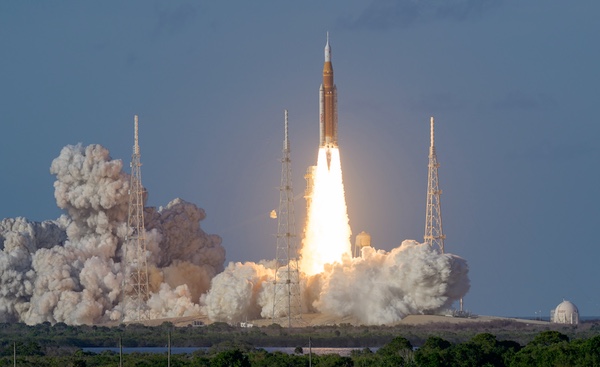
Perhaps the prank on everyone was that, on April 1, there were none of the problems that had come to be associated with the program. After multiple hydrogen leaks on Artemis 1 and a wet dress rehearsal for Artemis 2 in early Fwbruary, the tanks on the Space Launch System were filled without any sign of leaks. The countdown proceeded smoothly, with only a few minor hiccups. The weather cooperated, with a sea breeze pushing clouds inland.
So, at 6:35 pm EDT, just 11 minutes into a two-hour window on the first of six days in the early April opportunity, the engines of the SLS ignited and the vehicle lifted off from Launch Complex 39B. Eight minutes later, the Interim Cryogenic Propulsion Stage and Orion spacecraft separated from the core stage, performing a series of burns to enter a highly elliptical Earth orbit.
A day later, Orion ignited its main engine for a translunar injection burn, putting it on a path to go around the moon on a free-return trajectory. For the first time in 1972, human eyes got to see the Earth recede in the window as the Moon began to grow.
More than five days into the mission, Artemis 2 has largely been free of major problems. “Our subsystems continue to perform very well. Everything is nominal and as expected,” Howard Hu, NASA’s Orion program manager, said at one briefing.
The one trouble spot so far has been the spacecraft’s toilet. That is not entirely surprising: both the Space Shuttle’s toilet and those on the International Space Station have had problems over the years. In this case, there were issues setting up the toilet and, later, with ice blocking a wastewater vent line.
“It’s a complex engineering issue when you expose a liquid to vacuum. It’s a pretty chaotic environment, and there’s a lot of theory and textbook work done when you assume it’s pure water being exposed to a vacuum,” said Rick Henfling, an Artemis 2 flight director, at a briefing Sunday. “But when you introduce the variable of it being wastewater, there’s other complex phenomena that we don’t quite yet understand that are factoring into that vent line.”
In other words, there’s rocket science, and then there’s plumbing science. “We definitely have to fix some of the plumbing,” said NASA administrator Jared Isaacman when talking with the crew late Monday evening.
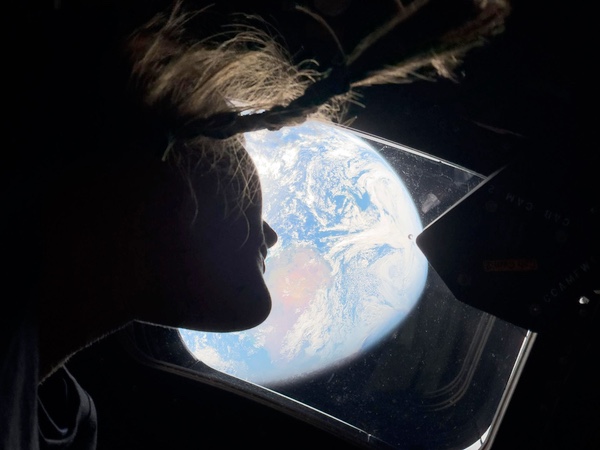 Artemis 2 astronaut Christina Koch looks at Earth through a window on the Orion spacecraft. (credit: NASA) |
A glitchy toilet, though, was a small price to pay for a mission that has otherwise gone smoothly. On Monday, the astronauts flew around the Moon, spending several hours observing and photographing the lunar surface, including an eclipse as the Moon blocked the Sun for nearly an hour (see “The science of Artemis 2”, The Space Review, March 23, 2026.)
The astronauts excitedly relayed their observations verbally to the ground—the photos would come later—and coordinated with the scientists in a science evaluation room (SER) near Mission Control, who appeared to be just as excited.
| “You really felt like you weren’t in a capsule. You’d been transported to the far side of the Moon, and it really just bent your mind,” Hansen said. |
For example, during the eclipse, Artemis 2 commander Reid Wiseman reported that he and Jeremy Hansen had seen several impact flashes caused by tiny meteoroids hitting the lunar surface. “Amazing news,” responded Kelsey Young, science team lead in Mission Control. “I literally just looked over at the SER and they were jumping up and down.”
After the flyby, President Trump spoke with the crew, praising them. “You’ve really inspired the entire world, really. Everybody’s watching. They find it incredible,” he said. “Your mission paves the way for America’s return to the lunar surface, very soon.” (The session was perhaps most noteworthy for a period of silence that lasted about a minute, leading the astronauts to think the link had been interrupted; it was, rather, an awkward lull in the conversation.)
Isaacman separately chatted with the crew after the flyby. “You had this sphere out in front of you, of the Moon,” Hansen told him of observing the Moon. “You really felt like you weren’t in a capsule. You’d been transported to the far side of the Moon, and it really just bent your mind. It was an extraordinary human experience.”
Christina Koch recalled trying to photograph the eclipse. “When we viewed that eclipse, that was the one time we all said we literally cannot capture this with a camera,” she said. “Having to set the low light features for Earthshine on the Moon while it's an eclipse? That was a new one.”
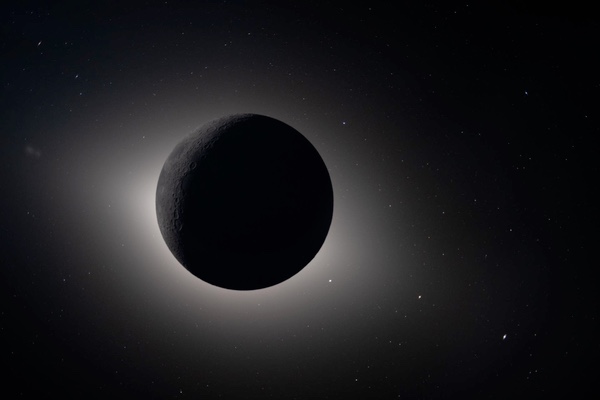 An eclipse of the Sun by the Moon seen from Artemis 2 during its April 6 flyby. (credit: NASA) |
Budgetary eclipse
The Artemis 2 mission has, so far, been a major success for NASA. Coming just days after the agency rolled out a revised exploration plan (see “Igniting a new vision for NASA”, The Space Review, March 30, 2026), Artemis 2 provides momentum for those new efforts. Of course, NASA had more than three years since Artemis 1 to prepare for Artemis 2, a mission whose launch slipped from late 2024 primarily because of issues with the Orion spacecraft, like its heat shield.
A successful completion of Artemis 2 does not guarantee that NASA will be able to pull off the plans it has laid out, including an accelerated flight rate, but is a critical prerequisite. It also builds up public interest in those future missions when astronauts will not just get a passing glance of the Moon but instead walk on it.
“I think we swung for the fence and launched on our first try after learning a lot earlier this year, but I think it set the stage for us to go out and continue to swing for the fence,” Victor Glover said Monday night. “I have huge expectations for what's coming next.”
And yet the agency—or, more accurately, the administration—has managed to make that task much more difficult. On Friday, the White House released its fiscal year 2027 budget proposal, followed hours later by NASA’s own detailed budget request.
| “I think we swung for the fence and launched on our first try after learning a lot earlier this year, but I think it set the stage for us to go out and continue to swing for the fence,” saod Glover. |
It was not a good Friday for much of agency. In a rerun of the 2026 budget proposal, the administration sought $18.8 billion for NASA, a 23% cut from what Congress appropriated for 2026. The budget proposal would cut science funding by 47%, the same percentage as the 2026 proposal, while also cutting ISS operations and space technology.
Exploration, by contrast, escaped the brunt of the cuts. The budget proposed an increase of nearly 10% for exploration, to $8.5 billion, along with funding set aside in last year’s budget reconciliation bill. That would fully fund the various elements of Artemis and includes $175 million for new robotic missions to help establish a lunar base.
The proposed cuts were not a surprise to some. “I would probably follow the betting and say that ’27 is going to look like ’26,” Jamie Wise, a staff member of the House Appropriations Committee’s commerce, justice and science subcommittee, said at the Goddard Space Science Symposium last month.
That did not make them any easier to accept. “As NASA astronauts are literally on their way to the Moon, showcasing the tremendous power of American innovation that the President claims to support, the administration is actively trying to sabotage their mission and the dedicated team at NASA,” said Rep. George Whitesides (D-CA), a former NASA chief of staff, in a statement about the budget.
“This proposal needlessly resurrects an existential threat to US leadership in space science and exploration,” The Planetary Society said in its statement about the budget, calling the Office of Management and Budget “out of step with this broad, bipartisan consensus” of support for NASA.
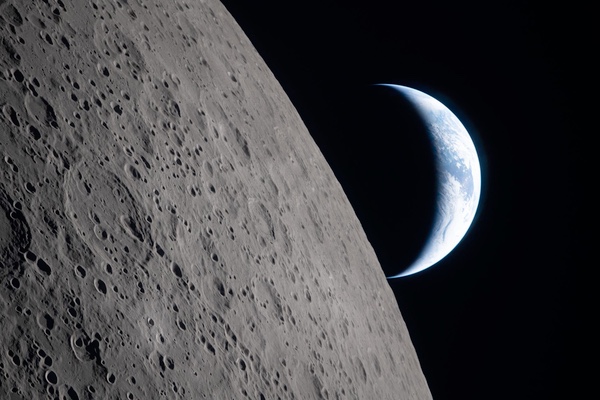 The Earth setting behind the Moon as seen from Artemis 2 on April 6. (credit: NASA) |
NASA itself initially did little to support, or even promote, the budget. While in past years there had been speeches and briefings about the budget proposal, NASA did not even issue a statement about this budget proposal. Even the detailed budget document, known as a congressional justification, was a slimmed-down version of those from even a couple years ago. Missions proposed for cancellation, for example, are simply not mentioned at all in the document.
Isaacman was forced to defend it two days later when he appeared on a pair of Sunday talk shows, primarily to discuss the Artemis 2 mission. “I certainly support President Trump and his 2027 budget request,” he said on CBS News’ “Face the Nation” program.
He focused on the funding for exploration in the budget proposal and last year’s budget reconciliation bill. “These resources are the only reason we can accelerate production to get to the moon, to add a mission in ’27, which is Artemis 3, to build the moon base and do all the other things,” he said.
| “The advice I give people is never get too caught up in what’s in the budget proposal,” Wise said. “It is just the beginning of the process.” |
He made similar comments on CNN’s “State of the Union” program. “NASA doesn’t have a topline problem. We just need to focus on executing and delivering world-changing outcomes,” he said of the budget, whose topline was 23% below what the agency received in 2026.
The 2027 proposal may face the same fate as the 2026 one, where congressional appropriators largely undid the proposed cuts, keeping NASA at close to its 2025 levels. Some called on the House and Senate appropriations committees to simply ignore the request as they craft their spending bills in the coming months.
“The advice I give people is never get too caught up in what’s in the budget proposal,” Wise said. “It is just the beginning of the process.”
However, it detracts from what should be an unqualified win for NASA: the first human spaceflight beyond Earth orbit since 1972. Instead of simply building on that success, the agency will have to defend it in a budget that skews towards exploration at the expense of science, ISS, and space technology. What is NASA willing to sacrifice to race back to the Moon?
Note: we are now moderating comments. There will be a delay in posting comments and no guarantee that all submitted comments will be posted.