Review: Open Spaceby Jeff Foust
|
| “Can you get there by March?” Altemus said Nelson asked because of the administrator’s concerns that China might attempt to lay claim to the south polar region of the Moon. |
That’s a remarkable pace because, so far, there have been only three landings by American companies on the Moon so far as part of Artemis: one in 2024 and two in 2025. There are as many as four planned for 2026, but NASA’s own charts at the Ignition event projected only two taking place.
Adding to that challenge is the difficulty in getting to the surface of the Moon: only Firefly Aerospace’s Blue Ghost 1 lander in March 2025 remained upright and completed its full mission. Intuitive Machines’ IM-1 lander in 2024 and IM-2 in 2025 both fell over upon touchdown, and IM-2 operated for only half a day before shutting down. There’s rocket science, it appears, and then there’s lunar-lander science.
These challenges came to mind when reading part of Open Space, a new book by David Ariosto that examines many of the emerging frontiers in space. (Disclosure: Ariosto hosts episodes of the “Space Minds” podcast by SpaceNews, but the book was not associated with that.) That includes the efforts by the United States and China to land on and explore the Moon.
For the book, Ariosto got behind-the-scenes access at Intuitive Machines as they were developing their IM-1 mission. That included the difficulties the company faced as it developed the lander, with its methalox engine, through witnessing the launch among the VIPs at the Kennedy Space Center, and then through the nail-biting landing.
Interspersed with that account of IM-1 is an examination of China’s space program and its lunar efforts. He talks with Chinese officials and goes to Argentina, where China has established a ground station for communicating with those lunar missions—and, likely, for military applications as well. The book’s chapters are short, almost giving the reader whiplash as he frequently toggles between the US and China.
That emerging space race is a theme of this section of the book: on one of Ariosto’s visits to Intuitive Machines’ Houston facilities, the company's CEO, Steve Altemus, gets a call from then-NASA administrator Bill Nelson. “Can you get there by March?” Altemus said Nelson asked because of the administrator’s concerns that China might attempt to lay claim to the south polar region of the Moon.
| There are chapters on war in space, orbital debris, SETI, planetary defense, interstellar propulsion, nuclear propulsion, terrestrial fusion research, and faster-than-light travel (roughly in that order.) |
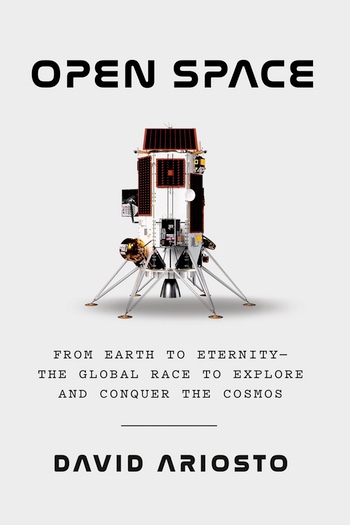
If that was the entire scope of Open Space, it would be an enlightening, tightly paced account of one company’s efforts to go to the Moon as part of a broader geopolitical competition in space between the United States and China. (The book doesn’t discuss Firefly’s successful landing in 2025 and mentions Astrobotic’s Peregrine mission, which malfunctioned hours after liftoff, only in passing.) With a picture of Intuitive Machines’ Nova-C landers, used for IM-1 and -2, on the cover, you might think the book is principally about that.
However, the second half of the book wanders off into other topics. It loses its focus on the Moon to examine, well, a lot of things. There are chapters on war in space, orbital debris, SETI, planetary defense, interstellar propulsion, nuclear propulsion, terrestrial fusion research, and faster-than-light travel (roughly in that order.) Ariosto again leverages his detailed reporting, including a visit to the Mars Society’s Mars Desert Research Station, where one of the analog astronauts there is the CEO of an Italian space company, to CERN’s “Antimatter Factory” that produces minute amounts of antimatter.
Yet, it’s difficult in that part of the book to find a definitive theme, other than there are fascinating people doing fascinating things that are often, if not entirely, related to spaceflight. That can make for entertaining reading, but it’s not obvious it’s subject matter for a book—or, at least, this book.
What Open Space does show is the current interest in the Moon and the difficulty in turning that interest into hardware that can launch and then land on the Moon. The amount of hardware making that journey may soon increase, but the difficulty level will likely not soon decrease.
Note: we are now moderating comments. There will be a delay in posting comments and no guarantee that all submitted comments will be posted.