Artemis 3 take shapeby Jeff Foust
|
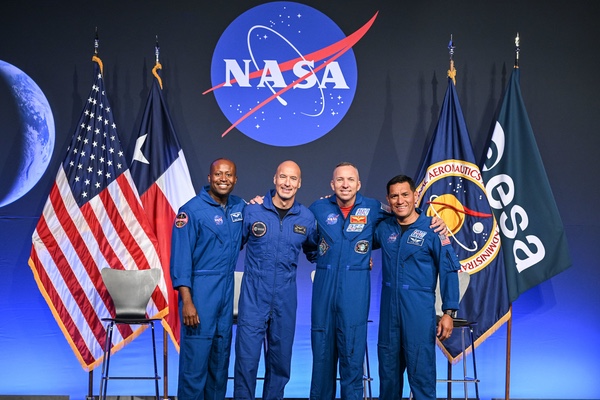
| Bresnik noted the Apollo 11 crew was named just six months before their mission. “If they can do that in six months, we can make one year.” |
But NASA provided few details about that revised Artemis 3 at that announcement or in subsequent events. That included the crew who would fly the mission. The Artemis 2 crew was named in April 2023 for a mission then set to fly in late 2024—it ultimately launched almost exactly three years after the crew was named—and without the complications of docking with other spacecraft. NASA, particularly after the successful completion of Artemis 2, would only say it would name the crew “soon” without more specifics.
Soon finally arrived last Tuesday at the Johnson Space Center. In an hour-long event, NASA announced the four astronauts, plus one backup, named to Artemis 3. All but one have extensive flight experiences: commander Randy Bresnik flew on one of the final shuttle missions as well as a long-duration flight on the International Space Station, while pilot Luca Parmitano was on two long-duration ISS flights. Mission specialist Frank Rubio spent just over a year on the ISS while Bob Hines, the backup crew member, also spent six months on the ISS. Mission specialists Andre Douglas is the only rookie, but he trained as a backup for Artemis 2.
The astronauts found out about their assignment to the mission in a matter-of-fact way. “A couple of weeks ago, Scott Tingle, the chief astronaut, called us in. We had a meeting on the schedule that had nothing to do with Artemis 3,” Bresnik recalled in an interview after the event. “He didn’t beat around the bush. He said, ‘Look around. This is the crew of Artemis 3.’”
With NASA pushing to launch Artemis 3 as soon as the middle of next year, the crew won’t have a lot of time to get ready. Bresnik, though, said he felt confident that the astronauts will be ready to go next summer. He noted he has been involved in various aspects of Orion for eight years, while Douglas has training from his backup role on Artemis 2.
“Between the two of us, we’ll be able to get Luca and Frank up to speed pretty quick, and so I fully expect that a year will be sufficient,” he said, adding that the Apollo 11 crew was named just six months before their mission. “If they can do that in six months, we can make one year.”
That training will focus initially on Orion as details about the lunar landers they will dock with get worked out. Artemis 2 provided both assurances about the flying qualities of Orion as well as a better understanding of what training is needed.
“The training load timewise is going to be much reduced from what they had,” he said of Artemis 2.
Two aspects of the crew selection stood out to many. One was that there were no women in the crew. There were varying degrees of frustration and outrage at the perceived slight.
“The crew selection does not involve any political appointees,” NASA administrator Jared Issacman said in a social media post the day after the event, after noting various milestones such as the first majority-female astronaut class announced last year.
“The Astronaut Office assigns the crew that gives the mission the best chance of meeting its objectives, taking into account many factors, including the background and expertise of the astronauts, such as test pilot experience, development work on specific programs, and availability,” he said. “For example, those raising this concern may not be aware of the pipeline of crews already preparing to launch to the Space Station, or those who have been undergoing lunar-specific training that would be a better fit for a future surface mission.”
The other noteworthy aspect of the crew is that it includes one ESA astronaut, Luca Parmitano. ESA had seats reserved on three future Artemis missions to the lunar Gateway in exchange for some of the modules it was providing for the facility, but those plans were in jeopardy after NASA announced at its Ignition event in late March it was putting Gateway on hold indefinitely.
| “This mission is deliberately designed to take calculated risks so that future crews will be safer and ultimately successful when we put boots on the lunar surface,” Parsons said. |
Two days after the event, ESA director general Josef Aschbacher said the assignment was part of negotiations between ESA and NASA after NASA’s decision to end the Gateway. “I cannot preempt any of the discussions, negotiations that are ongoing, but what I can say is that the announcement this week of Luca Parmitano being part of Artemis 3 is part of the negotiation process as the first step,” he said at a press conference during the ILA Berlin Air Show.
He did not discuss details of those discussions but suggested that the addition of Parmitano to Artemis 3 came relatively recently. “This was not clear at all just a couple of weeks ago,” he said.
The broader negotiations continue, with ESA now looking for ways to get its astronauts to the lunar surface. That could come through various contributions, Aschbacher said, ranging from a cargo lunar lander called Argonaut that ESA is starting to develop to rovers and robotic surface systems for NASA’s planned lunar base.
“We are just at the beginning of these negotiations, but I certainly hope that we get clarity before the end of this year,” he said.
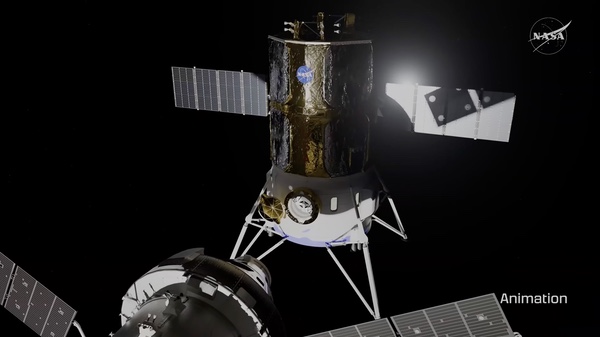 Orion will first approach and dock with a Blue Moon lunar lander prototype in low Earth orbit. (credit: NASA) |
Defining the mission
Last week’s announcement of the crew also provided details about exactly what the Artemis 3 mission would look like. NASA had said little beyond testing Blue Origin’s Blue Moon Mark 2 and SpaceX’s Starship landers in Earth orbit, including potential docking with them.
At the event, Jeremy Parsons, set to become Artemis program manager as part of an agency reorganization announced last month, described NASA’s current plan for the mission. It will start first with the launch of the Blue Moon Mark 2 prototype, placed into low Earth orbit and intended to loiter there for up to 90 days.
Orion will then launch, using a Space Launch System without an upper stage: NASA previously announced it would preserve the last Interim Cryogenic Propulsion Stage (ICPS) for Artemis 4 since Orion will remain in low Earth orbit on Artemis 3, providing more time to prepare using the Centaur upper stage for later SLS missions. Orion will then approach and dock with Blue Moon.
Orion will stay docked with Blue Moon for two days, with astronauts entering the lander and testing systems like life support. “This gives our teams key information on systems the lunar lander crew will depend on, in an environment close to home versus four-plus days away around the moon,” Parsons said.
After those tests are complete, Orion will undock and await a launch of a Starship lander prototype. Once that vehicle is in orbit, Orion will approach and dock with it. Astronauts won’t enter Starship, though, and Orion will undock after a day to return to Earth, splashing down in the Pacific as on Artemis 2.
“This mission is deliberately designed to take calculated risks so that future crews will be safer and ultimately successful when we put boots on the lunar surface,” he said.
The two lander prototypes will carry out different tests. The Starship vehicle will be a Starship V3 vehicle taken “off the line” with only minimal modifications, such as a docking port. It will lack a crew cabin or other lander-specific systems.
Blue Moon will have a crew cabin, but will lack the propulsion system it would need for a lunar landing. “They’re going to build a mass simulator of the Mark 2 lander coming back from the moon to dock with Orion,” Steve Creech, NASA Human Landing System (HLS) program manager, said in an interview after the crew announcement.
Creech noted that SpaceX is doing other crew cabin tests on the ground. Instead, the focus for the docked Orion-Starship activities will be to see how the docked combination handle maneuvers by Starship, which fit into the revised “acceleration plans” that SpaceX developed last year at NASA’s request.
| The Artemis 3 tests fit into the revised “acceleration plans” that SpaceX and Blue Origin developed last year at NASA’s request. |
“We have an updated plan with NASA that includes docking Starship with Orion in Earth orbit instead of NRHO,” or near-rectilinear halo orbit around the moon, said Jessica Jensen, vice president of customer operations and integration at SpaceX, at the announcement. “Then we use Starship to do the translunar injection with Orion attached.”
In that revised approach, Starship and Orion would travel together to low lunar orbit, rather than NRHO, with Starship then undocking for a landing. Doing so, she said, improved crew safety by doing a key docking maneuver in Earth orbit, while operating out of low lunar orbit provides more abort options from the lunar surface.
“The big thing in my mind is it eliminated the loiter requirements we had on them in order to rendezvous out in a lunar orbit,” Creech said. That reduces the propellant requirements for Starship and thus the number of launches needed to fill its tanks with methane and liquid oxygen propellant. Neither NASA nor SpaceX have disclosed how many tanker flights—a source of debate and controversy— will now be needed, though.
Blue Origin has also changed its plans, deferring work on a “transporter” vehicle that would aggregate liquid hydrogen and liquid oxygen propellant and take it to lunar orbit for use by Blue Moon Mark 2. Creech said that Blue Origin will instead use “Mark 1-derived transfer stages” based on its Blue Moon Mark 1 uncrewed lander.
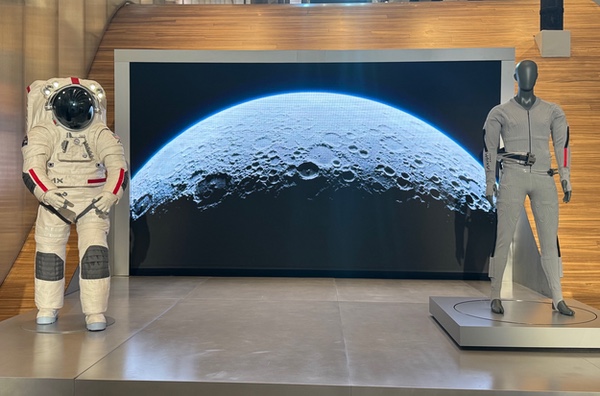 The outer layer (left) and new Liquid Cooling and Ventilation Garment inner layer of the Artemis spacesuit Axiom Space is developing. (credit: J. Foust) |
Testing the suits
When NASA announced its revised plans for Artemis 3 in February, the agency said the mission would also provide an opportunity to test the lunar spacesuit that Axiom Space is developing for lunar missions.
Since then, NASA has said little about those plans and Axiom has suggested that the suits could instead be tested on the ISS. At the crew announcement event, NASA said it now planned to test the suits both on the station and on Artemis 3.
“We are going to fly the spacesuit aboard the International Space Station to check it out in 2027,” Parsons said. “We will perform hardware interface checkouts on at least one lander and the spacesuit during Artemis 3.”
Two days before NASA announced the crew, Axiom Space unveiled part of the suit’s design, an undergarment called the Liquid Cooling and Ventilation Garment. That garment, like the outer payer, was developed by Axiom in partnership with Prada, and unveiled at a Prada showroom in New York.
| “If you ask NASA today, are we on track to deliver a qualification suit by the end of the year, they’d tell you yes,” Cirtain said. |
Axiom officials said they thought the ISS would provide a more complete test of the suit, including having an astronaut wear it on a spacewalk. “I think it’s more practical that it would go to the International Space Station in terms of how you would manage that,” Jonathan Cirtain, Axiom Space CEO, said after the unveiling.
One option, he said, would be to test the suit on the ISS but also fly “mass models” of the suits on the landers to see how they deal with launch loads and the flight environment on those vehicles.
Creech said that NASA’s current plans for Artemis 3 include testing the ability of astronauts to put on and take off the suit in the Blue Moon crew cabin.
Schedule concerns
That assumes that the suit will be ready in time. A report by NASA’s inspector general in April warned the suit might not be ready until after 2030, citing average development times for major spaceflight programs as well as original schedules for the suit’s development that “were overly optimistic and ultimately proved unachievable.”
Cirtain said the company is on track to have suits ready for both ISS and Artemis 3 flight testing next year.
“If you ask NASA today, are we on track to deliver a qualification suit by the end of the year, they’d tell you yes,” he said. “Are we on track to deliver that prototype suit for demonstration mission next year? They would tell you yes, because if they were to say no, if they were to disagree with that, it would be because we were telling them that, and we are not telling them that.”
The Axiom suit is not the only schedule concern. The explosion of a New Glenn rocket on its launch pad last month sidelined both that vehicle, which will be used to launch Blue Moon landers, as well as its launch pad. While Blue Origin says it is planning to complete pad repairs and resume New Glenn launches by the end of this year, many in industry expect pad repairs to take at least a year.
“We expect to complete the vehicle for Artemis 3 and be ready for launch in 2027,” John Couluris, senior vice president of lunar permanence at Blue Origin, said at the crew announcement event, stating that the company was making “excellent progress” on the investigation and pad cleanup. “We’ve redoubled our efforts and are moving forward.”
On a Fox Business interview in early June, Isaacman suggested that NASA was looking at “decoupling” the Blue Moon lander from New Glenn, but did not go into details. Launching the Blue Moon Mark 2 lander on vehicles like Falcon Heavy or Vulcan might be possible, but may require modifications to both the lander and the vehicles, as well as pad infrastructure so that the lander could be fueled on the pad.
“We’re looking at that option for risk mitigation,” Creech said, but cited one specific issue: Blue Moon is designed for New Glenn and its payload fairing, seven meters in diameter, larger than the fairings available for alternative vehicles.
| “We’re going to return to the Moon before the end of 2028,” Isaacman insisted. |
Isaacman told reporters after the crew announcement that NASA is working “very closely” with Blue Origin to help them get flying again. He also suggested that NASA might delay the mid-2027 launch of Artemis 3 if one of the landers, be it Blue Moon or Starship, is not ready.
“We’re not going to launch this mission until we feel like the objectives that are outlined are sufficient to bring down risk for a follow-on landing to the moon itself,” he said. “As it stands right now, that’s two landers.”
Delaying Artemis 3 would mean pushing Artemis 4 later into 2028 and almost certainly rule out flying Artemis 5 in late 2028, something NASA said it planned when it announced the revised plans for Artemis. “We’re going to return to the Moon before the end of 2028,” Isaacman insisted.
Another factor is funding. A report last week indicated NASA was in talks with Congress about the potential for several billion dollars in supplemental funding for Artemis, perhaps in a future reconciliation bill.
“We have all the resources needed to return to the Moon, build the Moon base, and do all the other things that we talked about,” Isaacman said after the crew announcement. However, he said that after Artemis 2 the agency was approached by some in Congress “and they've asked what resources they can make available to be helpful.”
NASA billed Artemis 3 as one of the most complex missions it has attempted, so the prospect of delays because some elements of it are not ready may not be surprising. But the future of Artemis will be no easier after Artemis 3.
“Spaceflight is hard and that’s why the most important Artemis mission will always be the next Artemis mission,” Bresnik said at the crew announcement event. “Every single mission we do after this will be more challenging and more complex.”
Note: we are now moderating comments. There will be a delay in posting comments and no guarantee that all submitted comments will be posted.