Lemons to bitter lemonade: from the Samos E-5 to the LANYARD reconnaissance satellite (part 3)by Dwayne A. Day
|
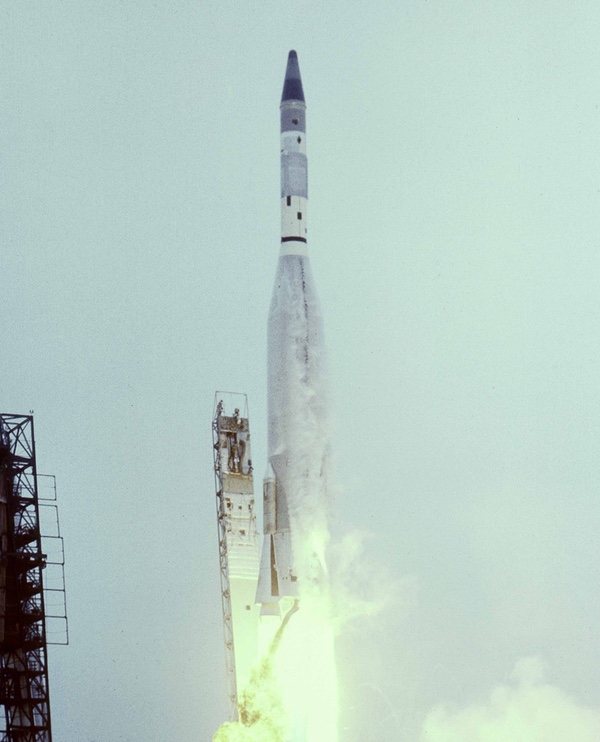
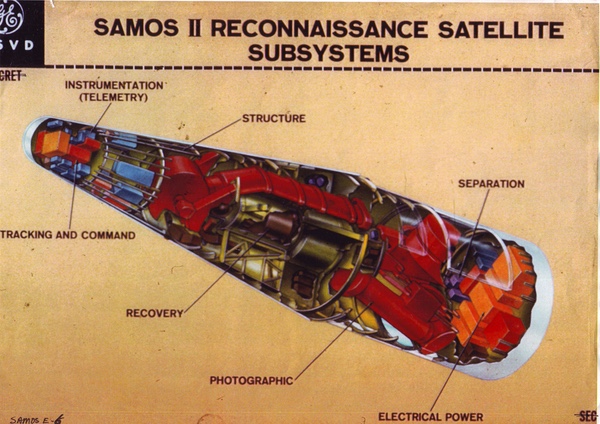 The Samos E-6 satellite was equipped with two cameras that were capable of photographing larger amounts of territory than the Samos E-5. The film would be wrapped up in in takeup reels inside the conical reentry vehicle at left. It would separate from the spacecraft, leaving the cameras to reenter and burn up. The reentry vehicle would deploy a parachute to be recovered in mid-air like the CORONA reconnaissance satellite. However, if it landed in the water, it would immediately sink, unlike CORONA. Five spacecraft were launched in 1962 and all five failed. The camera system was later adapted for the SPARTAN reconnaissance system. (credit: NRO) |
The Samos E-6
The Samos E-6 incorporated two 36-inch (0.9-meter) focal length Eastman-Kodak manufactured cameras that could scan large areas of the ground below at an estimated resolution of about six and a half feet (two meters), good enough to spot and identify aircraft, ships, submarines, and possibly even military ground vehicles, and better than the early CORONA versions. The E-6 used wide film, 6.6 inches (16.8 centimeters), bigger than the E-5’s 5-inch (12.7-centimeter) film. After the film was exposed in the cameras it was wound up on spools inside the reentry vehicle. The size of the E-6 film would prove to be a liability, because it limited how much could be stored in a reentry vehicle.
| In 1962, while the KH-6 LANYARD was under development, the Air Force launched Atlas Agena rockets with Samos E-6 satellites in April, June, July, August, and November 1962. All five missions failed to successfully return film. |
The operation of the E-6 camera remains a bit of a mystery to this day. It consisted of a long tube with an image-reflecting mirror at one end that bent the image of the Earth below 90 degrees and sent it down the tube with an image-focusing mirror at the other end. That focusing mirror concentrated the image and sent it about halfway back the tube, where another small mirror reflected it up and onto a film strip that was pulled across an aperture. The focal length was 36 inches (0.9 meters, compared to CORONA’s 24-inch/0.61-meter focal length). Only one poorly reproduced image of the camera design exists, along with some photographs of a wooden camera mockup, and it is unclear how the camera scanned the ground below from side to side. Other specific operational details also remain unknown. Carrying two cameras meant that one could point at a slightly different angle than the other one, providing stereo photographs and making measurement of objects on the ground easier.
The earlier Samos E-5 reentry vehicle was a large blunt-body design, nearly the size of a Mercury spacecraft, and also would have returned the camera to Earth. In contrast, the Samos E-6 reentry vehicle was long and pointed, and would not have returned the cameras, only the exposed film. While hanging underneath a parachute it would have been grabbed out of the air by an Air Force C-130 transport plane in a method that CORONA had successfully demonstrated numerous times. If the plane missed, the E-6 reentry vehicle would immediately sink in the ocean, whereas the CORONA vehicle floated for a limited time before it eventually sank to prevent recovery by the Soviet Navy.
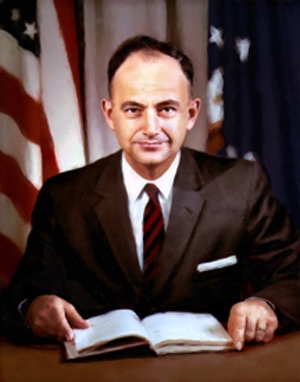 Joseph V. Charyk, the first director of the National Reconnaissance Office. Charyk approved modifying the Samos E-6 cameras to become the SPARTAN reconnaissance experiment in 1963, but he soon left the NRO and the program died. (credit: Wikimedia Commons) |
In 1962, while the KH-6 LANYARD was under development, the Air Force launched Atlas Agena rockets with Samos E-6 satellites in April, June, July, August, and November 1962. All five missions failed to successfully return film. The E-6 reentry vehicle overheated and was destroyed before it could ever deploy its parachute. The multiple failures led to serious doubts about the program within the Air Force and intelligence community. On December 11, 1962, almost one year after canceling the Samos E-5, Director of the National Reconnaissance Office Joseph Charyk terminated the Samos E-6 program and ordered that the remaining cameras and payload vehicles be placed into storage.[1]
Charyk’s decision was based not only on the E-6’s reentry vehicle problems but also on several other factors. The E-6 required a more expensive Atlas Agena launch vehicle. There was also a perception among some of those who knew of the program that it was of dubious value. Finally, the latest version of CORONA (known as the CORONA-MURAL as well as the KH-4) accomplished many of the same goals as the E-6, using proven equipment and a less expensive Thor Agena launch vehicle. Although CORONA’s resolution was not as good as the design resolution of the Samos E-6, it imaged much more territory. And it worked.
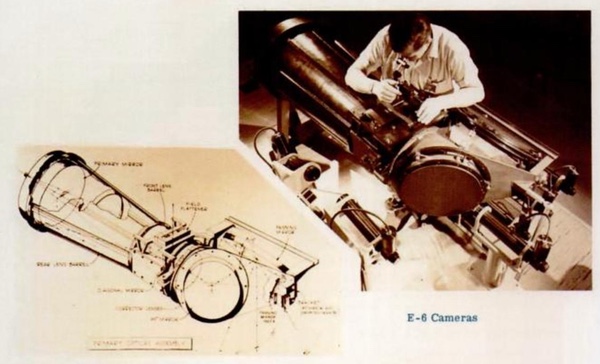 The only known photo and diagram of the E-6 camera. The SPARTAN proposal was to use a single camera in a spacecraft and use a proven CORONA reentry vehicle. Although work was started on the program, it was halted in 1963. (credit: NRO) |
Fast, simple, SPARTAN
At the time Charyk canceled the E-6, he also ordered that the NRO office in Los Angeles investigate the possibility of launching a single E-6 camera into orbit. He gave Major General Robert E. Greer, who ran the Secretary of the Air Force Special Projects Office, or SAFSP, discretion in finishing out the E-6 program and determining what could be done to salvage the work performed to date. Charyk’s idea was that the goal would be to prove the capability of the E-6 camera in orbit rather than developing a new area search system to replace CORONA—but the CIA did not see it that way.
The Samos program office within SAFSP quickly responded with three options. The first was to keep the Atlas Agena, develop a satellite midsection adapter to hold a single E-6 camera, and use a CORONA reentry vehicle. An additional option was to continue testing the E-6 reentry vehicle by mounting it to an Atlas rocket and lofting it on a trajectory that would test its heating qualities. The final option was to use the planned TAT Agena-D rocket, a new midsection atop the Agena with a single E-6 camera, and a CORONA reentry vehicle. The satellite would make one pass over the Soviet Union taking photos and then be recovered on the second pass, at nighttime over the Pacific Ocean, providing “invulnerable reconnaissance” of the Soviet Union because it would not be in orbit long enough for the Soviets to attack it. The Atlas Agena option could possibly be ready as early as April 1963, with the cheaper TAT Agena-D vehicle available by November.
The program office also offered two more complex and expensive options. One involved carrying both E-6 cameras on an Atlas Agena equipped with two CORONA reentry vehicles, one for each roll of film. CORONA’s film was 70 millimeters wide, and a reentry vehicle could carry two takeup reels of film side by side. But the Samos E-6 film was 168 millimeters wide, and only a single takeup reel could be mounted in a single reentry vehicle. Another option would have involved redesigning the camera to handle narrower film, enabling two E-6 cameras to use a single CORONA reentry vehicle, but that was a major redesign of the camera.
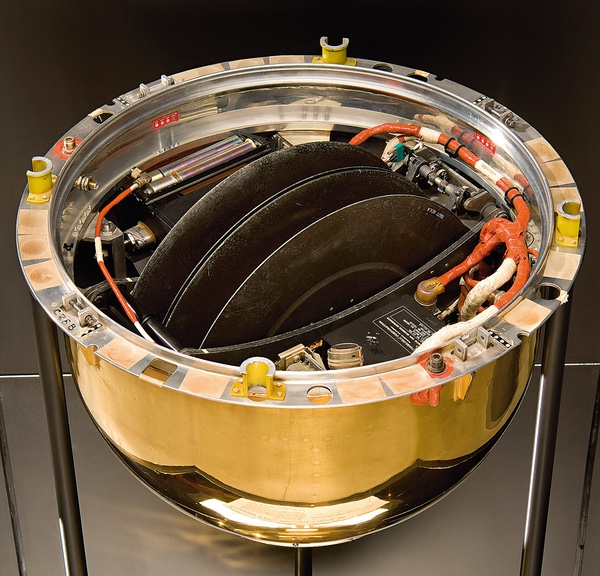 A CORONA reentry vehicle containing two film takeup reels. Although developed for CORONA, it was also adapted for the GAMBIT reconnaissance satellite and used for the LANYARD as well. It was planned to be used for SPARTAN, but the E-6 film was more than twice the width of the 70 mm CORONA film, meaning that only a single takeup reel could be included in the reentry vehicle. (credit: National Air and Space Museum) |
SAFSP’s recommended version was for a single camera and the Atlas Agena rocket using a CORONA reentry vehicle, along with the Atlas test of the original E-6 reentry vehicle. SAFSP also recommended development of a lighter weight midsection to hold the single camera. In addition, the special projects office noted that it was possible to merge the E-6 camera with Samos E-1 and E-2 hardware to create a “recovery-readout” capability. Five E-1 and three E-2 camera payloads were still in storage and the ground equipment also still existed. There were eight E-6 cameras in storage.
After some delays, at the end of January 1963, Charyk approved a “black,” or covert, project to demonstrate the E-6 camera in orbit. The work on the new project would not be done in the SAFSP offices in Los Angeles but in a nearby Eastman-Kodak facility. Charyk ordered that they use the TAT Agena option with a CORONA reentry vehicle. But there remained many details to be decided, including whether to use an Agena B or the more capable Agena D upper stage. Other decisions concerned developing a new satellite midsection, identifying a funding channel and cover plan, and determining how to procure CORONA reentry vehicles without disclosing the new covert project’s existence.[2] A day after approving the covert program, Charyk ordered that no more Samos E-6 missions be conducted.
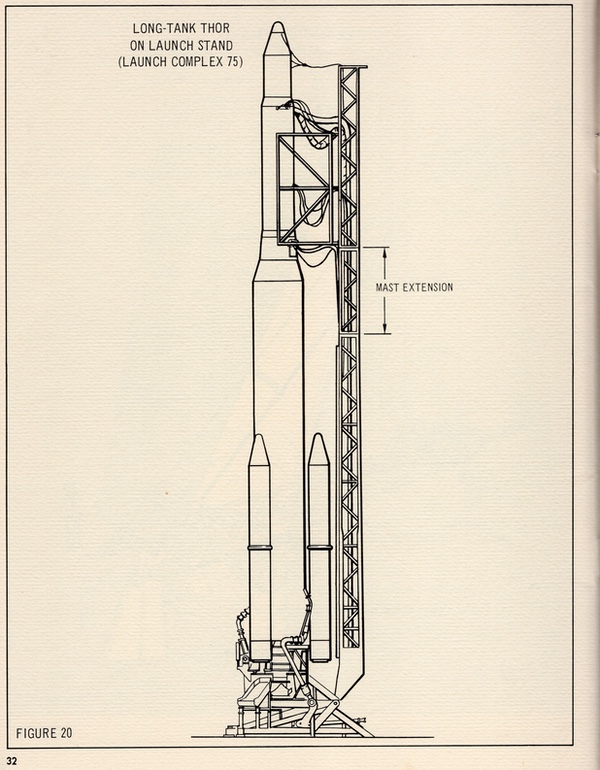 Contractor illustration showing the TAT Agena on the launch pad. This was the vehicle selected for the SPARTAN program because it was cheaper than the Atlas Agena. (credit: Douglas) |
Charyk’s approval stated that “The approach should be spartan in nature, as simple as possible, and should take no consideration of any future system applications.” That order resulted in the project being named SPARTAN, although on February 2 it also received the formal designation of Special Project-Advanced Study 1963, or SP-AS-63.[3]
Once it was approved, the concept evolved into two possible design approaches. The first would have a single camera, the original E-6 midsection, and a single CORONA type reentry vehicle. The second approach was to have a single camera equipped with a rotating mirror to provide stereo capability. It would require a redesigned midsection and either an enlarged reentry vehicle or two reentry vehicles in tandem to enable it to operate longer and take more photographs.[4]
Whereas the Samos E-6 was designed to operate in a 125-nautical-mile (231.5-kilometer) orbit, SPARTAN would operate in a 100-nautical-mile (185-kilometer) orbit. The single SPARTAN camera would also have improved lens-film definition, meaning that the images focused by its lenses would result in more detail on the film. If it worked as planned, SPARTAN would have better resolution than the Samos E-6, and significantly better than CORONA.[5]
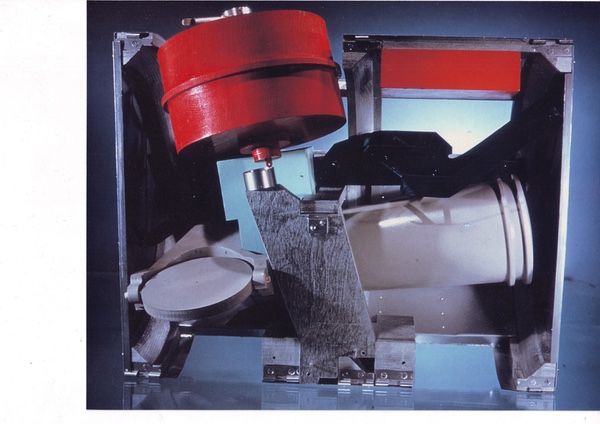 A wooden mockup of one of the cameras for the Samos E-6. This mockup and the camera system was built by Eastman-Kodak of Rochester, New York. The red cylinders at top contained two film supply reels. A mirror at left looked out a port in the satellite and took a panoramic image that was longer in length than width, representing more territory covered east-west than north-south on each film frame. A second port for the other camera is visible at right. The two cameras looked at the ground at different angles, enabling stereo imagery that was valuable for measuring objects on the ground. (credit: NRO) |
Going nowhere, fast
Despite Charyk’s approval, SPARTAN ended up in a strange state of limbo throughout February 1963, apparently due to CIA opposition. Herbert Scoville, CIA’s Deputy Director for Research, the official in charge of CIA reconnaissance satellites, perceived SPARTAN to be a competitor to the CIA’s plans to improve CORONA’s performance. At the time, other issues had resulted in a deteriorating relationship between Scoville and Charyk, and Scoville was now questioning every decision Charyk made. Although officially SPARTAN was only an experiment, Scoville indicated that he suspected it was a prelude to a new satellite system. The CIA was then evaluating a proposed MURAL-2 (or M-2) concept that would have provided 6-to-8-foot (1.82-to-2.44-meter) resolution, compared to SPARTAN’s 6-to-7-foot (1.82-to-2.13-meter) resolution.
| Charyk engaged in a game of bureaucratic sleight-of-hand: he ordered that SAFSP could continue “studies” of using the E-6 camera with the goal of achieving SPARTAN’s objectives. But SAFSP was also spending money to procure hardware, not simply conduct studies. |
While the arguments raged in Washington, work on SPARTAN continued on the West Coast. SAFSP developed a budget and a plan for launching four vehicles starting in July 1963. A cover story was produced that it was for development of a new reconnaissance system, although the specific details of that cover story remain classified. Kodak was actively working on plans to modify the camera for use in the new vehicle.
On February 12, Charyk disapproved the specific SPARTAN proposal, although he allowed the studies to continue. Charyk’s decision was apparently due to Scoville’s opposition to SPARTAN. Both Charyk and General Greer had doubts that the CIA’s M-2 camera could provide consistent quality, whereas they believed that the E-6 camera had a smoother operation that would be more reliable. Charyk engaged in a game of bureaucratic sleight-of-hand: he ordered that SAFSP could continue “studies” of using the E-6 camera with the goal of achieving SPARTAN’s objectives. But SAFSP was also spending money to procure hardware, not simply conduct studies. On February 18, Eastman-Kodak received the contract for the SPARTAN camera modification work.[6]
By this time, Kodak had also determined that using a mirror with a single E-6 camera could provide stereo imagery with six-foot (1.82-meter) resolution, possible because new mirror coatings would improve the quality of the image going into the camera. The swath width would be 17 by 140 nautical miles (31.5 by 259.3 kilometers). Kodak also proposed that it construct the camera vehicle in-house rather than delegating that task to General Electric. In addition, Kodak suggested other camera modifications to improve performance.[7]
Charyk’s “disapproval” of the SPARTAN plan effectively ended the name as well, and after that point all work was referred to as SP-AS-63. Kodak proposed a minimally modified E-6 camera for the first flight by July, which it designated the Type A configuration. The company also planned to deliver four vehicles between July 21 and September 15, 1963. The Type B configuration would increase film capacity, improve resolution, and provide for stereo photography. General Electric would provide a scaled-up reentry vehicle that would be 45 inches (1.14-meters) in diameter compared to the original 33-inch (0.83-meter) diameter for the CORONA vehicle. Kodak also indicated that there were other growth options for the camera system that would improve performance and reliability.[8] Despite it being an experimental program, all parties involved were looking for as many improvements as possible. Kodak leadership obviously sensed an opportunity to take the wide area search mission away from their rival, Itek, which was responsible for CORONA.
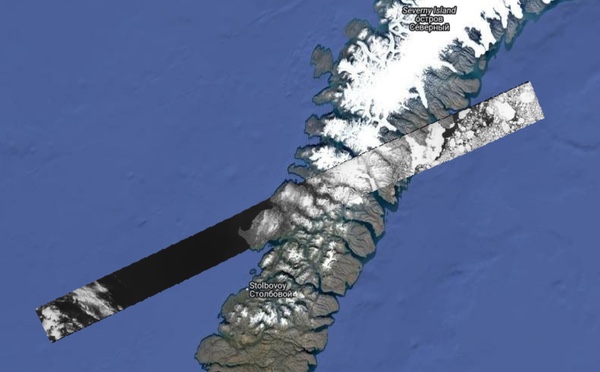 In July 1961, a CORONA reconnaissance satellite photographed the Soviet island of Novaya Zemlya, which was one of the main nuclear test sites for Soviet weapons. This image illustrates how the CORONA panoramic photographs covered a large swath roughly east-west, and a narrow swath roughly north-south. Normally, the CORONA would have taken a bunch of images like this as the satellite passed north to south, "mowing the lawn" and covering much of the territory. The Samos E-6 was similar in operation, but covered a significantly smaller swath of territory at higher resolution. (credit: Harry Stranger) |
Things fall apart
By March, Joseph Charyk had left as NRO director to become head of the newly established Comsat Corporation at a considerable salary increase. He was replaced as director by Brockway McMillan, who inherited a rapidly deteriorating relationship with the CIA, and lacked Charyk’s reputation. McMillan ordered a special study of an “improved search type satellite reconnaissance system” which would include variations of the Samos E-6 as well as the CIA’s M-2. Rather than reinforcing the work that was already underway, McMillan’s study had the effect of raising doubt about the rapid effort to fly an SP-AS-63 vehicle in four-months’ time. After all, nobody wanted to finish hardware for flight if an impending study proved it was unnecessary.
| But the bigger problem was that the CIA was still opposed to reviving the E-6 camera in any form that challenged the CIA-managed CORONA. |
McMillan ordered the study in response to a statement at the beginning of the year by the United States Intelligence Board about the need for a reconnaissance system with five-foot (1.52-meter) resolution and stereo search capabilities. The USIB established intelligence requirements, and none of the systems then in development could meet that USIB requirement. In response to McMillan’s order, SAFSP created an ad hoc committee which eventually concluded that reactivating the Samos E-6 program made the most sense, an idea that impressed nobody.
Work continued on SP-AS-63, but it began to slow. Officially the launch date was now July 1963, but it was increasingly doubtful that this goal could be achieved. The SPARTAN experiment had been designed to determine the maximum resolution of the camera, in part by lowering its orbit. This lower orbit limited its ground coverage, and those outside the program criticized its limited coverage. But the bigger problem was that the CIA was still opposed to reviving the E-6 camera in any form that challenged the CIA-managed CORONA.[9]
The SP-AS-63 project continued to evolve in April and May. Kodak also began evaluating significantly improved versions of the E-6 that would have essentially been new cameras, undermining the argument for flying an experiment using one of the existing E-6 cameras. Support for the experimental project evaporated. By July 9, the NRO formally canceled the SP-AS-63 project, along with any hope of reviving the Samos E-6.[10]
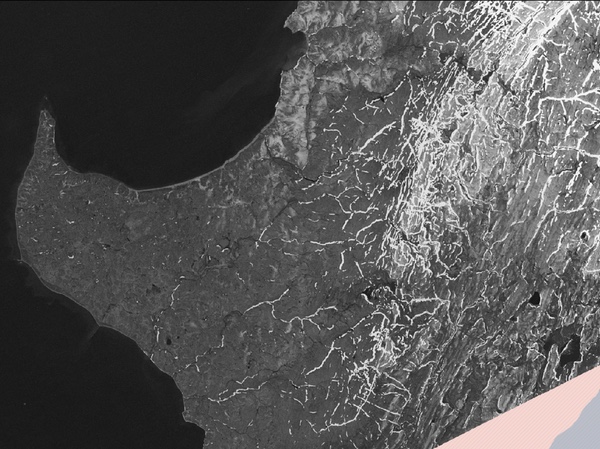 The Sukhoy Nos nuclear testing area on the island of Novaya Zemlya photographed by a CORONA reconnaissance satellite in July 1961. In late October, only a short distance south of this area, the Soviet Union tested the largest nuclear weapon ever exploded on Earth, the so-called "Tsar Bomba." The United States photographed Soviet nuclear test areas with satellites to detect preparations for future tests. (credit: Harry Stranger) |
Samos’ swansong
SPARTAN petered out in the first half of 1963 both because of bureaucratic opposition by the CIA and technological obsolescence. Whereas both SPARTAN and LANYARD were efforts to salvage technology from the Samos program, SPARTAN threatened the CIA’s CORONA program. But from the CIA’s perspective, LANYARD was an insurance policy in case the Air Force-led GAMBIT program did not work. CIA opposition, and a lack of clearly defined objectives, killed SPARTAN, but CIA support allowed LANYARD to continue until it was no longer needed.
Reconnaissance satellite technology was advancing rapidly by the time LANYARD launched in summer 1963, and engineers were learning many things about operating a reconnaissance camera in orbit. LANYARD was in essence a 1958 camera launched in 1963, and although it included some systems that had been successfully proven in orbit, like the CORONA recovery system, it was still an outdated approach to the problem at a time when new technologies were in development. As one person put it, the LANYARD camera “included a lot of things that clanked back and forth, sometimes rather violently.” By this time, program managers and camera designers were interested in more elegant solutions.[11]
Once the GAMBIT demonstrated that it worked as planned in the latter half of 1963, LANYARD became superfluous. As NRO historian Robert Perry explained, LANYARD had always been an insurance policy in case GAMBIT did not work and CIA officials never thought of it as anything else.[12]
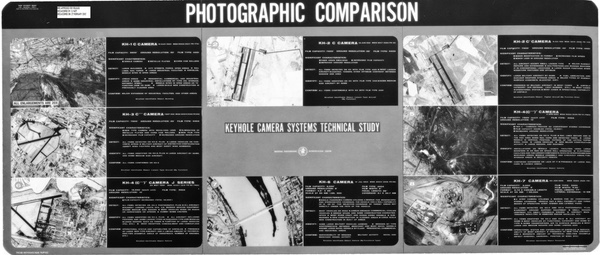 A 1966 comparison of the different reconnaissance satellites successfully operated by that time. The Samos satellites, which were not successful, were not included. The resolution data for LANYARD is not completely accurate. The early photos from the camera were high quality, but a thermal problem then affected the resolution of later photos taken over the Soviet Union. [larger version] (credit: NRO) |
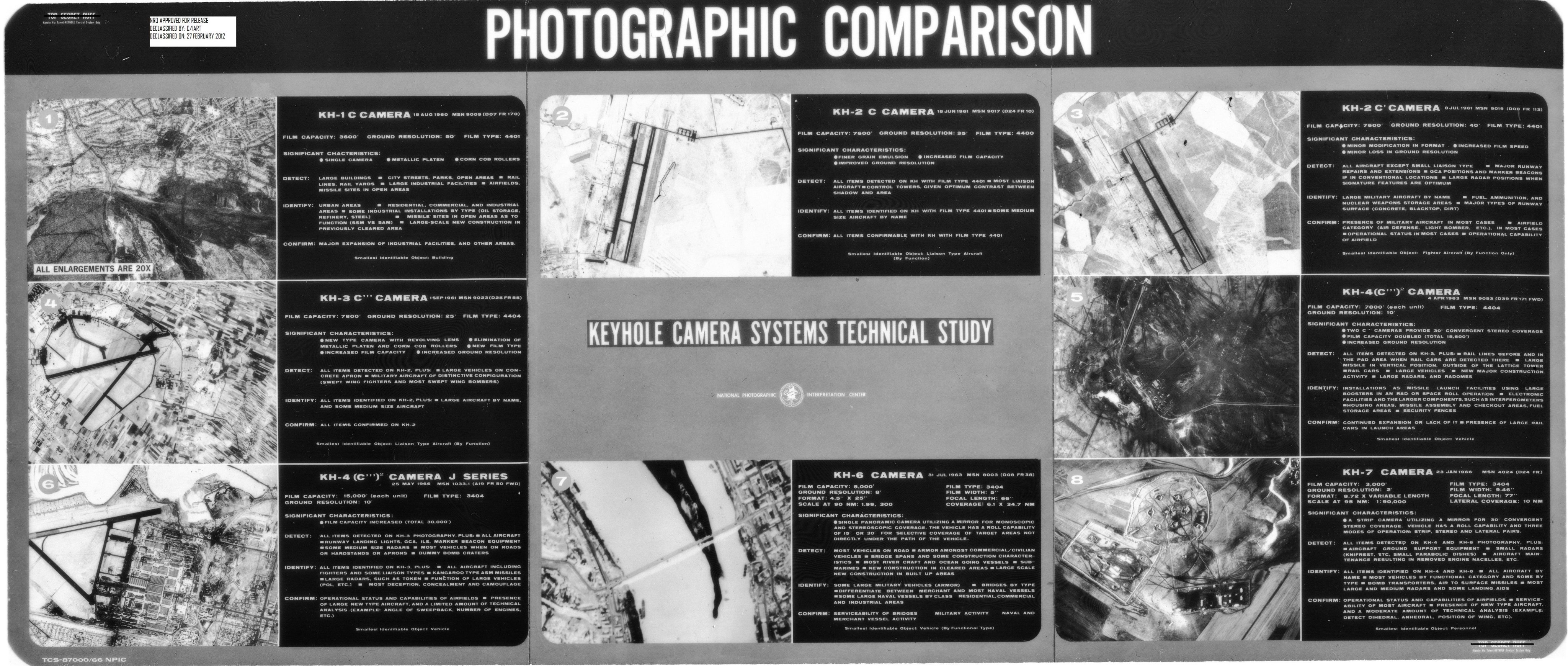
GAMBIT provided better resolution than LANYARD, and the GAMBIT-CORONA combination complemented each other quite well: CORONA found the targets in the vast territory of the Soviet Union and GAMBIT reported their characteristics. LANYARD occupied a niche between the two other systems, and CIA and NRO officials decided by late 1963 that this niche no longer needed to be filled. Even LANYARD’s designer, Jack Herther, conceded that the camera was near the practical limit for conventional refracting optical systems. To obtain better resolution, camera designers would have to switch to reflecting mirrors instead of heavy glass lenses. GAMBIT therefore had greater margin for improvement—and would be improved substantially over the next two decades—whereas LANYARD was a technological dead end.
Even during the 1995 declassification of early American reconnaissance satellites LANYARD was nearly forgotten. But the satellite had a positive, if unheralded legacy. It proved the capabilities of the TAT Agena-D booster that soon became the mainstay of the CORONA program. It also forced Itek to conduct research and development on large, lightweight optical mirrors, which enabled the company to propose a radical new camera system.
There was one other LANYARD legacy as well. In the mid-1960s, Lockheed was able to win the contract for the GAMBIT-3 spacecraft, in part because of work it had first demonstrated on the LANYARD. The KH-7 GAMBIT-1 had used a spacecraft developed by General Electric that separated from the Agena upon reaching orbit. But the GAMBIT-3 utilized the Agena upper stage as the spacecraft, providing power and stabilization in orbit. Lockheed had incorporated a roll joint at the front of the Agena that enabled the forward section of the spacecraft, containing the payload, to rotate to either side and photograph targets that were not directly below. Lockheed had demonstrated the roll joint worked on the single successful LANYARD mission.
Note: A previous version of this series on LANYARD appeared in Quest – The History of Spaceflight Quarterly. A version of this article on SPARTAN appeared in The Space Review in early 2022. The LANYARD reconnaissance images have only recently become available thanks to the work of Harry Stranger.
Endnotes
- Robert Perry, “A History of Satellite Reconnaissance, Volume IIB – SAMOS E-5 and E-6,” October 1973, p. 461.
- Ibid., p. 467.
- Ibid., p. 468.
- Ibid., p. 469.
- Ibid., p. 470.
- Ibid., p. 474.
- Ibid., p. 476.
- Ibid., p. 478.
- Ibid., pp. 481-483.
- Ibid., pp. 484-485.
- Ibid., p. 389.
- Ibid., p. 390.
Note: we are now moderating comments. There will be a delay in posting comments and no guarantee that all submitted comments will be posted.