Backfire to space: The Backfire bomber and Skif rocket systemby Dwayne A. Day
|
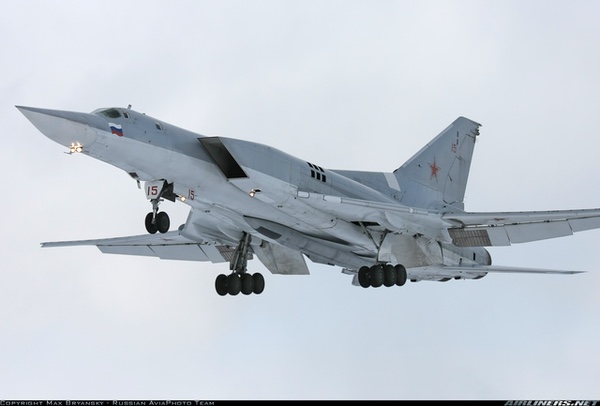
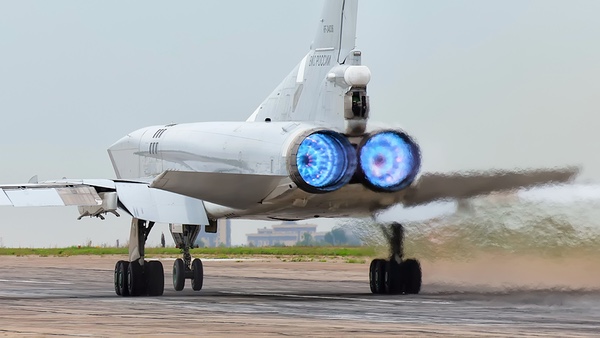 The Tu-22M3 Backfire was first developed in the late 1960s as both a medium bomber and a naval attack aircraft. It could carry 1-3 large cruise missiles externally, as well as bombs. It was designed to go fast to penetrate enemy air defenses. (credit: Andrei Shmatko, Wikimedia) |
After the end of the Cold War, however, the Backfire’s importance quickly diminished. It was never built in the large numbers the Air Force had predicted, and the approximately 400 or so in service were quickly reduced in numbers. Ukraine, no longer part of the Soviet Union, scrapped dozens of aircraft. The Russian air force retired dozens more. By the early 2000s, some Russian aircraft engineers proposed a new, peaceful role for the Backfire, launching commercial rockets into space as part of a program named “Skif.”
| Throughout the history of the Space Age there have been many proposals for air-launched rockets. The purported advantages of air launch include performance enhancements to the rocket of both speed and altitude provided by the aircraft. |
Skif means Scythian, an ancient nomadic people who populated parts of what became the Soviet Union. They were known for their ability to shoot arrows while riding horseback, which may explain why the name was adopted for the rocket. The Raduga Design Bureau was the lead developer of the rocket, with aircraft designer Tupolev responsible for the overall system and the Tu-22M3K carrier aircraft. The aircraft would have been a modified Tu-22M3 bomber, with “K” standing for “Kosmos.”
The Backfire was selected instead of a larger aircraft because of its speed. The plan was to launch Skif not only at high altitude, but also high speed, imparting extra velocity onto the rocket at deployment. The goal of the Skif system was to launch relatively small satellites up to 300 kilograms into orbits of 200 to 2,800 kilometers. The expectation was that these could be Earth remote sensing, communications, and scientific satellites.
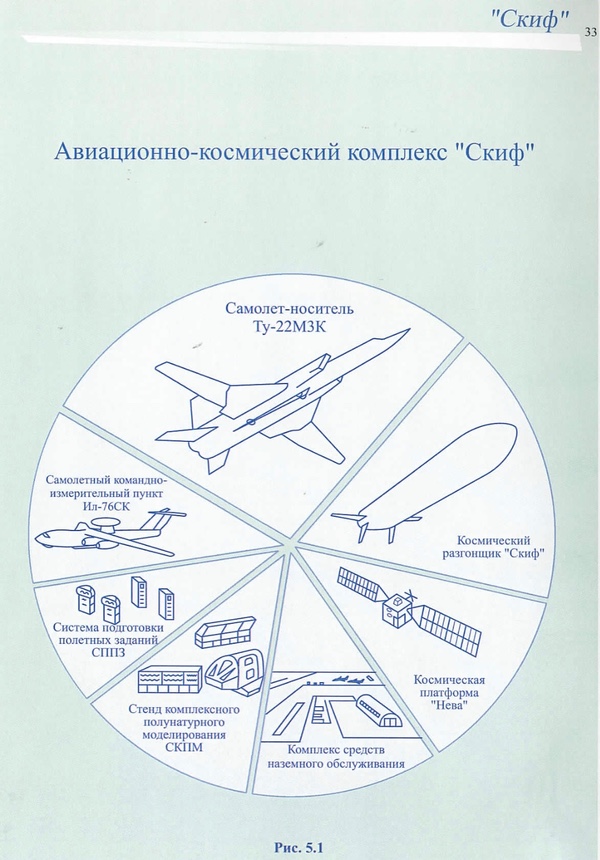 Illustration from a report about Skif showing the various components of the system. (credit: “Skif: An Air-Launched Space System Based on the Tu-22M3 Aircraft”) |
Air launch
Throughout the history of the Space Age there have been many proposals for air-launched rockets. The purported advantages of air launch include performance enhancements to the rocket of both speed and altitude provided by the aircraft. The aircraft could also take the launch vehicle to a more favorable latitude and location, such as over the ocean, and launch to a wider range of inclinations than a fixed launch site. It might even gain performance by launching from near the equator and benefitting from the Earth’s rotation. Air launch purportedly also could make a satellite system more responsive to operational needs, perhaps by quickly launching a satellite to replace a damaged one.
The US Navy explored the concept in the early 1960s. American aerospace contractors considered numerous proposals throughout that decade, including launching from beneath a B-58 Hustler bomber (a program called TOWN HALL), launching from the back of a C-130, and launching from a modified Mach 3 A-12 OXCART (see “Blackbirds and black satellites: the A-12 OXCART as a satellite launcher,” The Space Review, January 3, 2022; “Roads not taken in satellite photo-reconnaissance: Part 1, 1960s,” The Space Review, October 16, 2023, and part 2.) In the early 1970s, the National Reconnaissance Office also considered launching a relatively small rocket from an F-4 Phantom interceptor. In the mid-1990s there was a proposal to use a B-1 bomber—nicknamed “the Bone” by its crews—to launch a rocket, a concept similar to Skif.
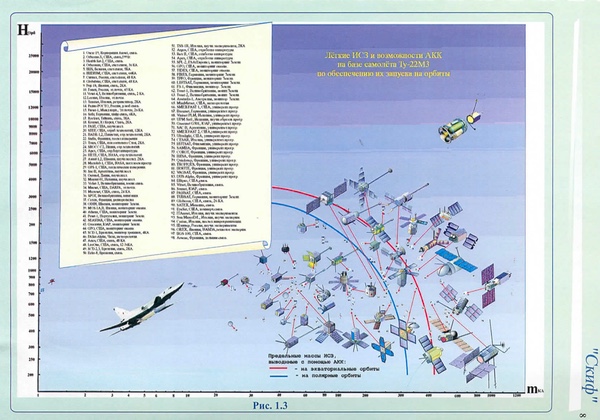 The plan was for Skif to launch a variety of commercial and scientific satellite payloads. (credit: “Skif: An Air-Launched Space System Based on the Tu-22M3 Aircraft”) |
By the 2010s, air-launch seemed to be gathering attention again, with multiple proposed projects, including Stratolaunch, which never found a rocket; AirLaunch, which would have used an Air Force C-17 Globemaster II; and eventually Virgin Orbit, which used a modified 747. Only Virgin Orbit achieved any technical success, although it was soon canceled because of lack of customers in a rapidly changing market. Stratolaunch now owns both the massive Roc aircraft and Virgin Orbit’s former 747, using them to launch hypersonic missiles.
Despite many proposals, there has only been one operational air-launched rocket. In the 1980s, the United States developed its only operational air-launching system, the Pegasus, launched from beneath a modified L-1011 airliner. Pegasus, however, had a very low launch rate: between 1990 and 2026 it launched 46 times, with three failures and three partial failures. Its July 2026 launch of the Link satellite was its last, and Pegasus has now been put out to pasture. Its carrier aircraft, the Lockheed L-1011, is the last of its type still flying, and it will be interesting to see what happens to it.
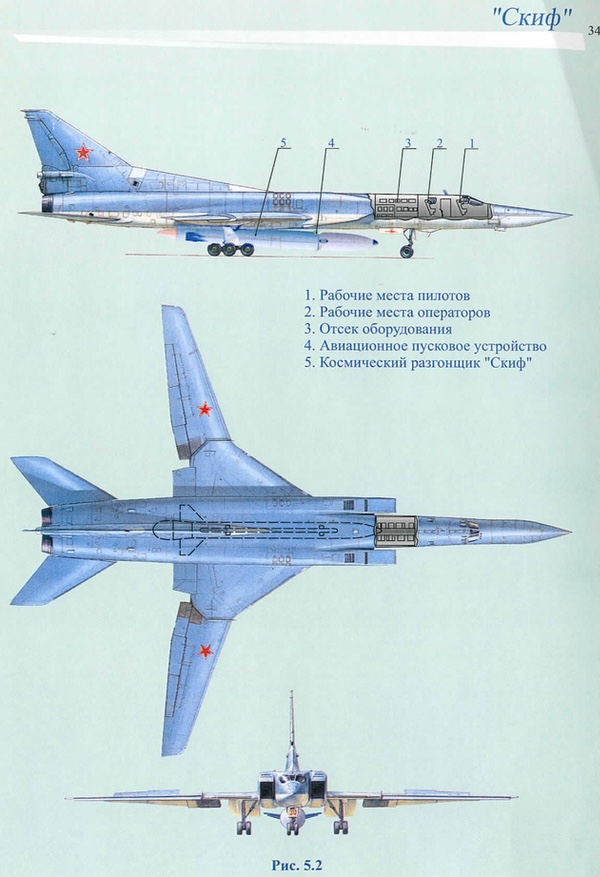 The launching aircraft required the removal of military systems and their replacement with systems to support and monitor the rocket and satellite in flight. (credit: “Skif: An Air-Launched Space System Based on the Tu-22M3 Aircraft”) |
The Soviet Union also explored air launch numerous times throughout its history, as well as air-launched anti-satellite weapons like the United States tested in the 1980s. Perhaps the most notable Soviet/Russian example of an air-launched space vehicle was known as MAKS, which would have launched a spaceplane off the back of a massive An-225 Mriya aircraft. MAKS was never built, and in 2022 the Russians destroyed Ukraine’s An-225 on the ground.
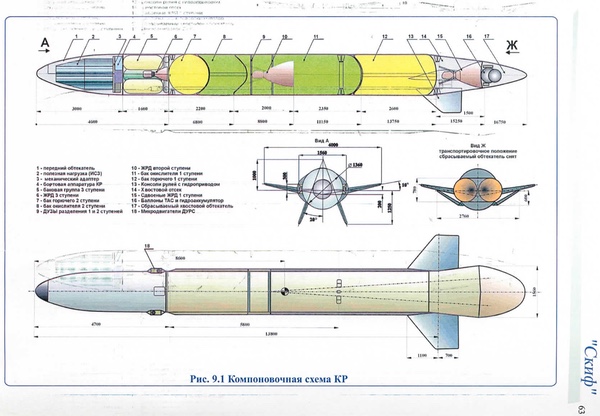 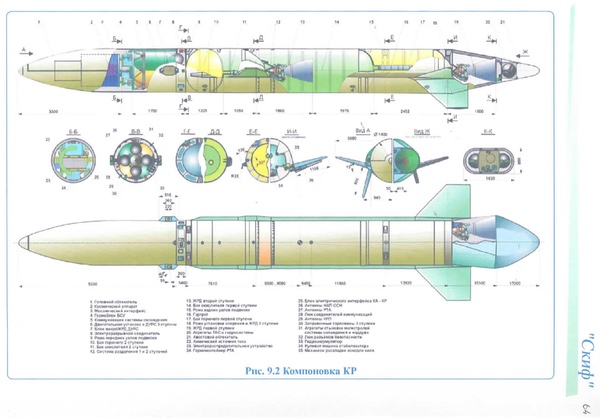 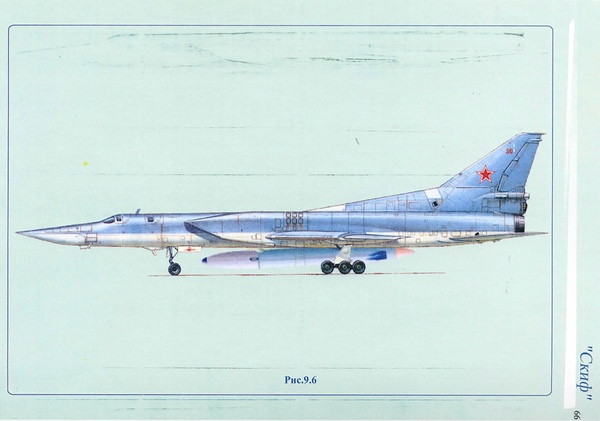 Skif would be carried under a modified Tu-22M3K medium-range bomber. The "K" stood for "Kosmos." Note that the rocket's lower fins folded up so the rocket could be carried underneath the aircraft. They would deploy in flight. (credit: “Skif: An Air-Launched Space System Based on the Tu-22M3 Aircraft”) |
Skif rocket
The Backfire was a medium-size bomber, and one of the many limitations of air launch is that the rocket has to be sized to fit the aircraft, and after that, it cannot be enlarged. To fit under the Tu-22M3K fuselage, the Skif rocket could be no larger than 17 meters in length and 1.5 meters in diameter. The combined mass of the rocket and the support equipment was limited to 20 tons, with the booster massing 17.3 tons.
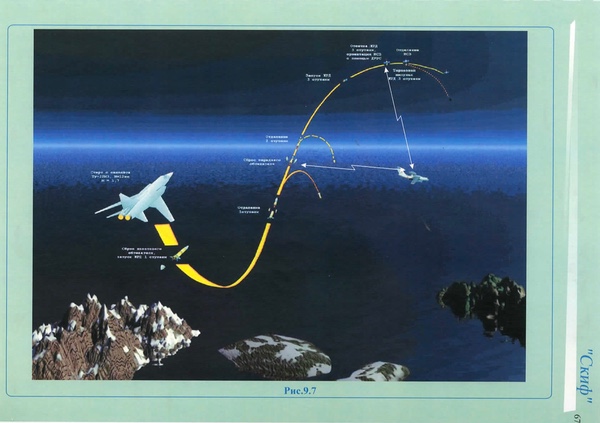 For rocket deployment, the carrying aircraft would perform a powered climb. (credit: “Skif: An Air-Launched Space System Based on the Tu-22M3 Aircraft”) |
Skif was a two-stage rocket. The first stage was required to provide 21 to 26 tons of thrust. Two modified RD-0242 engines equipped with thrust-vector control could provide 25 tons of thrust. A single RD-0242 engine would power the second stage, providing 8.5 tons of thrust. The engine used UDMH/N₂O₄ propellants, which were storable propellants often used in liquid-fueled ballistic missiles. The propellants were also nasty, requiring careful handling.
Skif could deliver 220-250 kilograms to 600-kilometer polar and sun-synchronous orbits. The payload mass could be increased to 300 kilograms for a medium-inclination orbit.
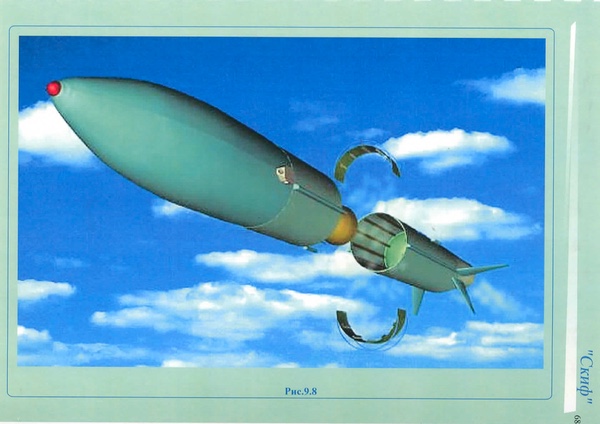 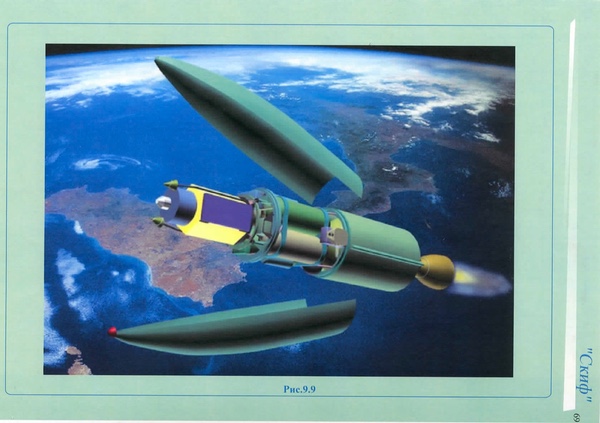 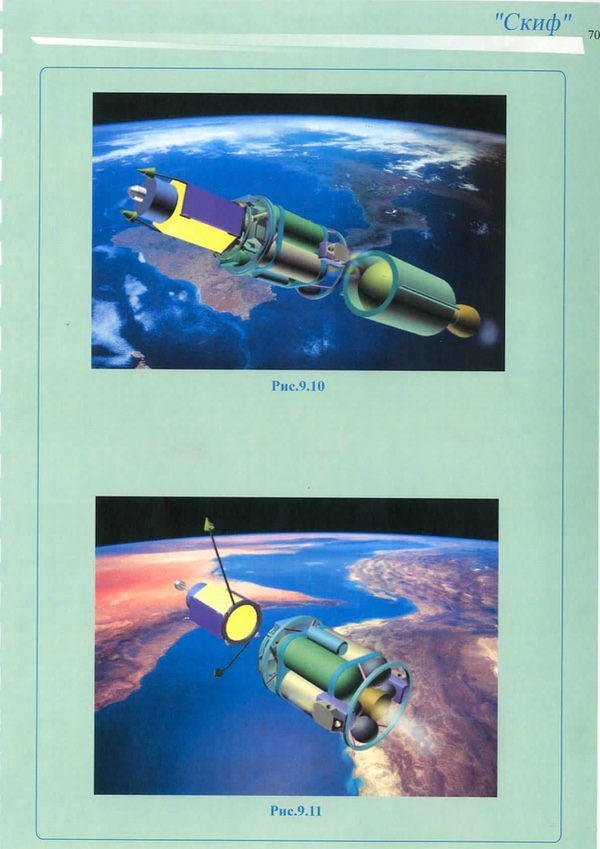 Deployment of the two-stage rocket. Ideally, it could carry a 300-kilogram payload to obit. (credit: “Skif: An Air-Launched Space System Based on the Tu-22M3 Aircraft”) |
Tu-22M3K Backfire
Because the Backfire was designed as a bomber, some of its systems were not required for the air launching mission and could be removed. The military systems would be replaced with mission-specific equipment to monitor and launch the rocket in flight. The bomb bay doors would be replaced by a fairing with a raised aft section for holding the rocket. Some equipment would be installed in the bomb bay and connect to the rocket through the faring. The bomber’s fuselage would have to be reinforced to hold the rocket. The Skif would be heavier than the Kh-22 cruise missile that was often carried by the Tu-22M3 and has been used in the illegal war against Ukraine to blow up apartment complexes.
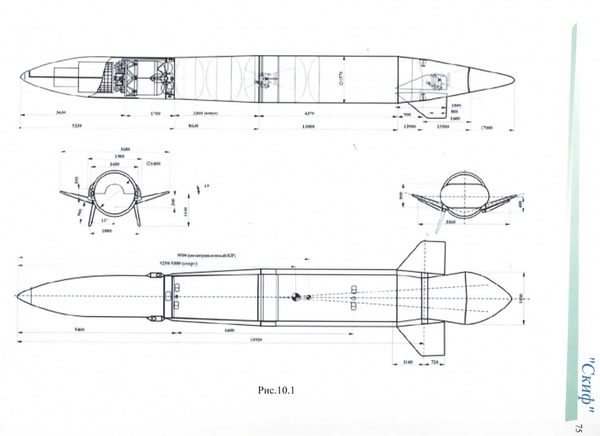 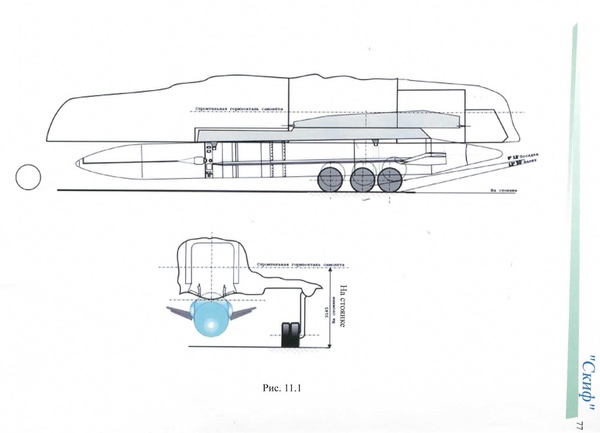 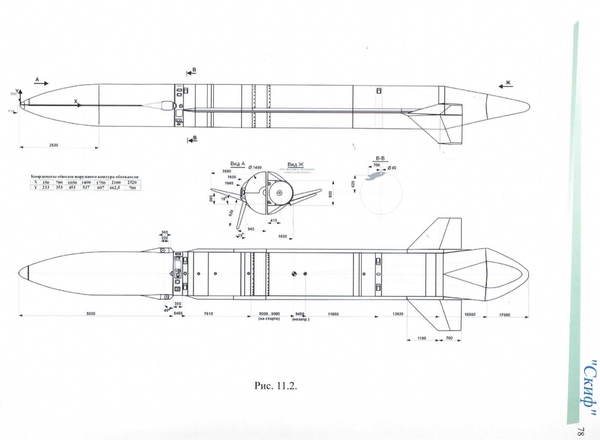 The Skif rocket would be a unique design and had to be sized to fit underneath the carrying aircraft. One of the limitations of air-launch is that the rocket's size cannot be increased later for greater performance. (credit: “Skif: An Air-Launched Space System Based on the Tu-22M3 Aircraft”) |
Tupolev also sought to improve the aircraft’s aerodynamic performance. In coordination with Russia’s Central Aerohydrodynamic Institute (TsAGI), they tested a scale model in wind tunnels. Some modification of the airframe was suggested, including changes to the wings and wing tips to increase lift. The Tu-22M3 was equipped with a tail gun, which would be removed and replaced with a redesigned after section, reducing drag. Several other modifications were proposed to also reduce drag, like closing gaps in flight control surfaces. The overall goal was to increase the thrust available and increase flight range while carrying a large, externally mounted rocket, and engineers estimated that the overall subsonic cruise lift-to-drag ratio could be increased by approximately 10%. Subsonic flight range could be increased by approximately 600 kilometers.
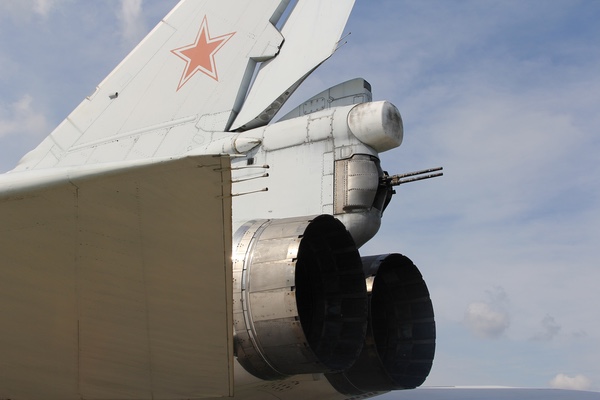 The Backfire was equipped with a tailgun to deal with pesky American aircraft. It would be removed to reduce weight and drag for the air-launch version. (credit: Clemens Vaster, Wikimedia) |
Proposal to nowhere
The Skif air-launched rocket proposal never proceeded to development. Russia’s space industry had no success in marketing new hardware commercially and was only able to sell existing rockets such as the Soyuz and the Proton. Skif was soon forgotten, filed away with a long list of Russian dreams of reclaiming lost spaceflight glory.
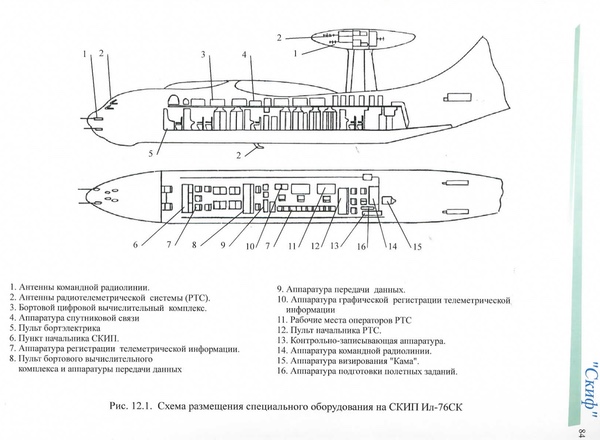 For Skif launches, the carrying aircraft would be accompanied by an airborne support aircraft that would assist in communications and tracking. (credit: “Skif: An Air-Launched Space System Based on the Tu-22M3 Aircraft”) |
Sources
A. Pukhov, “Skif: An Air-Launched Space System Based on the Tu-22M3 Aircraft. Preliminary Design, Book 1.” Moscow, 2003. (Пухов А.Л. "Скиф" Авиационно-космический комплекс на базе самолёта Ту-22М3 / Эскизный проект, книга 1, Москва, 2003)
Note: we are now moderating comments. There will be a delay in posting comments and no guarantee that all submitted comments will be posted.