Starship (finally) reaches orbitby Jeff Foust
|
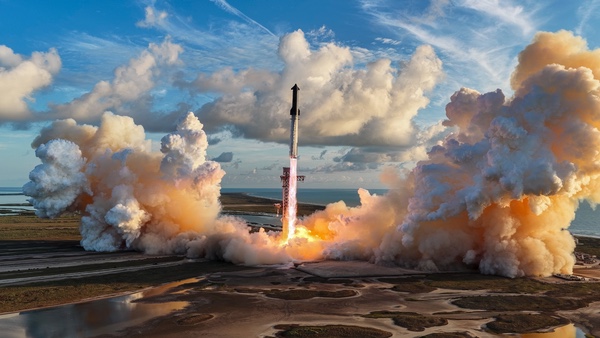
| As Huot finished the explanation of the revised flight, he paused as contollers deliberated on communications loops not aired on the public webcast. “So, we are not giving up yet on orbit.” |
“I think my nervous system almost got fried watching that flight,” SpaceX CEO Elon Musk said on the company’s webcast of the launch shortly after Falcon 1’s upper stage and its inert payload reached orbit. “I don’t know what else to say. It’s so fricking awesome my mind is blown.” (See “A sign of progress”, The Space Review, September 29, 2008.)
On September 28, 2026, it was Starship’s turn. This was the 14th flight of Starship/Super Heavy; the first 13 had all been intentionally suborbital, albeit with varying degrees of success. While some of those earlier flights had gone almost all the way to orbit, this time SpaceX planned to place Starship’s upper stage in orbit and deploy 26 Starlink V3 satellites, larger next-generation spacecraft for the company’s broadband constellation.
It almost didn’t happen. While Starship lifted off at 8:48 am EDT from Starbase, Texas, after a smooth countdown, one of the six Raptor engines in the ship shut down prematurely during its ascent. SpaceX previously said they would only proceed with a brief orbit insertion burn and payload deployment if the vehicle was healthy.
“We did have one of those engines go out on the way uphill, and because of that, we are not going to do the additional burn that will send us into orbit. So definitely not the outcome we were all hoping to hear today,” SpaceX Dan Huot said on the webcast.
He explained that Starship would instead complete a suborbital flight like previous ones, splashing down in the Indian Ocean without deploying its Starlink payload. But as finished the explanation of the revised flight, he paused as contollers deliberated on communications loops not aired on the public webcast.
“Teams continue to look at everything, so you're getting this in real time as I’m starting to see it,” he said, followed by another pause. “So, we are not giving up yet on orbit.”
The engine that shut down, he explained, was one of three vacuum-optimized engines that would not have been used for the rest of the mission. If the other engines were healthy, controllers could agree to continue the flight, including performing the orbit insertion.
About ten minutes later, Huot came back with good news. “All right, so the go/no-go poll for orbit has finished, and we are go for orbit,” he announced. One Raptor engine then fired for 19 seconds, placing Starship into a roughly circular orbit at an altitude of about 275 kilometers.
Payload deployment followed, with 26 Starlink V3 satellites slowly released from Starship’s payload bay. SpaceX reported soon after the completion of the half-hour deployment that all 26 were functioning, making contact with the ground and with other Starlink satellites through laser links.
| “If this flight goes well,” Musk said earlier this month, “then on Flight 15 we will attempt to catch the ship.” |
The original plan for Flight 14 was for Starship to make about six orbits of the Earth, reentering and splashing down in the South Pacific Ocean off the coast of Chile nearly ten hours after liftoff. Instead, SpaceX decided to end the mission early, wrapping up after less than two orbits with a splashdown in the North Pacific several hundred kilometers north of Hawaii. The reentry was similar to previous suborbital flights, with the ship making a “soft” splashdown before toppling over and exploding.
“Out of an abundance of caution given the engine issue experienced during ascent, the flight control team decided to limit the duration spent on orbit and proceeded with deorbiting Starship to a splashdown location in the northern Pacific Ocean,” SpaceX said in a summary of the mission published later in the day.
While Musk had his mind blown with the first Falcon 1 reaching orbit, he seemed more sedate about the first Starship. “First orbital flight of Starship successful!” he posted on X, the social media site now part of SpaceX, but didn’t appear to fixate on the milestone, posting as much about AI developments at the company as about Starship.
Now to do it again and again
With SpaceX now demonstrating that Starship can reach orbit and deliver payloads, it’s now time for the company to demonstrate what will set the vehicle apart: recovering and reusing both stages.
Before the launch, Musk said that the next mission, Flight 15, could be the first to not just recover the Super Heavy booster—which SpaceX has done on previous missions dating back nearly two years—but also the upper stage.
“If this flight goes well,” SpaceX Chief Executive Elon Musk said of Flight 14 during an appearance at the All-In Summit earlier this month, “then on Flight 15 we will attempt to catch the ship.” The ship, like the booster, will be caught by a launch tower back at Starbase.
He sounded confident that could be done. On Flight 13 in July, the ship made a pinpoint splashdown in the Indian Ocean and remained intact after toppling over. SpaceX spent weeks recovering the ship, loading it on a transport vessel currently on its way back to Texas.
For the Flight 13 splashdown in the Indian Ocean, he said, “if there had been a tower at that location, it would have caught the ship.” He gave SpaceX a 50–60% chance of catching the ship on that next flight.
One question, though, is whether this flight went sufficiently well to attempt a recovery of the ship at Starbase. In addition to the premature Raptor shutdown on the ship, one of 33 Raptors in Super Heavy shut down during ascent and a second failed to relight for boostback and landing burns. That did not affect the mission—Super Heavy made a controlled splashdown in the Gulf of Mexico as planned—but Raptor engine malfunctions have been an issue on several Starship test flights.
Musk said earlier this month he was primarily concerned about Starship’s ability to remain intact through reentry since, for a return to Starbase, it will reenter over land. “What we’re most concerned about is, if the ship were to break up over land and rain debris on people, our popularity would diminish very rapidly,” he said.
| “Either at the end of this year or, more likely, early next year, we will refly the ship and refly the booster,” Musk said. |
Notably, Musk said in early August in a SpaceX earnings call that Flight 14 would be the first to attempt a return to Starbase for the upper stage. “I would say things look very good, and that’s why we, assuming we receive regulatory approval to do so, will attempt to catch the ship with the tower on the next flight, which is tentatively scheduled for the end of this month,” he said.
By later in the month, though, he scaled back those plans, saying a catch of the ship was planned “in a few months.” By that point Flight 14’s launch had also slipped from end of August to mid-September, before being pushed back again to the end of the month.
One Starship and Super Heavy are recovered, SpaceX will then need to demonstrate they can be reflown, and rapidly. “Either at the end of this year or, more likely, early next year, we will refly the ship and refly the booster,” Musk said at the All-In Summit, with the goal of “full reusability with rapid reflight” in 2027.
That is vital to SpaceX’s ambitions. SpaceX is counting on Starship to start deploying next-generation Starlink satellites with greater capacity than the Starlink V2 mini satellites being launched by Falcon 9 today. Last month, SpaceX abruptly ended Falcon 9 Starlink launches from Florida as part of that transition, although it continues to launch them from Vandenberg Space Force Base in California. Starship is also needed for the company’s orbital data center satellites that it plans to launch as soon as next year.
While SpaceX has two Starship launch pads in Texas and three under construction in Florida, the company is thinking much bigger. It announced last month plans for Starbase Louisiana, a massive spaceport on the Gulf coast that could ultimately include 10 pads and support infrastructure.
“By starting with a clean-sheet design, we’re planning to build a self-sustaining spaceport with its own propellant production, power generation, deepwater shipping capabilities, vehicle processing facilities, and probably an airport,” SpaceX president Gwynne Shotwell said at the event announcing the spaceport.
Louisiana state officials said SpaceX would invest $100 billion in Starbase Louisiana, far more than what the company has spent on Starship development overall to date, but did not disclose details about how the money would be spent or over what period. The first launches from Louisiana could take place as soon as 2029.
NASA is also anxiously awaiting routine Starship flights. Starship is a central part of the Artemis lunar exploration effort, but delays in Starship’s development have raised doubts about whether the vehicle will be ready to support a lunar landing mission in 2028, requiring NASA to turn to Blue Origin’s Blue Moon (see “Artemis 3 take shape”, The Space Review, June 15, 2026.)
That includes a long-awaited demonstration of in-space cryogenic propellant transfer from one Starship to another, a core enabling technology for any Starship mission beyond low Earth orbit. While SpaceX has tested transfers between tanks inside a Starship on a suborbital flight, the ship-to-ship transfer required an orbital capability.
| Many technical details about the vehicle have changed since then, along with its name, but the broad outlines Musk presented in 2016 are present in Starship today: full reusability, use of methane as fuel, and in-space propellant transfer. |
In an interview at a Wall Street Journal Leadership Institute event earlier this month, NASA administrator Jared Isaacman called that technology a “gamechanger for America’s competitiveness in space.” He expected that demonstration to take place “in very early 2027, maybe the end of this year.”
NASA itself has provided few details about the development of the lunar lander version of Starship or other capabilities needed for Artemis since June, although Isaacman said in a memo to agency employees last week that preparations for the Artemis 3 LEO mission, involving Starship and Blue Moon, were running about three months behind schedule. He promised an “Artemis acceleration update” in early October.
The first Starship orbital flight took place 18 years to the day after the first Falcon 1 reached orbit, but it also took place ten years and one day after another milestone: a talk by Musk at the International Astronautical Congress in Guadalajara, Mexico, where he unveiled what was then known as the Interplanetary Transport System, the precursor to Starship (see “Elon Musk’s road to Mars”, The Space Review, October 3, 2026.)
Many technical details about the vehicle have changed since then, along with its name, but the broad outlines Musk presented then are present in Starship today: full reusability, use of methane as fuel, and in-space propellant transfer. He predicted then that the vehicle would become the central focus of SpaceX, with the company investing $10 billion to develop it. (SpaceX has spent more than $15 billion on Starship, the company disclosed in filing as part of going public earlier this year.)
He said then that the vehicle could be ready by the early 2020s, with the first missions to Mars in the mid-2020s. But, he acknowledged even then a reputation for setting and then missing deadlines: “I’m not the best at this sort of thing.”
Ten years later, Starship has finally delivered payloads to orbit. Now it’s time for the vehicle to deliver on that promise of rapid reusability, something demanded by the company’s investors and partners.
Note: we are now moderating comments. There will be a delay in posting comments and no guarantee that all submitted comments will be posted.