Flying under the radar: Russia’s tacit reliance on Chinese SAR satellites (part 1)by Bart Hendrickx
|
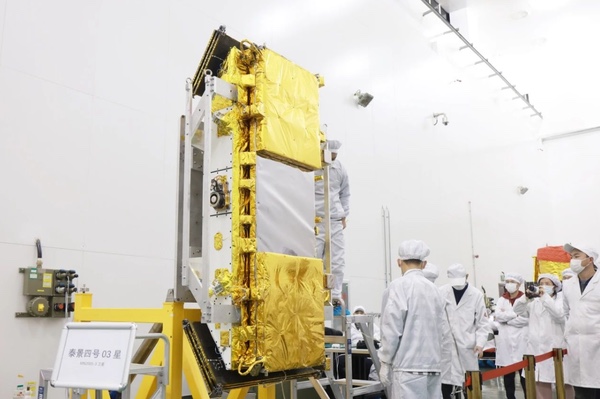
| Statements made by corporate executives last year indicated that the home-built Okulus was not expected to fly until 2028 at the earliest. It therefore came as a complete surprise when clear indications emerged last April that the deployment of the first operational satellite was imminent. |
The Russian military currently operates a single radar satellite under the official name Kosmos-2550. Internally known as Pion, it is a specialized ocean reconnaissance satellite designed to accurately pinpoint the location of military vessels. Although officially declared operational by Russia in November 2022, high-resolution ground-based photographs of the satellite strongly suggest that one of its two radar antennas failed to deploy. [1] No follow-on satellite is expected to be launched in the near future. Meanwhile, work has been underway for over a decade on a separate series of military X-band radar satellites called Araks-R, but the project has suffered numerous delays and has still not seen a single launch. Many of these delays are likely caused by Western sanctions that have hampered the import of radiation-hardened microelectronics, which are critical, among other things, for the assembly of advanced synthetic aperture radar payloads.
Novyy Kosmos’ Okulus project
One of the private companies aiming to compensate for the lack of radar satellites is Moscow-based Novyy Kosmos (“New Space”), a startup founded in October 2021 which has been working on a radar satellite called Okulus. Some basic details regarding the platform are available from the company’s public website and promotional materials. The spacecraft weighs 448 kilograms and is intended to operate in a 97.2° inclination Sun-synchronous orbit at an average altitude of 475 kilometers. Its X-band radar operates within the 9.3–9.8 gigahertz range and is advertised to produce images with resolutions of 2 meters in spotlight mode, 5 meters in stripmap mode, and 20 meters in ScanSAR mode. Confusingly, the company’s website also lists a 0.4-meter maximum spatial resolution alongside an additional Ku-band radar capability. [2]
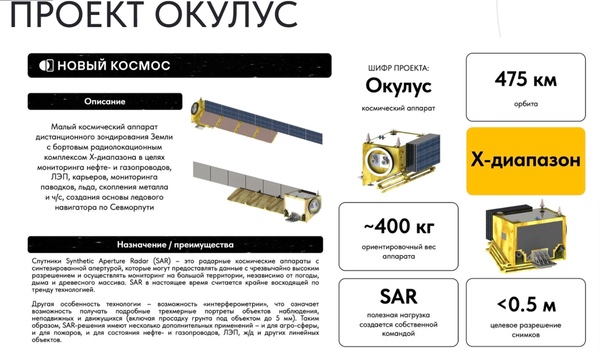 Basic parameters of Okulus on the Novyy Kosmos website. Source |
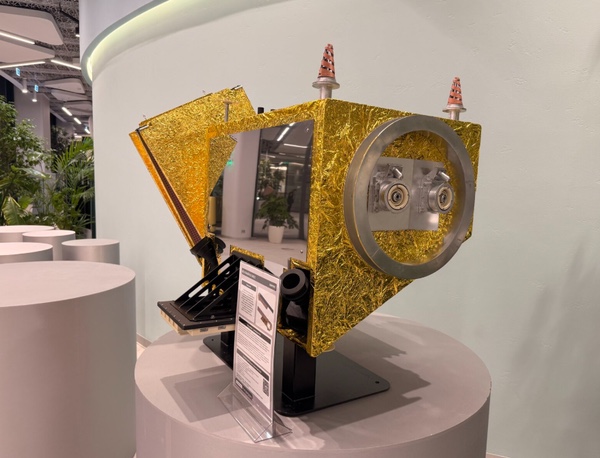 Model of Okulus. Source |
The stated goals of Okulus are to provide all-weather, high-resolution radar monitoring of critical linear infrastructure, including oil and gas pipelines, power lines, and railways. Utilizing advanced synthetic aperture radar (SAR) interferometry, the platform is designed to track ground subsidence under these structures with a precision of up to 5 millimeters, while also monitoring quarries and metallic accumulations. Furthermore, it serves vital civil and environmental functions, including flood and forest fire management, agricultural optimization, and mapping ice dynamics along the Northern Sea Route.
Company officials have frequently emphasized that 80% of the satellite’s components will be manufactured within Russia—a crucial asset in an industry heavily restricted by Western sanctions. Novyy Kosmos aims to field a constellation of three Okulus satellites. A technical schematic displayed during an interview with the company’s CEO Anton Alekseyev two years ago suggests that plans have been considered to launch all three spacecraft simultaneously aboard a single Soyuz-2 carrier rocket equipped with a Fregat upper stage.
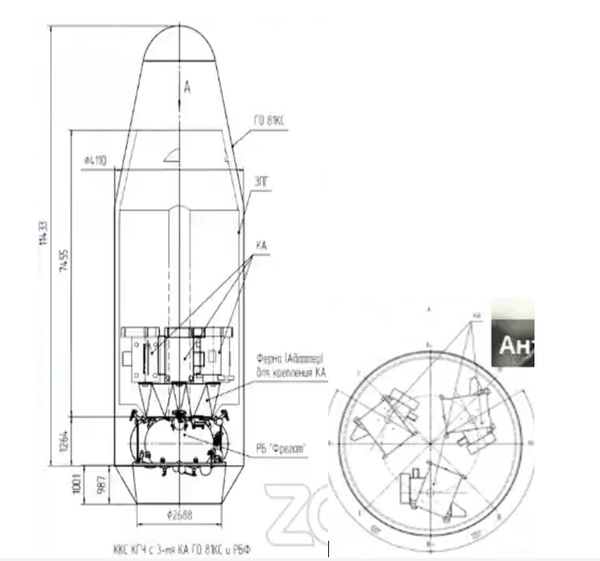
Soyuz-2 payload shroud configured to house three Okulus satellites. Source
|
The surprise launch of Okulus
Statements made by corporate executives last year indicated that the home-built Okulus was not expected to fly until 2028 at the earliest. Some early private funding had been secured for the project (expected to cost 1 billion rubles or roughly $11.5 million), while engineering designs for the satellite's radar were reportedly being finalized. [3]
It therefore came as a complete surprise to observers when clear indications emerged last April that the deployment of the first operational satellite was imminent. On April 12, just a day after Roscosmos chief Dmitriy Bakanov explicitly mentioned Novyy Kosmos during a high-profile meeting with President Vladimir Putin, the company’s chairman, Dmitriy Matsuk, noted on the company’s social media platform that the firm was “getting down to on-orbit flight tests of its first commercial radar satellite.” [4] On the same day, a blog post by Moscow Mayor Sergei Sobyanin highlighting the city's commercial space sector revealed that Okulus would be placed into orbit later that month. [5]
| The document reveals that Novyy Kosmos is actively offering data from two operational Okulus satellites already in orbit. |
Following this announcement, no further updates surfaced until mid-June, when Matsuk was quoted on the company's website confirming that the first satellite had indeed been successfully launched in April and was undergoing the in-orbit tests necessary for “the further development of the company’s products in the field of radar imaging.” [6] Curiously, Matsuk’s statement went entirely unnoticed and was not picked up by any mainstream Russian media outlets.
In a news report published on the company’s website in late July, Novyy Kosmos CEO Anton Alekseyev sowed confusion by describing Okulus as a project "under development." Contradicting this statement, however, the report was accompanied by a high-resolution radar image of a sports stadium credited to a satellite called Okulus-01. [7]

Radar picture credited to Okulus-01. Source
|
Okulus was showcased again during a presentation given by an official from Russia’s Ministry of Emergency Situations in early September. Speaking about the ministry’s use of satellite data obtained by private companies, he displayed high-resolution radar strips of Russia’s Arctic region and the southwestern Volgograd region captured by Okulus in early and late June 2026. [8]
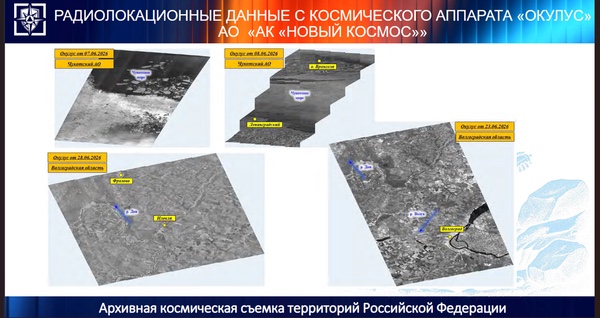
Pictures taken by Okulus in June 2026. Source
|
Finally, during a meeting with Prime Minister Mikhail Mishustin on September 22, Roscosmos chief Dmitriy Bakanov officially confirmed that the Okulus satellite had been successfully orbited earlier in the year and was actively furnishing radar data to several federal executive agencies. Novyy Kosmos officials responded enthusiastically on their corporate platform, framing the launch as a major milestone for Russia’s private space sector and underlining that its imagery would serve both government and commercial clients. [9]
All these public disclosures presented analysts with a conundrum. Announcements from both Novyy Kosmos and Roscosmos claimed a satellite named Okulus was deployed in April and delivering active data within months, despite statements by the company last year that the first flight was not expected until 2028. Furthermore, no satellite officially bearing the name Okulus had been placed into orbit in April.
The most obvious explanation was that Okulus was tucked inside a cluster of six unnamed military satellites launched from the Plesetsk cosmodrome on April 16 by a Soyuz-2 rocket with a Volga upper stage. Registered by US Space Command as Kosmos-2609 to 2614, five of these payloads triggered intense Western scrutiny in mid-May when they executed high-energy maneuvers to lock themselves into orbits that were nearly coplanar with those of the Finnish-American radar satellites ICEYE-X36 and X37. [10] ICEYE has provided radar data to support Ukraine’s armed forces in the war against Russia, raising speculation that the five Russian satellites might be on an inspection mission or have some type of anti-satellite capability. Possibly, Okulus was the sixth satellite, hitching a ride into an orbit far away from that of the ICEYE satellites.
The Chinese connection of Okulus
The Okulus story took a new turn when Novyy Kosmos recently released an updated user guide for customers wishing to purchase customized remote sensing data. Published inconspicuously on the company’s platform, the document reveals that Novyy Kosmos is actively offering data from two operational Okulus satellites already in orbit. The first, named Okulus-01, carries a Ku-band radar operating at a center frequency of 13.5 gigahertz. The second, named Okulus-02, houses an X-band radar transmitting at a center frequency of 9.6 gigahertz with an expansive 1,200 megahertz maximum signal bandwidth. The guide details a specialized processing service that enables customers to use these radar datasets to automatically detect and measure marine oil spills. [11]
The following performance characteristics are given for the two satellites:
Okulus-01(Ku-band)
| Mode | Resolution | Ground swath |
|---|---|---|
| Sliding spotlight 1 | 0.5 m | 5x5 km |
| Sliding spotlight 2 | 0.5 m | 20x10 km |
| Stripmap | 2 m | 15 km |
| ScanSAR | 18-20 m | 150 km |
Okulus-02 (X-band)
| Mode | Resolution | Ground swath | |
|---|---|---|---|
| Spotlight 0.5m | 3x3 km | ||
| Sliding spotlight 1 | 0.5 m | 8x20 km | |
| Sliding spotlight 2 | 0.5 m | 10x30 km | |
| Sliding spotlight 3 | 1 m | 10x100 km | |
| Stripmap | 2.5 m | 25 km | |
| ScanSAR 1 | 7 m | 45 km | |
| ScanSAR 2 | 15-20 m | 100 km |
At the time the document was compiled, Okulus-01 was operational and supplying commercial data, while Okulus-02 was still undergoing in-orbit check-outs. Imagery from the second satellite was expected to become available for customers on August 1, 2026. Okulus-01 and 02 are in orbits with an average altitude of 530 and 535 kilometers respectively. They both have an inclination of 97.5° and cross the descending nodes of their orbits at 10:30 am local time.
| Closer analysis leaves no doubt that Okulus-01 is, in fact, a radar satellite built and launched by China on January 23, 2024, under the name Taijing-4-03. |
The orbital parameters detailed in the guide make it clear that Okulus-01 and 02 were not among the satellites launched from Plesetsk on April 16. The military payloads are in slightly higher orbits with more elevated inclinations. In addition to that, they cross the descending nodes of their orbits in the mid-afternoon, whereas the Okulus satellites do so in the mid-morning. Neither are there any other unidentified Russian satellites launched in recent months that match the orbital elements given for the two Okulus satellites.
Closer analysis leaves no doubt that Okulus-01 is, in fact, a radar satellite built and launched by China on January 23, 2024, under the name Taijing-4-03. Manufactured by Beijing Weina Star Technology (better known by its international name MinoSpace), it is the world’s first commercial Ku-band SAR satellite. Only two other Ku-band radar satellites have been launched since—specifically China’s Airsat-01 (Zhongke-01) and Airsat-02 (Zhongke-02) in September 2024—but these were inserted into slightly lower dawn-dusk orbits with a Local Time of Descending Node (LTDN) of 6:00 am.
Taijing-4-03 is a highly compact, ultra-thin flat-panel radar satellite. Utilizing an 80-kilogram active phased array antenna measuring 3.6x0.6 meters, it is based on Minospace’s MN200S platform and has an overall mass of 230 kilograms.
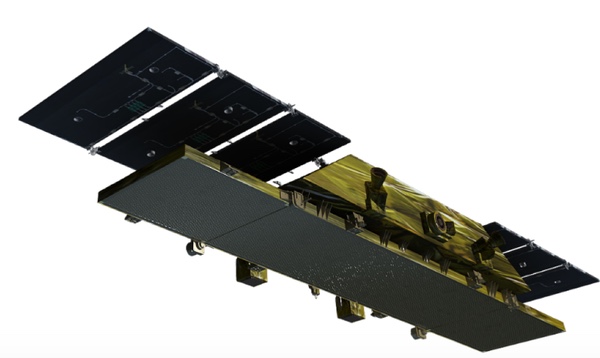
Taijing 4-03. Source: Minospace.
|
The orbital parameters published for Okulus-01 in the Novyy Kosmos user guide perfectly match those of Taijing-4-03 following its launch in January 2024. Catalogued by US Space Command as Object 2024-016D (NORAD number 58823), the satellite has not executed any orbital corrections since its deployment and has consequently decayed from the original 530 kilometers altitude down to approximately 385 kilometers. This has compressed the satellite’s ground footprint, which could explain why some of the swath widths and spatial resolutions marketed for Okulus-01 slightly differ from Taijing-4-03’s factory specifications seen below. [12]
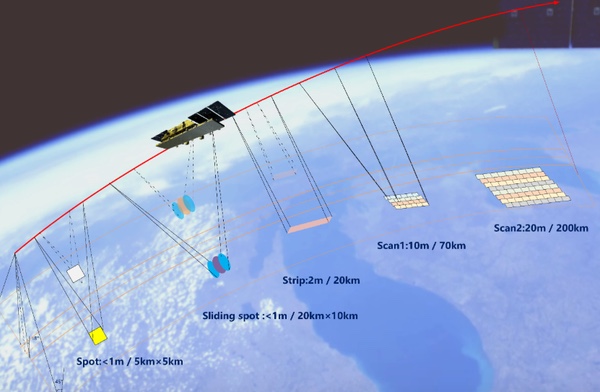
Radar performance data for Taijing-4-03. Source
|
Less than two months after the launch of Taijing-4-03, MinoSpace released a sharp Ku-band capture of US Navy aircraft carriers moored at Naval Station Norfolk in Virginia. Although Novyy Kosmos executives have never openly acknowledged their ties with MinoSpace, they explicitly praised the aircraft carrier tracking capability of Taijing-3-04 in a paper on China’s remote sensing industry published in November 2025. More particularly, they singled out the platform's integrated, spaceborne AI processors that enable such automatic, real-time monitoring. [13]
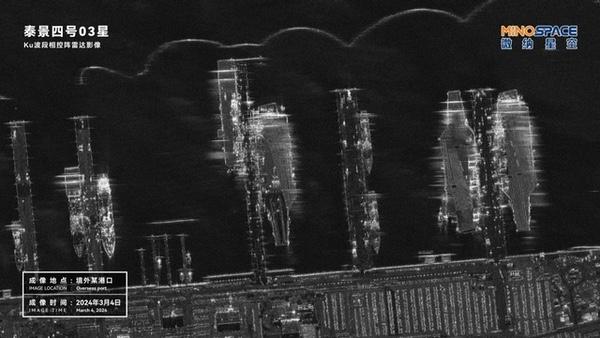
US Navy aircraft carriers imaged by Taijing-4-03. Source: Minosat.
|
Okulus-02, an X-band radar satellite, is almost certainly a cover name for another Chinese satellite, but its identification is not as straightforward. There are four Chinese commercial X-band radar satellites launched after Taijing-4-03 that have been placed into an orbit corresponding to that of Okulus-02:
- Taijing-4-02A (built by MinoSpace), launched on May 21, 2025
- Dongpo-16 (built by MinoSpace), launched on March 16, 2026
- Juntian-1-04A (built by Beijing Juntian Space Technology), launched on March 16, 2026
- Dianjian-1/Tianyi-50 (built by Spacety), launched on May 15, 2026
Chinese sources offer only baseline radar operating parameters for these platforms, making it impossible to positively identify any of them as Okulus-02. Taijing-4-02A and Dianjian-1 can likely be ruled out because their reported maximum swath widths of 240 kilometers significantly exceed the tighter 100-kilometer limit advertised for Okulus-02. Furthermore, Taijing-4-02A is likely to have completed its on-orbit shakedown and commissioning phases long before August 2026, when the second Okulus was declared operational.
This leaves Dongpo-16 and Juntian-1-04A—launched together in March 2026—as the most probable candidates. Both feature a maximum spatial resolution of 0.5 meters that matches the specifications published for Okulus-02. To date, only a single swath width has been publicly disclosed for these platforms, namely “more than 25 kilometers” for Dongpo-16, which closely aligns with the parameters marketed for Okulus-02 in stripmap mode. Between the two, Dongpo-16 is a significantly more plausible candidate because it is built on the exact same MinoSpace MN200S satellite bus as Taijing-4-03 (Okulus-01). From a corporate procurement standpoint, Novyy Kosmos is far more likely to have secured a multi-satellite agreement with a single Chinese partner than with two competing manufacturers.

Juntian-1-04A. Source: Juntian Space Technology.
|

Dongpo-16. Source: MinoSpace
|
MinoSpace is no newcomer to cooperative ventures with the Russian space industry. There is strong evidence that at least two of its high-resolution optical remote sensing satellites are actively being operated by the Russian defense contractor Stilsoft under the pseudonym Stilsat-1. These platforms, Taijing-3-02 and Taijing-3-04, were orbited together with Taijing-4-03 and Taijing-4-02A, respectively. While the exact commercial details of the arrangement between Stilsoft and MinoSpace remain unknown, Stilsoft maintains its own ground station infrastructure to command the satellites and downlink imagery. This independent operational capability strongly indicates that the assets have been turned over to the Russian firm on a complete turnkey basis. [14]
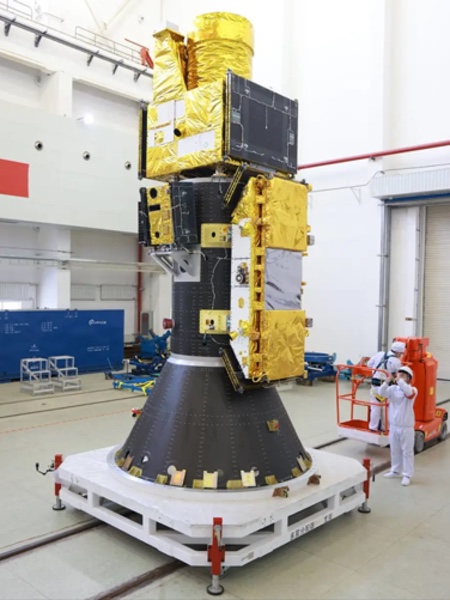
Taijing-3-02 and Taijing-4-03 prior to launch. Source
|
Whether this turnkey operational model also applies to Okulus-01 and Okulus-02 remains unclear. The possibility cannot be entirely ruled out for Taijing-4-03, which has no publicly identified anchor customers within the Chinese domestic remote sensing market. Conversely, Dongpo-16 and Juntian-1-04A were explicitly ordered from their respective manufacturers by domestic Chinese enterprises for localized remote sensing applications.
Dongpo-16 forms part of a planned 20-satellite hybrid radar and optical constellation operated by Huantian Smart Technology. For this specific spacecraft, the operator teamed up with a regional partner, Xingyuan Space, to dedicate a portion of the platform's data capacity to the Jinjiang district of the city of Chengdu in southwestern China. This is why the satellite also bears the alternative name Jinjiang Xingyuan. Proving its domestic utility, Dongpo-16 was one of several satellites of the constellation to image the aftermath of the catastrophic glacier collapse on the China-Nepal border in August 2026. Meanwhile, Juntian-1-04A (also known by the alternative names Tianzhu-1 and Hawkview-1) is the first satellite in a planned SAR constellation operated by Dongfang Zhiyuan, which officially assumed operational control of the satellite in late August 2026.
| By characterizing the launch of Okulus as a domestic accomplishment, Bakanov possibly sought to create the impression that Russia is well on its way to achieving a goal to boost the contribution of private companies to Russia’s space program. |
If either of these platforms is indeed operating as Okulus-02, Novyy Kosmos cannot be its direct operator. Instead, the firm must have concluded a data-sharing agreement with one or more of these Chinese enterprises to obtain imagery gathered by the satellite during its overflights of Russian territory. Novyy Kosmos appears to have established similar arrangements with other Chinese commercial remote sensing operators. According to its own user guide, the company actively markets customized radar imagery from China’s HiSea-1 satellite, alongside optical datasets captured by the Chinese remote sensing satellite Jilin-1 Gaofen-04 (GF04). Furthermore, Russian customers can order high-resolution imagery obtained via Stilsoft’s Stilsat-1.
Other platforms from which Novyy Kosmos routes data to its customers are three Sentinel radar satellites of the European Space Agency as well as an unidentified number of commercial ICEYE satellites. While the Sentinel imagery is available from open-access datasets, the current geopolitical context makes it is absolutely impossible for a Russian company to directly purchase imagery from ICEYE. This can only mean that the ICEYE data is being forwarded to Novyy Kosmos by one or more third parties.
One final question is why Novyy Kosmos openly claims to have launched a single Okulus satellite in April 2026 while it is quietly marketing data from two (Chinese-built) Okulus satellites launched in January 2024 and (probably) March 2026. One remote possibility is that one of the six satellites launched from Plesetsk on April 16 is indeed a product of Novyy Kosmos itself, operating in orbit independently from the two Chinese-built satellites. Company officials have given some vague hints that the domestically produced Okulus would be preceded by one or more technology demonstrators carrying only sections of the radar. However, they may also have been referring to tests of these radar sections with the company’s Argos drones.
A more likely scenario is that Novyy Kosmos did not launch its own satellite in April at all and is instead gathering data exclusively from the two Chinese satellites through commercial lease agreements. Naturally, any open admission of this would tarnish the reputation of Russia’s domestic space industry, which prides itself on its capability to substitute imported technology. In his meetings with Putin and Mishustin in April and September 2026, Roscosmos chief Bakanov portrayed Novyy Kosmos’ projects as an integral part of a new ten-year national space policy approved by Putin in June last year. This policy aims to boost the contribution of private companies to Russia’s space program from 5% to 35% by 2036. By characterizing the launch of Okulus as a domestic accomplishment, Bakanov possibly sought to create the impression that Russia is well on its way to achieving that goal.
The organizational smokescreen even seems to extend to the engineering specifications for the home-built Okulus given on the website of Novyy Kosmos. The 0.4-meter maximum spatial resolution and the additional Ku-band radar capability mentioned there appear to apply only to the Chinese-built satellites, rather than to Novyy Kosmos’ own Okulus satellites. At aerospace exhibitions, Novyy Kosmos’ promotional materials for the home-built hardware present a far more modest capability, restricting the maximum resolution to 2.0 meters and omitting any mention of a Ku-band radar.
Even if the Russian-built Okulus eventually makes it into space, it remains doubtful that it will consist of the 80% domestically sourced components officially claimed by the company. Novy Kosmos possesses no prior industrial experience in fabricating 400-kilogram-class satellite buses or radar payloads, and it has kept the identities of its manufacturing partners strictly classified. The active phased array radar planned for the domestic platform demands a vast quantity of highly sophisticated, space-qualified electronic components. Because these microelectronics face stringent Western sanctions blockades and are not mass-produced within the Russian Federation, Novyy Kosmos may well continue to rely on its Chinese partners to incorporate them into the Russian-built platforms.
References
- Post by Austrian satellite watcher Felix Schöfbänker on the SeeSat forum.
- Okulus page on the Novyy Kosmos website.
- TASS report, June 17, 2025 ; Interviews with Novyy Kosmos CEO Anton Alekseyev during an exhibition in August 2025 and in Vestnik Glonass magazine, October 16, 2025.
- Statement by Matsuk on Novyy Kosmos’ social media platform, April 12, 2026.
- Blog post by Sergei Sobyanin, April 12, 2026.
- Report on the Novyy Kosmos website, June 17, 2026.
- Report on the Novyy Kosmos website, July 27, 2026.
- Video of presentations given during a security conference in Kazan, September 3-5, 2026 (see 3:49:20).
- Report on the Novyy Kosmos website, September 22, 2026 (includes video of the meeting between Bakanov and Mishustin).
- G. Gillinger, Is Russia maneuvering to threaten an ICEYE satellite?, Integrity News Flash, May 22, 2026.
- User guide on the Novyy Kosmos website.
- W. Yan et al, Design and on-orbit performance of Ku-band phased-array synthetic-aperture radar payload system, MDPI Sensors, October 12, 2024.
- A. Alekseyev, D. Matsuk, Satellite remote sensing of the Earth: global trends and China’s experience (in Russian), Universum, November 2025.
- B. Hendrickx, Stilsat-1: a Russian-owned and Chinese-built satellite watching Ukraine, The Space Review, part 1 (November 3, 2025), part 2 (November 10, 2025).
Note: we are now moderating comments. There will be a delay in posting comments and no guarantee that all submitted comments will be posted.