Flying under the radar: Russia’s tacit reliance on Chinese SAR satellites (part 2)by Bart Hendrickx
|
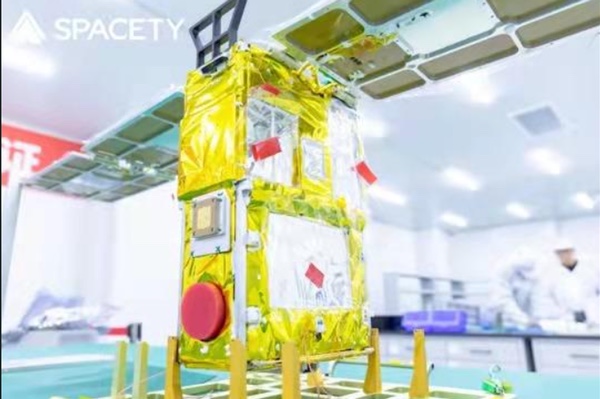
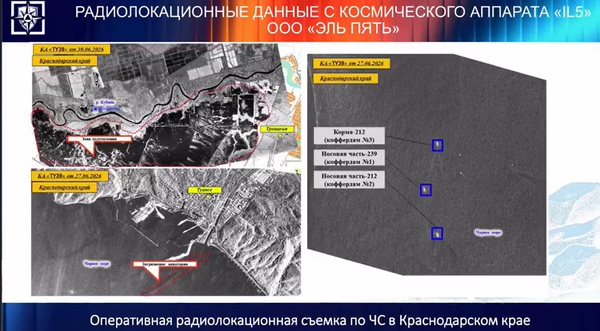 Pictures made by the IL5/TY39 satellite. Source |
Appearing during the same event, L5’s CEO Dmitriy Monakhov outlined the company’s plans to build its own fleet of satellites, but also showed a slide confirming that the company already has a satellite in orbit. Identified there as Elsat-1, it operates in a polar orbit and has a resolution of one meter in spot mode and a swath width of 170 kilometers in ScanSAR mode. Imagery can be delivered to customers within three to four hours of collection. [3]
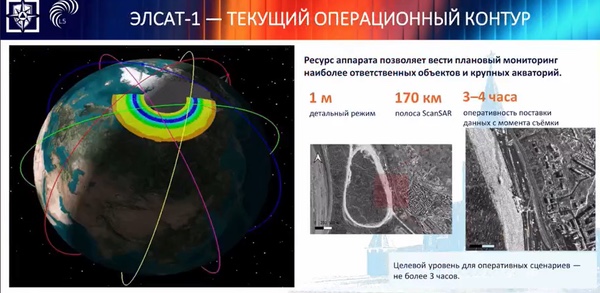 L5 slide on Elsat-1. Source |
Monakhov did not elaborate on Elsat-1, leaving open the question of when and where the satellite was launched. It must be assumed that this is the same satellite designated as TY39 and IL5 in the parallel presentation by the Ministry of Emergency Situations. While no satellites have been officially cataloged under any of these names, TY is the factory designator for a series of optical and radar remote sensing satellites manufactured by the Chinese company Tianyi Space, also known under the international name Spacety.
| As it turns out, Novyy Kosmos is not the only Russian company that is using cover names to obscure its reliance on Chinese space assets. |
Spacety and the Russian satellite data distributor TerraTech were placed on the US sanctions list in early 2023 following intelligence disclosures that their commercial radar datasets were being routed to assist the combat operations of Russia’s mercenary Wagner Group in Ukraine. By utilizing the cover name Elsat-1, L5 is apparently attempting to hide its reliance on a blacklisted Chinese manufacturer—an effort compromised by the disclosure of the TY designator during the other presentation.
There are four C-band radar satellites manufactured by Spacety that have parameters corresponding to those seen in the L5 slide:
- Chaohu-1 (launched on February 27, 2022)
- Fucheng-1 (launched on June 7, 2023)
- Shenqi-01/TY41 (launched on September 24, 2024)
- Shenqi-02/TY42 (launched on May 17, 2025)
The TY numbering sequence indicates that Chaohu-1 and Fucheng-1 carry the factory designators TY39 and TY40. Even though Spacety never openly linked these to the two satellites, they do appear in lists of Two-Line Elements published until late last year by SCANEX. This is a Russian company that operates a network of ground stations to capture imagery from both Russian and foreign remote sensing satellites and also markets some of that imagery. The international designators embedded within the orbital elements for TY39 and TY40 (2022-019J/51832 and 2023-081A/56846) confirm their identity as Chaohu-1 and Fucheng-1. [4]
 Two-Line Elements for TY-39 and TY-40 published on the SCANEX website last year. Source. |
The two satellites are also mentioned under the names Chaohu-1 and TY40 in a presentation given by SCANEX in 2025. The company explicitly states that it markets data collected from these two platforms via its own ground station network and boasts a delivery turnaround time of just four hours after downlinking. [5]
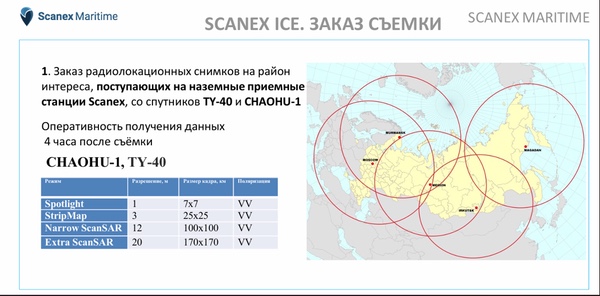 Slide showing the operating modes of Chaohu-1/TY39 and Fucheng-1/TY-40 and the location of SCANEX ground stations picking up imagery from them. Source |
The obvious conclusion is that the satellite called TY39, IL5, and Elsat-1 in the September 2026 presentations is actually China’s Chaohu-1 radar satellite. Imagery collected by Chaohu-1 has been distributed within the Russian market not only by SCANEX, but by several other companies as well. This raises the question of exactly what role L5 plays in Chaohu-1’s mission. In December 2025, a company representative confirmed that L5 had “acquired the rights for a Chinese satellite” earlier that month and was already selling its imagery to customers. [6] In May 2026, company CEO Monakhov stated that L5 expected to “assume control of a foreign satellite” that July. [7]
One possible interpretation is that L5 was initially granted exclusive access to Chaohu-1 data in late 2025, taking over the distribution roles previously held by other Russian companies. The company may subsequently have assumed direct operational control of the spacecraft in the summer of 2026. This would mean that L5 is operating the satellite on a turnkey basis, monitoring the platform from its own mission control center and downlinking data directly via domestic ground stations, potentially using SCANEX's infrastructure. In a similar fashion, the Russian defense contractor Stilsoft is operating one or more Chinese-built high-resolution optical imaging satellites under the cover name Stilsat-1. [8] There clearly are structural ties between the two entities. The L5 website lists Stilsoft as a corporate partner, and Monakhov himself confirmed in an interview that he has actively cooperated with Stilsoft since 2022. [9]
Whatever L5’s exact role, Chaohu-1 was still providing data to Chinese customers in August 2026, when it was one of several Spacety radar satellites reported to have imaged the aftermath of the glacier collapse on the China-Nepal border [10]. It should also be noted that L5 has published radar imagery on its website that it attributes to two separate satellites. Both of these exhibit the radar performance specifications of Spacety’s TY-39/40/41/42 series. [11]
L5’s ambitions extend beyond the use of Chinese radar platforms. The firm is actively developing a domestically built satellite bus called A-100, designed to accommodate a diverse array of payloads. With a target launch mass of approximately 100 kilograms, this bus is being pitched for optical and radar imaging, Internet-of-Things (IoT) routing, telecommunications, scientific research, and technology demonstration missions. L5 officially projects the launch of its first home-grown satellites for 2027.
Novyy Start
Another speaker at the September 2026 event was Yegor Nazarov, representing a startup named Novyy Start (“New Start”) that was founded in March 2025. Nazarov presented a planned constellation of small radar and optical remote sensing satellites that Novyy Start intends to orbit using solid-fuel launch vehicles called Start-1M. These are decommissioned Topol-M intercontinental ballistic missiles that Novyy Start is converting into space launch vehicles in cooperation with the missile’s original designer, the Moscow Institute of Thermal Technology (MIT Corporation). Infrastructure for the launch of Start-1M rockets is being built at the Vostochnyy cosmodrome in Russia’s Far East. The rocket may also fly from the Plesetsk launch site in northwestern Russia.
| The obvious conclusion is that the satellite called TY39, IL5, and Elsat-1 in the September 2026 presentations is actually China’s Chaohu-1 radar satellite. |
Novyy Start’s satellite fleet, named Spectre, will consist of optical remote sensing platforms (Reflexio) alongside two distinct variants of radar imaging satellites (Luminio and Emissio). Both Luminio and Emissio are projected to provide imagery with a spatial resolution ranging from 0.5 to 25 meters. The ground swath will span between 7 and 200 kilometers for Luminio, and between 10 and 200 kilometers for Emissio. During his presentation, Nazarov bluntly acknowledged that the company will initially rely on Chinese-built active phased array radar antennas for its SAR satellites. Reacting to apparent consternation from the audience, he hinted that subsequent iterations of the satellites would transition to domestically produced radar systems. [12]
The inaugural launches under the Spectre project are planned for 2027. According to an unconfirmed report from May 2026, Russia’s Gazprom corporation, which is scaling back its space operations, is expected to sell its satellite manufacturing facility and mission control center to Novyy Start before the end of the year, an acquisition that could significantly accelerate the startup’s assembly timelines. [13]
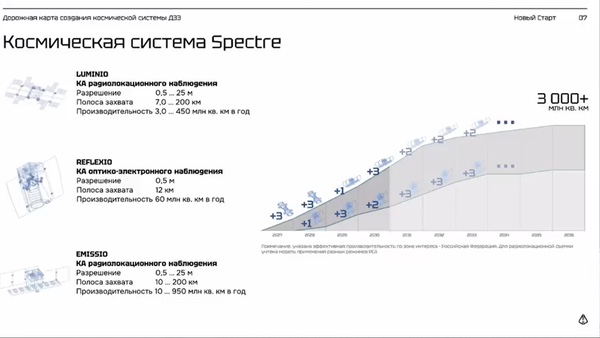 The Spectre constellation of Novyy Start. Source |
PIESAT
Russia also may have been involved in a major deal signed in August 2025 by Aerospace Hongtu, also known under the international name PIESAT. This company operates a commercial radar satellite network known as Nuwa currently consisting of 16 high-resolution X-band SAR satellites. Manufactured by GalaxySpace, some of them orbit the Earth in a hub-and-spoke “cartwheel” formation optimized to provide interferometric data.
 PIESAT satellites. Source |
On August 29, 2025, PIESAT secured a $138 million export contract with a buyer initially identified only as “Customer A”. The contract called for the procurement of a satellite and related ground infrastructure, to be executed over a 1,200-day window. PIESAT stated that the transaction marked its first delivery of on-orbit satellite services to an international client and explicitly noted the contract’s record value. On September 5, 2025, the company provided additional information regarding the deal, revealing that the project’s physical delivery location was an African country. However, it also cautioned that the contract might not be fulfilled on schedule or in full due to “significant changes in the external macroeconomic environment, changes in relevant national policies, changes in customer demand, and other unforeseen or force majeure events.”
| Other domestic firms operate exclusively as processors and distributors of data acquired by Chinese radar and optical remote sensing satellites. |
The deal was signed just days after two high-level Russian diplomatic visits to PIESAT’s Beijing headquarters: one by Russia’s Minister of Industry and Trade, Anton Alikhanov, on August 26, and another by Alikhanov’s deputy on August 23. While Russian media briefly mentioned only Alikhanov’s visit (without providing additional details), Chinese sources disclosed more context. The August 23 meeting was described as a “high-level decision-making meeting” that “further solidified details and related agreements” concerning an unspecified project whose “delivery volume and contract size” were expected to set industry records. During Alikhanov’s subsequent visit on August 26, PIESAT proposed “products and services in areas such as satellite on-orbit delivery and launch services, UAV technology cooperation, sales and services of Nuwa constellation data, and industry application services.” Notably, these Chinese sources also emphasized that the two parties had already “finalized the content of cooperation and related agreements based on thorough communication prior to the meeting.” [14]
 Russian delegation led by Anton Alikhanov visiting PIESAT headquarters on August 26, 2025. Source: PIESAT. |
Reading between the lines, it would seem that the visits by the Russian delegations were primarily intended to hammer out the final details of the contract signed on August 29. The explicit designation of an African country as the ultimate delivery location may point to a sophisticated proxy procurement scheme that could potentially support the operational requirements of Russia’s Africa Corps. This was established by the Russian Ministry of Defense in 2023 to absorb and institutionalize the remnants of the Wagner Group’s mercenary network across the Sahel (Wagner itself was disbanded following its short-lived mutiny against the Russian government in June 2023). By routing the purchase to an African state client, both Russia and PIESAT may have attempted to deflect the immediate threat of Western sanctions and export controls. Such sanctions would be particularly devastating for PIESAT, which battled mounting corporate debt and intense internal salary disputes throughout 2025. The $138 million contract appears to have been treated by the company as a necessary step for immediate corporate stability, outweighing the risks of international economic restrictions.
Other Russian distributors of Chinese remote sensing data
While Russian enterprises such as Novyy Kosmos, L5, and Novyy Start view their cooperation with Chinese entities as a steppingstone toward deploying independent satellite constellations, other domestic firms operate exclusively as processors and distributors of data acquired by Chinese radar and optical remote sensing satellites. Six of these companies market data from the following Chinese radar satellites:
- SCANEX: Gaofen-3, HiSea-1, Chaohu-1, Fucheng-1, Ludi Tance, SuperView Neo-2 01/02 [15]
- TerraTech: HiSea-1, Chaohu-1 [16]
- Rakurs: Gaofen-3, Chaohu-1, Fucheng-1 [17]
- Sovzond: Gaofen-3, Gaofen-12, Gaofen-12, Gaofen-12-2 [18]
- Innoter: Gaofen-3, HiSea-1, Chaohu-1, LuTan-1A, LuTan-1B, PIESAT [19]
- Prime Group: Shenqi-01/TY41, Shenqi-02/TY42 [20]
A seventh company, MT-LAB, has confirmed that it distributes imagery from Chinese optical and radar satellites, but without specifically identifying them [21]. MT-LAB will also act as the operator and data distributor for three types of Russian-built remote sensing satellites: KOEN, EOS-O, and EOS-R. KOEN, an optical imaging satellite developed by Stilsoft, is believed to feature a domestic Russian bus outfitted with an imported Chinese optical payload similar to the one flown on Stilsat-1. The satellite is scheduled for launch from the Vostochny cosmodrome in late 2026 or early 2027.
EOS-O and EOS-R are optical and radar satellites manufactured by the Russian company NPK Barl. EOS-R is designed to carry a C-band radar with a claimed maximum resolution of 0.5 meters. While there is no officially acknowledged industrial connection between this hardware and the Chinese space sector, NPK Barl notably utilized a radar image of Dubai produced by MinoSpace’s Taijing-4-01 satellite to demonstrate the potential capabilities of the EOS-R platform. [22]
Military use of Chinese remote sensing data
According to an official organizational chart of Russia’s remote sensing industry published in August 2026, between 50% and 70% of all remote sensing data processed by domestic enterprises is channeled to government clients, including the so-called “security agencies” (silovye vedomstva), a term encompassing the Ministry of Defense, the Ministry of Internal Affairs, the National Guard, and the Federal Security Service (FSB). [23] Because the Russian Ministry of Defense operates only a relatively modest fleet of dedicated reconnaissance satellites, it appears to systematically rely on high-resolution imagery from commercial remote sensing platforms to supplement the intelligence collected by its own satellites.
A substantial portion of this supplemental geospatial intelligence is likely to come directly from Chinese space assets. At a remote sensing industry conference held in September 2025, a representative from Prime Group disclosed that over 80% of the sub-meter resolution satellite imagery distributed on the Russian commercial market in 2025 originated from the Jilin-1 Gaofen optical imaging satellites manufactured by Chang Guang Satellite Technology. The most advanced satellites in this series, Jilin Gaofen-04 and Jilin Gaofen-05, possess a maximum spatial resolution of 0.20 to 0.30 meters. While the Chinese government had not yet formally authorized the commercial distribution of this spy-satellite-grade imagery to Russian enterprises at the time of the presentation, the Prime Group official noted that regulatory clearance was anticipated in the near term. [24]
| The procurement patterns analyzed here expose a significant reliance of Russia’s remote sensing industry on Chinese space assets. |
There can be little doubt that a significant portion of the radar and optical imagery obtained from Chinese commercial satellites is being systematically utilized to support Russia’s combat operations in Ukraine. Several Chinese and Russian enterprises have already been placed under international sanctions for exactly this reason. As already mentioned, both Spacety and TerraTekh were added to the US sanctions list in early 2023 following disclosures concerning their transactional ties with the Wagner Group. HEAD Aerospace, a prominent Chinese commercial distributor of remote sensing data, similarly came under US and European sanctions in 2023 and 2024 for supplying satellite imagery of Ukrainian locations to Wagner entities, as well as providing high-accuracy topographic datasets to the General Staff of the Armed Forces of the Russian Federation via the company Rakurs. Furthermore, the Wagner Group bypassed conventional state procurement lines to directly purchase two Chinese high-resolution optical imaging satellites—Jilin-1 Gaofen-03D12 and Gaofen-03D13—from Yunze Technology Co., Ltd. This intermediary entity was added to the US sanctions list in December 2023 alongside Chang Guang Satellite Technology, the satellites’ actual manufacturer.
Other Chinese satellite manufacturers may well be utilizing similar intermediary structures to conceal their supply lines. Prime Group openly claims that it places orders for imagery from Spacety’s Shenqi-1 and Shenqi-2 radar satellites through a partner entity named Kunming Sunny. This company is also designated as the operator of Spacety’s HiSea-1 radar satellite (under the abbreviated label “Sunny”) on the website of SCANEX. [25] Kunming Sunny’s virtual absence on the Internet indicates that it functions as a specialized shell company designed to mask the procurement pipeline and bypass further sanctions. [26]
Both Russia and China have officially denied allegations of high-level cooperation in conducting satellite reconnaissance of Ukraine’s territory. Reacting to such accusations in October 2025, Kremlin spokesman Dmitriy Peskov claimed that Russia covers all its needs on the battlefield with its own capabilities, including satellites. China’s Ministry of Foreign Affairs responded it was not aware of any such cooperation, emphasizing the country’s neutral stance in the Ukrainian conflict. [27]
However, these official claims have been directly contradicted by statements from some corporate executives involved in these cooperative ventures. Officials of Stilsoft have directly linked the purchase of the Chinese-built Stilsat optical imaging satellites to the war in Ukraine. [28] Similarly, executives from Novyy Kosmos have hinted on two occasions that they view their Okulus constellation at least partly as a strategic response to the intelligence applications of the Finnish-American ICEYE radar satellite fleet. [29]
In summary, the procurement patterns analyzed here expose a significant reliance of Russia’s remote sensing industry on Chinese space assets. This operational dependency spans from the deployment of white-labeled Chinese platforms and the integration of Chinese hardware components on Russian satellites to the large-scale distribution of Chinese remote sensing data on the Russian market, among other things to support military operations. While diplomatic and corporate rhetoric maintains a narrative of technological self-reliance, a deeper analysis establishes that Russia’s contemporary remote sensing industry is extensively supplemented by Chinese technology to sustain its primary operational capabilities.
References
- The original version of the user guide is available for download in this thread on the NASA Spaceflight Forum. The edited version has been published on the Novyy Kosmos website here. Also removed from the Novyy Kosmos website was a reference to the Ku-band capability of the company’s domestically built Okulus satellites. This capability most likely applies only to the Chinese-built Okulus-01 satellite, which can be identified as Taijing-4-03.
- Video of presentations given during a security conference in Kazan, September 3-5, 2026 (see 3:48:40).
- See reference 2 (4:07:00).
- An archived list of TLEs published by SCANEX (including those for TY39 and TY40) is available here.
- ScanEx presentation, 2025.
- Interview with L5’s Yuriy Tebin, December 10, 2025.
- Interview with L5’s Dmitriy Monakhov, May 25, 2026.
- B. Hendrickx, Stilsat-1: a Russian-owned and Chinese-built satellite watching Ukraine (part 1), The Space Review, November 3, 2025.
- See reference 7.
- Chinese press report, August 31, 2026.
- Radar satellite page on the L5 website.
- See reference 2 (3:58:05).
- Article published on the Kommersant website, May 26, 2026.
- Article published on the “China in space” website, August 30, 2025 ; Articles published by Chinese news outlets on August 26, 2025 and September 5, 2025.
- Satellite page on the SCANEX website ; ScanEx presentation, 2025.
- Radar satellite page on the TerraTekh website.
- Radar satellite page on the Rakurs website.
- Radar satellite page on the Sovzond website.
- Satellite page on the Innoter website.
- Reports on the Prime Group website, February 17, 2025 and November 10, 2025.
- Presentation by MT-LAB’s Aleksandr Minov.
- A radar image of Dubai taken by Taijing-4-01 is seen on the websites of both Minospace and NPK Barl.
- Article on the Habr website, August 25, 2026.
- Presentation by Prime Group’s Stanislav Konyukov.
- See reference 19 ; HiSea-1 page on the SCANEX website.
- The only online source providing information on Kunming Sunny is here.
- Report by Reuters, October 6, 2025 ; Report by United24 Media, October 6, 2025.
- See reference 8.
- Reports on the Novyy Kosmos website on July 24, 2025 and December 21, 2025.
Note: we are now moderating comments. There will be a delay in posting comments and no guarantee that all submitted comments will be posted.