The great launch constraintby Jeff Foust
|
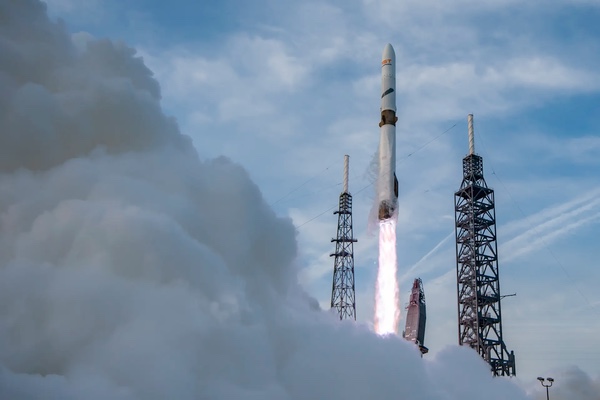
| While successful launches all appear alike, each unsuccessful launch usually goes awry in its own way. |
Reuse is vital to the business case for New Glenn, given the size and expense of the booster. Rather than taking the iterative approach SpaceX used for Falcon 9 landing and reuse a decade ago, Blue Origin needed to get landing and reuse down right away. (While the booster itself was previously flown, the company had swapped out its seven BE-4 engines between the two missions; CEO Dave Limp said that allowed them to test upgrades while saving the engines used on NG-2 for later flights.)
The company, it appeared, nailed that aspect of the NG-3 mission. A little more than nine minutes after liftoff, the booster returned to the vicinity of Jacklyn. Intermittent video from the drone showed the booster moving into position over the ship and making its final descent. “I’m hearing cheers on the touchdown!” one webcast host said as plume enveloped the vehicle and ship briefly. Second later, they cleared, showing the booster standing in the middle of Jacklyn’s landing deck.
“The show isn’t over,” the host said a couple minutes later. “The booster is back, but GS2 is going to be delivering our payload for AST.” GS2 is the second stage of New Glenn, which was carrying a satellite for broadband direct-to-device company AST SpaceMobile. That was another reason the launch was anticipated: this was the first commercial mission for New Glenn, after carrying a demo payload on its inaugural flight and NASA’s ESCAPADE Mars mission on its second.
Despite the host’s comments, the show was over: the webcast ended just after the second stage completed its first burn (after reminders Blue Origin was both hiring and selling NG-3 merch.) A second burn was planned about an hour later, shortly after which AST SpaceMobile’s satellite, BlueBird 7, would be deployed into low Earth orbit. The company said it would provide updates on social media.
But the scheduled second burn of the upper stage, and subsequent satellite deployment, came and went without updates from the company. Silence is rarely a good communications strategy, and social media soon filled with speculation that something had gone wrong.
Only an hour after the planned payload separation did Blue Origin confirm that speculation: the payload, it said, was placed in an “off-nominal” orbit but didn't say more. A few hours later, AST SpaceMobile said the orbit New Glenn placed BlueBird 7 in was too low for the spacecraft’s electric thrusters to recover from, and that the satellite would be deorbited.
While successful launches all appear alike, each unsuccessful launch usually goes awry in its own way. Blue Origin has said little about what happened on NG-3 beyond a social media post by Limp the day after the launch.
“Early data suggest that on our second GS2 burn, one of the BE-3U engines didn’t produce sufficient thrust to reach our target orbit,” he wrote. “Blue Origin is leading the anomaly investigation with FAA oversight to learn from the data and implement the improvements needed to quickly return to flight operations.”
The failure comes as Blue Origin was planning to ramp up launches of New Glenn to serve customers like AST SpaceMobile. That firm was counting on New Glenn to help deploy its BlueBird satellites, which will offer connectivity to smartphones that are outside terrestrial networks through phased array antennas that, once deployed in orbit, span 220 square meters.
| There is never a good time for a failure, but the NG-3 failure comes at a bad time for the broader space industry. |
While NG-3 carried a single BlueBird satellite, AST SpaceMobile planned on stacking multiple satellites on future launches: up to eight on a single New Glenn. Before the failure, the company expected to have at least 45 satellites in orbit by the end of the year, enough to provide services in the United States and other key markets; it currently has six. AST SpaceMobile said it still planned to reach that 45-satellite threshold this year but said little about how it expected to do so.
Another customer who will feel the effects of the delay is Amazon, which is a major customer of New Glenn. It is already feeling the effects of the February anomaly involving United Launch Alliance’s Vulcan rocket, which has grounded that vehicle (see “Reforging Vulcan”, The Space Review, March 9, 2026). Amazon is well off the pace of launches needed to deploy its Amazon Leo constellation, and even before the incidents asked the FCC to extend or waive a requirement that half of the 3,200 satellites be in orbit by this July. With an Atlas 5 launch on the evening of April 27, Amazon has launched 270 satellites.
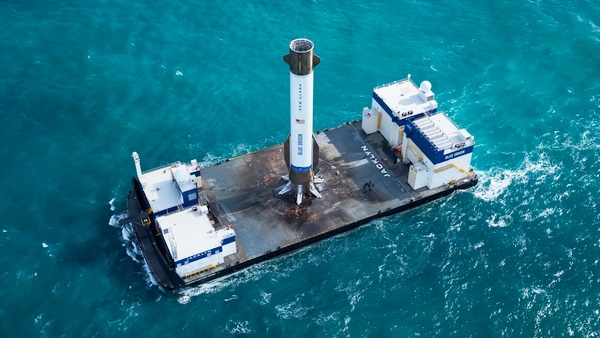 The New Glenn first stage after landing on the ship Jacklyn on the NG-3 mission. (credit: Blue Origin) |
The New Glenn failure also affects the US government. The NG-3 launch took place just as the company got back its first Blue Moon Mark 1 lunar lander from the Johnson Space Center in Texas, where it had completed thermal vacuum chamber testing. The lander is going through final tests at Blue Origin’s Florida facilities ahead of a launch that was expected, before this failure, by the summer. A delay in that mission could affect how Blue Origin accelerates its larger Mark 2 lander for NASA’s Human Landing System program so that it has something ready to test in low Earth orbit for the Artemis 3 mission next year.
Blue Origin had been working to certify New Glenn for military launches, and its approach required it to successfully complete four launches to do so. The Space Force revealed in a recent “sources sought” notice that it expects to significantly increase the number of launches it performs to what it terms “highly stressing orbits,” such as direct injection into geostationary orbit, in 2027 through 2029. Those launches must be done by companies certified under Lane 2 of the National Security Space Launch contract, which currently includes only SpaceX and ULA. Blue Origin would also qualify, but only if can compete certification of New Glenn in time.
There is never a good time for a failure, but the NG-3 failure comes at a bad time for the broader space industry. Vulcan has yet to fly since its February anomaly involving a solid rocket booster, which remains under investigation. In an earnings call last week, Northrop Grumman, which makes those boosters, said it took a $71 million charge in the first quarter for what it called “the evaluation and implementation of corrective actions for a solid rocket motor anomaly that occurred during a Q1 2026 launch.”
Neither Northrop nor ULA have given a timeline for completing the investigation and resuming Vulcan launches. However, Space Force officials said this month they were considering resuming Vulcan flights in configurations that did not require any solid rocket boosters for some missions that do not the additional performance the boosters provide.
Commercial launch customers are feeling additional pressure. Japan’s H3 rocket is also out of service after a very unusual failure last December. On that launch, carrying the Michibiki 5 navigation satellite, Japanese officials originally reported problems with the rocket’s upper stage kept the satellite from reaching orbit.
An investigation in the following weeks showed that there was an unusual shock when the rocket’s payload fairing separated, followed by a drop in pressure in the upper stage’s liquid hydrogen tank. The upper stage suffered a 20% loss in thrust, yet the stage itself was still able to reach orbit, which appeared puzzling.
The investigation found that the shock at payload fairing separation damaged the adapter on which the Michibiki 5 satellite was installed. That caused the drop in pressure in the upper stage’s fuel tank, but also resulted in the satellite falling off the adapter when the upper stage separated from the first stage. The upper stage made it to orbit because it had no payload attached.
The Japanese space agency JAXA announced last week that the H3 will return to flight in June on a previously planned test flight of a new configuration of the rocket that will also test changes to its payload separation system. That launch will carry only a demonstration payload and several smallsat secondary payloads.
Those failures, along with the continued grounding of India’s PSLV after back-to-back failures last May and this January (see “The PSLV-C62 failure marks a setback for India’s space ambitions,” The Space Review, January 19, 2026), have severely stressed the launch market. Satellite operators say it is very difficult to find a launch slot in the next couple of years given high demand exacerbated by the recent failures.
SpaceX has dominated the market in the sheer number of launches, many of which are for its own Starlink, but has little room for more. “Our manifest is really, really, really busy this year, next year, 2028. It is packed,” said Stephanie Bednarek, vice president for commercial sales at SpaceX, during a panel at the Satellite 2026 conference last month.
| “This year we'll still launch a lot, but not as much,” Shotwell said of Falcon 9. “We launched 165 times last year. This year, maybe 140, 145-ish.” |
The Falcon 9 launch rate, which has grown significantly in recent years, appears to be topping out. The company performed 165 Falcon 9 launches in 2025 and, through April 26, had conducted 50, a pace slightly slower than last year. Bednarek said last year that SpaceX was near the peak of Falcon 9 launches as it prepared to ramp up Starship launches. (That vehicle has not flown since last October, with the first flight of the new Starship v3 pushed back several times, now to the first half of May.)
Gwynne Shotwell, president of SpaceX, confirmed that Falcon 9 launches will start to decline this year. “Last year was our largest launch year for Falcon. Yeah, this year we'll still launch a lot, but not as much,” she said in a recent interview in Time magazine. “We launched 165 times last year. This year, maybe 140, 145-ish.”
That limited supply, but growing demand from government and commercial customers, have squeezed the market in the near term. The arrival of Starship may help, given its high projected flight rate, but even then, it will initially be used primarily by SpaceX for both its Starlink and orbital data center satellites as well as to support Artemis missions.
“We are our largest demand for launchers now,” Shotwell said in the interview. “Starlink basically created this incredible demand for Falcon 9, and the AI satellites will do the same for Starship launches.”
In any case, a healthy launch market requires both multiple customers for launchers and multiple suppliers of them. The industry still has a lot of work to do to achieve that.
Note: we are now moderating comments. There will be a delay in posting comments and no guarantee that all submitted comments will be posted.