Artemis and the blue micromoonby Jeff Foust
|
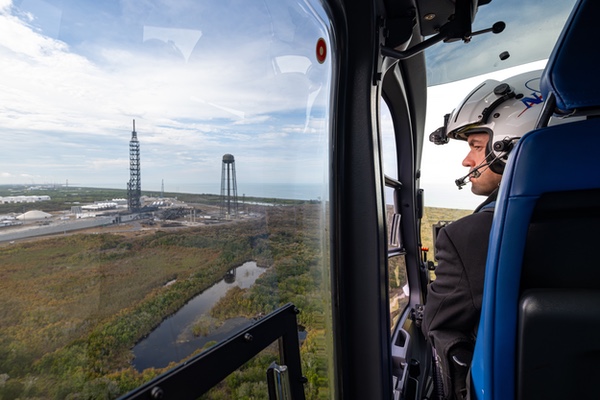
| The rechristening of the missions was a bit puzzling since they predate the agency’s lunar base plans and, in some cases, have little to do with it. |
The term might also reflect the mood in the space exploration community over the weekend. Barely 48 hours after NASA provided more details, and nearly $1 billion in contracts, to advance the lunar base plans it announced in March (see “Igniting a new vision for NASA”, The Space Review, March 30, 2026), the agency suffered a serious setback when one of the key vehicles needed for those plans exploded on the launch pad. Just how serious a setback, and how much further away the Moon now seems, is uncertain.
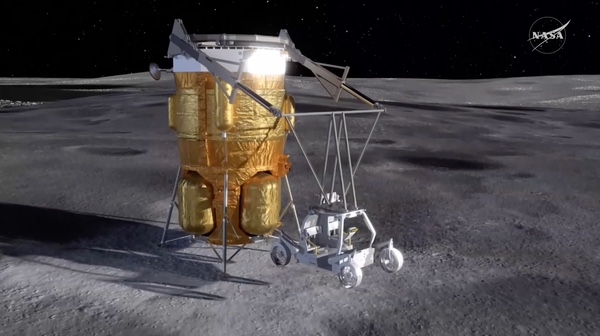 A Blue Moon Mark 1 lander deploys an Astrolab rover to the lunar surface. (credit: NASA/John Kraus) |
Rovers, landers, and hoppers
Last Tuesday, NASA held a briefing to outline some elements of its Moon Base initiative announced at the Ignition event in March. At the time, details were scarce: NASA said it would spend $20 billion over the next seven years, and more than $30 billion for the next decade, to build out a lunar base, including a monthly cadence of robotic landings. The agency said little in March, though, about how it would get there from here.
NASA administrator Jared Isaacman started the event with a curious rebranding move. “We are discussing three Moon Base missions and a series of additional awards with more missions to be announced in the in the months ahead,” he said.
Those three missions, though, were landers already in development, in some cases for several years. Moon Base 1 is the name NASA now gives to the first Blue Moon Mark 1 lander from Blue Origin, at the time scheduled to fly in the fall of 2026 with a NASA payload added to it through the Commercial Lunar Payload Services (CLPS) program. Moon Base 2 is the new designation for Astrobotic’s Griffin-1 lander, also supported by CLPS even after NASA decided not to fly its VIPER rover on it. The third Intuitive Machines lander, carrying a science payload to the Moon’s Reiner Gamma region, became Moon Base 3.
The rechristening of the missions was a bit puzzling since they predate the agency’s lunar base plans and, in some cases, have little to do with it. Reiner Gamma, for example, is far from the south polar regions of the Moon, the location NASA plans to establish that base.
The agency said that with the new names comes additional resources for the companies, part of a push by Isaacman to provide agency expertise for commercial partners. “We want to make sure that the reliability is there, and we’re putting all the resources of NASA, including test facilities if they need them, in play here,” said Carlos Garcia-Galan, program manager for Moon Base at NASA. “We're basically putting all of our assets in play, including experts, facilities, know-how; whatever it takes to make them successful before they get to fly and when they’re flying.”
The bigger news came later when Garcia-Galan announced a series of contracts. In 2024 NASA selected three companies—Astrolab, Intuitive Machines, and Lunar Outpost—for study contracts for its Lunar Terrain Vehicle (LTV) Services program. Last year, they submitted proposals for the next phase of the program, contracts to develop and demonstrate the rovers on the Moon.
However, at Ignition, NASA announced it was asking the companies to go back to the drawing boards, and quickly. Instead of the more advanced rovers previously sought by NASA, the agency asked for revised concepts that would be simpler and faster to develop, ready in time for the Artemis 4 landing in 2028. The companies had about a month to provide revised proposals.
At last week’s briefing, Garcia-Galan announced NASA selected Astrolab and Lunar Outpost to develop their rovers, each receiving contracts valued at about $220 million.
Astrolab offered what it called Crewed Lunar Vehicle 1, or CLV-1. It is based on the FLEX rover concept the company had originally adapted for the LTV program, but scaled down to meet NASA’s revised requirements. Lunar Outpost proposed Pegasus, a rover that used much of the design for its larger Eagle rover originally proposed for LTV.
NASA did not discuss in detail why it selected those two companies and how they beat out Intuitive Machines. “They're a mix between the Apollo lunar roving vehicle and the Mars-style rover,” Garcia-Galan said, including the ability to operate autonomously or be teleoperated when astronauts are not present.
| “We're basically putting all of our assets in play, including experts, facilities, know-how; whatever it takes to make them successful before they get to fly and when they’re flying,” Garcia-Galan said of the lander companies. |
Besides changing the design of the rovers, NASA also changed how the rovers would be delivered. NASA initially treated the LTV effort as a service, leaving it up to the companies to decide how to get their rovers to the Moon. NASA took over responsibility for the rover delivery, instead giving the rover developers mass and volume envelopers their designs had to fit into, while using CLPS to select a landing system for them.
NASA announced at the event that it picked Blue Moon Mark 1 to deliver both rovers on separate missions under a contract worth up to $468.4 million if all options are exercised. NASA didn’t state why it selected Blue Moon Mark 1, but given the size of the rovers—NASA set the upper limit on their mass at one metric ton—there were few other options as most CLPS landers are designed for smaller payloads.
One other, smaller award made at the briefing was to Firefly Aerospace. The company won an $80 million deal to deliver to the Moon the “MoonFall” drone-like spacecraft being developed at JPL that will be able to hop across the lunar surface and serve as scouts. A Firefly Elytra spacecraft will ferry the spacecraft to a low lunar orbit, releasing them to allow them to land on their own.
A clear message from the event was the role Blue Origin was playing in the lunar base plans. With the LTV lander contract, NASA now has four missions using the Mark 1 lander, including the renamed Moon Base 1 mission and a planned 2027 mission to deliver the VIPER rover.
The Mark 1 lander also gives Blue Origin experience for its larger crewed Blue Moon Mark 2 lander. NASA did not discuss that lander at the briefing beyond Garcia-Galan’s comments that the Mark 1 missions “reduce the risk for future crewed missions.”
Just after the briefing, NASA said that it will announce the crew of Artemis 3 at a June 9 event at the Johnson Space Center, along with providing updates on the mission’s design. NASA said earlier this year that Artemis 3, once planned to be the first crewed landing attempt of the Artemis program, will instead stay in low Earth orbit, approaching and docking with prototypes of both Blue Moon Mark 2 and SpaceX’s Starship.
“America is returning to the Moon,” Isaacman announced at the briefing. “We are working alongside our many international and commercial partners to leverage the incredible capabilities from commercial industry to build a moon base.”
Here's our video of the explosion at Launch Complex 36. It happened about 9 pm ET (0100 UTC) as Blue Origin was beginning a static fire test of its New Glenn rocket.
— Spaceflight Now (@SpaceflightNow) May 29, 2026
Watch live views: https://t.co/tm2wZQmAVD pic.twitter.com/PmbgQC6Qmq
Blue Origin faces launch pad surgery
Those initial lunar base plans survived for only a little more than 48 hours. While NASA discussed those various missions in Washington, Blue Origin was busy at Cape Canaveral getting ready for the next launch of New Glenn. It would be a return-to-flight mission for the rocket after its previous flight in April suffered an upper stage malfunction (see “The great launch constraint”, The Space Review, April 27, 2026). After a remarkably fast investigation, the FAA cleared the vehicle to return to flight May 22, and Blue Origin was planning for an early June launch of 48 Amazon Leo broadband satellites.
| “Cleanup has to be done with a sense of urgency, but extreme precision. It’s literally launch pad surgery,” Donchev said. |
Those preparations included a static-fire test at Launch Complex 36. The vehicle, without its payload, rolled out to the pad, was erected, and filled with propellants. The company did not announce the test in advance but cameras around the Cape were watching the pad to catch the static fire.
They instead saw a massive explosion. At 9 pm EDT, the first stage’s seven BE-4 engines ignited, but something went wrong. An explosion appeared to occur at the base of the vehicle, and in just a few seconds a massive fireball erupted, shock waves visible in the humid Florida air. When the fireball faded, the rocket was gone, along with its transporter-erector and a lightning tower.
No one was injured in the blast, but the pad was severely damaged. Photos the next day showed metal beams in the main launch tower that were bent and buckled, with damage also visible in support buildings near the pad.
The explosion recalled a similar incident, on a smaller scale, in 2016, when a Falcon 9 exploded at the Cape’s Space Launch Complex 40 ahead of a static-fire test (see “Blasting to conclusions”, The Space Review, September 6, 2016). It took SpaceX 15 months to rebuild SLC-40, although the company was able to resume launches after a few months using its pad at Vandenberg and Kennedy Space Center’s Launch Complex 39A, which SpaceX was finishing converting into a Falcon 9 pad at the time of the SLC-40 explosion.
However, Blue Origin has no other pad for New Glenn. It was planning a second pad at LC-36 and also in talks for a Vandenberg site, but both are likely years away. As long as LC-36 is offline, New Glenn is grounded, even if the problems that caused the explosion are resolved.
How long it takes to rebuild LC-36 is one of the space industry’s biggest questions right now. Many speculate it will take at least a year, citing the experience with the SLC-40 explosion.
One SpaceX executive, declining to comment on a rebuild timeline, noted that one of the most basic parts of it, the cleanup, can be time consuming. “In the initial days and weeks, you’re using a scalpel, not a bulldozer,” said Kiko Donchev, vice president of launch, on social media.
That meticulous process, he said, is needed to preserve evidence for the accident investigation and to save equipment that can be salvaged, all while avoiding the risk of injury to those working on the cleanup.
“Cleanup has to be done with a sense of urgency, but extreme precision. It’s literally launch pad surgery,” he said.
CNBC interviewed Isaacman on Monday, and according to the network’s account he suggested an even longer timeline for repairs. “Even if you’re moving at, you know, a pretty quick pace, that’s going to take some serious time,” he said of launch pad repairs. The report suggested that Isaacman thought the pad might not be ready until 2028.
| “We will fly again before the end of this year,” vowed Limp. |
Isaacman said on social media Monday night that his remarks were misinterpreted. “I was pointing out that those [lunar base] missions are not until 2028, which should be well within what is possible for pad recovery,” he said.
Moments later, Blue Origin CEO Dave Limp offered an aggressive schedule for pad repairs. Much of the pad infrastructure escaped serious damage, he said, including propellant tank farms that are “very long lead items” had they needed to be replaced. The main launch tower can be repaired, he said, and the company had already been considering an “alternative vertical conop” in place of the transporter-erector, so that system does not need to be replaced.
“We will fly again before the end of this year,” he concluded.
In that best-case scenario, the impacts on Artemis will be minimized. Moon Base 1, that first Blue Moon Mark 1 lander, will be delayed, but only by several months rather than a year or more. That would also limit the effects on the VIPER launch and the two LTV rovers, while keeping open the chance that Blue Moon Mark 2 would be ready for Artemis 3 if NASA sticks to a mid-2027 schedule.
But if pad repairs slip into 2027, closer to the year-long timelines others have projected, the effects will be more significant. Moon Base 1 is primarily a test flight of the Blue Moon Mark 1 lander, and NASA previously stated it wanted to see a successful landing before entrusting VIPER to that lander. If New Glenn and Blue Moon Mark 2 are not ready by mid-2027, NASA would have to decide whether to delay the mission, and thus push back the Artemis 4 landing later into 2028, or fly it without Blue Origin and thus rely on SpaceX’s Starship for that first landing attempt.
Perhaps, like the blue micromoon, the Moon is only a little but further away than it was a week ago. But it’s unlikely to be the last disruption to NASA’s lunar plans in the years ahead.
Note: we are now moderating comments. There will be a delay in posting comments and no guarantee that all submitted comments will be posted.